|
FAQs on Marine Ich, White
Spot,
Cryptocaryoniasis 28
Related Articles: Marine Ich: Fighting The War On Two
Fronts, Cryptocaryoniasis, Parasitic
Disease, Quarantine, Quarantine of Marine
Fishes,
Related FAQs: Best on Crypt, Crypt 1, Crypt 2, Crypt
3, Crypt 4, Crypt 5, Crypt
6, Crypt 7, Crypt 8, Crypt FAQs
9, Crypt FAQs 10, Crypt FAQs 11, Crypt FAQs 12, Crypt FAQs 13, Crypt FAQs 14, Crypt FAQs 15, Crypt FAQs 16, Crypt FAQs 17, Crypt FAQs 18, Crypt FAQs 19, Crypt FAQs 20, Crypt FAQs 21, Crypt FAQs 22,
Crypt FAQs 23,
Crypt FAQs 24, Crypt FAQs 25, Crypt
FAQs 26, Crypt
FAQs 27 Crypt
29, Crypt 30, Crypt 31,
Crypt 32,
Crypt 33, Crypt 34,
& FAQs on Crypt: Identification, Prevention, "Causes", Phony Cures That Don't Work, Cures That Do Work, Products That
Work By Name: Free Copper/Cupric Ion
Compounds (e.g. SeaCure), Chelated Coppers (e.g. Copper Power,
), Formalin Containing: (e.g.
Quick Cure), About: Hyposalinity & Ich, Treating for Crypt & Sensitive
Fishes: By Fish Group: Sharks/Rays, Morays and other Eels, Mandarins/Blennies/Gobies, Wrasses, Angels and
Butterflyfishes, Tangs/Rabbitfishes, Puffers & Kin... &
Marine Parasitic Disease, Parasitic Marine Tanks,
Parasitic Reef Tanks,
Marine Velvet Disease,
Biological Cleaners,
Treating Parasitic Disease,
Using Hyposalinity to Treat
Parasitic Disease, Best Quarantine
FAQs, Quarantine 1,
Quarantine 2,
Quarantine
3, Quarantine 4, Quarantine 5, Quarantine 6, Quarantine 7, Quarantine 8, Quarantine 9, Quarantine 10, Quarantine 11, Quarantine 12, Quarantining
Invertebrates,
|
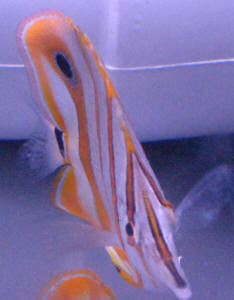 Cryptocaryon and other protozoan
parasites are hard to "make out" on light colored
fishes. Cryptocaryon and other protozoan
parasites are hard to "make out" on light colored
fishes.
|
Ich, Treatment, rdg.... 10/14/08 I have
been battling against ich for the last few weeks. So far I have lost 2
fish and now have 4 remaining. Last week I dropped the SG down to
1.019. Before this weekend my Yellow Tang was covered in ich and when I
got home today from out of town my Tang was spotless. I was wondering
if the ich is completely gone or if I should medicate just in case.
<A SG of 1.019 is not low enough to effect the parasite. The fish
need to be removed from the display tank and treated in a hospital
tank. See here for more http://www.wetwebmedia.com/ichart2mar.htm .>
Also my water temperature was around 74 degrees. Any help would be
greatly appreciated. <Give a look through our disease section, lots
to learn here. http://www.wetwebmedia.com/mardisindex.htm .>
<Chris>
Ich treatment and cause? 9/11/08 Marine
Ich.. Good morning crew! <Hello> I believe I have Marine Ich in
my tank. I have a few questions. I spent hours last night scouring the
WWM and now my head is spinning..I have a fair amount of questions just
making sure I read everything properly, and there are sometimes a few
opinions in the WWM <Ok> I've done all the proper husbandry
including quarantine tank for new fish.. and don't get it.. We have
"finished" adding new members to our reef tank about 4 months
ago. The only thing different we have done is added 2 pieces of coral
last week, and tired a new food "Reef Bugs" Yesterday morning
not a problem. <Did you QT the coral?> Come home from work and
there is what looks to be marine ich over 3 fish. Our purple tang had
about 30 "grains of salt" looking ich on it including its
fins, our chevron tang, about 10 "grains", and Flameback
angle 20 "grains". This morning, the chevron had about 5
grains, the Flameback 10, but the purple tang perhaps had slightly
less, but where the grains are now have 1/4" diameter light spots
surrounding the "grains" (he also seems to be the only one
going to the cleaner shrimp and trying to scratch). <Sounds like ich
to me.> I hoped it was the air bubbles last night, but the light
spots this morning is for sure an indications it's not air bubbles.
<Agreed> So, is it possible marine ich can lie dormant for that
long and then pop up out of no where? <Can stay in the fish's
gills where it is impossible to detect without gill scrapings, also
could have come in on the new corals.> Is it possible the new coral
brought in the ich? <Yes> Reef Bugs - I don't think that
could do it? <Doubt it.> We chose not to have a UV sterilizer
after reading pro/cons. We thought that if we quarantined properly, we
would not need it. <Is not a cure, but can help contain an
infection.> Should we have used one? Could we have prevented this?
<I don't believe the UV would have saved you from this
situation. As far as preventing, its more a matter of limiting risk
rather than a guarantee of being ich free, QTing greatly lowers the
chances of introducing ich but sometimes a fish can get through without
showing symptoms.> Now on to the cure, on the WWM, there are
compelling cases for copper based treatments, and formalin.. do a
copper with hyposalinity.. Skip a Methylene Blue 5% freshwater bath
because the symptoms are not that bad on the fish? <When dealing
with fish particularly sensitive to copper I would go another route,
either formalin which can also be tough on fish or quinine which has
it's own set of problems. Any time you engage in chemotherapy like
this there are certain risks with each method.> 3 out of the 5 fish
in the tank have symptoms.. treat all 5? Hospital tank(s) 1 per fish or
can you stick them all in 1 tank (no sand/ substrate and use pvc to
make hiding places/homes)? Daily water changes to keep water quality
ok. (last night I read the suggestion to keep a separate / spare sponge
filter running for situations like this..will get one going!) <As
long as your QT is large enough you can keep all the fish together.>
The LFS opens in a few hours so I'm ready to spring into action..
<Good.> Time to make another donation to the WWM. I still wish
you had a pay- pal account going! <<Mmm, we do... is at the
bottom of most pages: "Donate". RMF>> <Thanks for
the donation.> Peter Baron <Chris>
For Chris: Re: Ich treatment and cause? Re: Ich
treatment and cause? 9/11/08 "Now on to the cure, on the
WWM, there are compelling cases for copper based treatments, and
formalin.. do a copper with hyposalinity.. Skip a Methylene Blue 5%
freshwater bath because the symptoms are not that bad on the fish?
<When dealing with fish particularly sensitive to copper I would go
another route, either formalin which can also be tough on fish or
quinine which has it's own set of problems. Any time you engage
in chemotherapy like this there are certain risks with each
method.>" Is the treatment I outlined above ok? Or do you
suggest something different? Your response has me puzzled? <I
would not use copper on a tang, it tends to cause too much long term
damage. I would investigate either formalin or quinine sulfate and see
which one you are more comfortable with.> ""3 out of the 5
fish in the tank have symptoms.. treat all 5? Hospital tank(s) 1 per
fish or can you stick them all in 1 tank (no sand/substrate and use pvc
to make hiding places/homes)? Daily water changes to keep water quality
ok. (last night I read the suggestion to keep a separate / spare sponge
filter running for situations like this..will get one
going!)"" how large of a hospital tank is needed to keep 1 -
4" chevron tang 1 - 3" purple tang 1 - 2" Flameback
angel 1 - 3" maroon clownfish 1 - 3" zebra barred Dartfish..
I have a 30 gal ready to go.. is that not big enough? Get a few 10gals
to help out? <I think the 30 will be ok for 6 weeks or so. Just
watch the fish carefully.> Plain old HOT filter just to help out?
but daily water changes for water quality? Correct? <Yep, that is
what I would do.> Thanks, Peter <Welcome> <Chris>
Swissguard Basslet/ich 9/11/08 Hi
there, I have been reading and reading on your site for days and I have
learned a lot but I thought I would ask about a less aggressive way to
fight (what appears to be) ich/crypt. I had my Swissguard Basslet in QT
just shy of a month and he wasn't the happiest guy (there isn't
tons of cover) <These little basses do need this> but he was
okay. Then I moved him to my 4+ year old 28 gallon nano reef. <And
though small in size, they need more room than this> Long-time
occupants are 3 shrimp gobies (wheeler, orange-spotted, hi-fan banded)
and two tiger pistol shrimps, a Tailspot blenny, a small solar fairy
wrasse, <This as well> 2 peppermint shrimps and a cleaner shrimp.
He was much happier in this tank, eating well, showing a lot more
interest in his surroundings and a lot more personality. I really fell
for him. :) Well, after about 4 or 5 days, he developed what appears to
be ich. <Mmm, likely Cryptocaryon was/is resident in your main
display... the stress brought on its expression> He doesn't seem
to have lots of obvious white bumps although he has a few and it is
hard to tell with his stripes/coloration and he isn't scratching
but he is doing this little quiver thing and he looks a little dinged
up and well, I have been keeping saltwater for 20 years and my instinct
is that he has ich. I moved him back to QT <Mmm, I would not have
done this> but he immediately got very morose and jammed himself
into a rock and wouldn't eat. I was hesitant to treat with copper
because I have found some fish to be quite sensitive to it, and there
is a flame angel in QT, <Now infested as well...> anyway. Well, I
moved him back and he perked up and ate until he had a very round
tummy, but I don't know what to do. I am going to do a freshwater
dip (with or without methelyne blue? ) <... see WWM re> tonight.
Is this something I should do on a daily basis? <... What for?
No> The cleaner shrimp does not appear to be tending to him. If I
leave him there and raise the temperature and dip him--and maybe get a
UV sterilizer, is there hope? <Mmm, always as long as there is life
for me> No other occupants have even a hint of it and I hate to
disrupt them. I have a UV on my 150 and I never have any problems with
ich in that tank. Also--If I go the lowered salinity route, I would
have to remove all the corals--and the shrimp, correct? I assume they
can't handle the hyposalinity. I hate to separate the shrimp from
their gobies. Thanks for your help and your site. Jeanne <Let's
have you start reading here:
http://wetwebmedia.com/reefparasittksfaqs.htm and on to the linked
files above... till you understand your options here. Bob
Fenner>
Re: Swissguard Basslet/ich and new question about
sexy shrimp 9/11/08 Good morning, I really appreciate
the prompt response. You certainly have better things to do than read
yet another letter about ich. I realize the ich must have been present
in the nano. <Ahh!> Everyone there has been there at least one
year and several two or more, and I am very careful about quarantine so
I wasn't prepared to see it show up. <Can be "the
Dickens" to eradicate completely> I also realize it is a
delicate balance and although I maintain very good water quality, we
had a power outage several months ago that probably caused some latent
problems. I did a freshwater dip on the Basslet which he tolerated
surprisingly well (stopped at two LFS and neither had methelyne
blue--is this unusual? <Mmm, not really... some do, others
don't> I mean, do I need to go to a pharmacy? ) <I'd
order online...> and I am not quite ready to go the hyposalinity
route. I did know the fairy wrasse would have to move to a bigger tank
(my ornate wrasse won't tolerate him in the 150) but my research
had indicated that 20 gallons was the minimum size for the Basslet. Is
it because of the instability of nanos? <Both this and moving
room> Before writing you, I had carefully read the fallow tank
article(s) but I was hoping for an interim method. I gather that short
of waiting, environmental cleaners, etc. there really isn't one.
The consensus on garlic (specifically, a product like Kordon
Ich-Attack) is that it may have some preventive qualities, but does
nothing to affect a cure? <Not much consistently> There seems to
be some dissent on your site about this. <There are several of us
here... a couple dozen... more than this over time... all have their
opinions, and yes, these do vary> One last (tedious) question, and
then I hope to leave you alone for awhile. A few months ago, I put two
sexy shrimp in this nano, and although they hung around for a few days
(although nowhere near the small bubble tip anemone, as I had hoped),
they quickly vanished. I suspect the peppermint shrimp who seem big and
aggressive to me. Fish ignored them (Basslet wasn't there then).
However, Blue Zoo Aquatics (from whom they were purchased) said that
unless I had camelback shrimp (which I do not) none of the shrimp in
the tank are the culprit. I would appreciate your feedback. Thank you
so much as always. <Mmm, the Peppermint would generally not eat the
Sexy Shrimp... but any actually could. Bob Fenner>
Slippery slope..., Ich treatment 9/5/08
Hello guys, <Hi> I am pretty sure I am in over my head here! Last
Saturday night, I tore my 72 gallon reef apart to gather up my fish for
QT as they had come down with a case of ich. <Not fun.> I
purchased a 26 gallon bow front for a hospital tank. The guy at the LFS
told me of a product called SuperBac Aquarium (nitrifying bacteria).
<Not familiar with this product, I like Bio-Spira, but only if the
store keeps it refrigerated.> He said that for a hospital tank, I
could administer the product, and put the fish in provided that the
water temp and spec grav were the same as my reef tank. <Ok> I
used 15 gallons of water from my 72, and filled the rest with stored
water with same temperature and spec gravity. He then recommended a
product called Ich-x to treat the ich. <Malachite Green and
formalin, strong stuff, not much room for error.> After
administering this product, my one Tomini Tang started to breath
extremely heavy. I did an immediate water change (25%). He died the
next morning. I stopped with the medication. Then later that day, I
noticed the other fish breathing heavy. (2 Black Clowns, 2 Flame
Angels, 1Coral Beauty Angel, 1 Mimic Tang and a Scopas Tang). I tested
the water and discovered a nasty ph drop (about 7.5). After some
excellent advice from one of your team, I added a powerhead to the 26
gallon, opened the lid, and alas, my pH came back very nice the next
day. <Good> The pH has been strong at 8.2 ish all week. Alk is
steady at 2.2. On Tuesday, since my pH remained stable, I administered
a product called Coppersafe for the ich. On Wednesday my nitrite levels
spiked to 0.5 as well as my ammonia increased to 2.0. <The copper
will kill off your biofilter, will need lots of water changes to keep
up the water quality. Also several of your fish do not handle copper
well, but I would still use it over the Malachite Green.> I changed
20% of the water. Then today my levels were still high. Nitrite at 1.0
and ammonia at 2.0. that was this afternoon, so I changed 10%. Then
tonight (10 hours later) after test results showing NO2 to be 1, and
ammonia to be 2, I changed another 25%. I also put in a piece of my
live rock (although I thought this was bad for the ich treatment).
<I would remove this, for one it will absorb some of the copper,
making it difficult to maintain therapeutic levels, and secondly the
copper will kill off much of the life on the rock, making it more
difficult to maintain water quality.> I had also stopped feeding as
of this morning. <Feed as little as possible until you get a grasp
on the ammonia/nitrite.> Also please note that I have replaced the
Coppersafe medication proportionately for the amounts of water I have
changed. <Good, just make sure you are using the appropriate test
kit.> Also, I dripped the new water so the water changes happened
very slowly. <Ok, but probably not necessary as long as you match
parameters.> It took about 5 gallons per hour or so. My goal is to
keep the water clean enough so I can cure the ich and get my fish back
in the 72 gallon (which tests nicely). <Will take 6-8 weeks to have
most of the ich die off in the main tank.> Is this going to work?
<Should, just be careful not to cross contaminate the main tank with
anything from the hospital tank.> Is it also true that if I put a uv
light on my main tank, this will also cure the ich? <Not really,
will help control it some, but running the tank fallow for 6-8 weeks
should do it alone.> If that is the case, would I be better to put
my fish back in my reef tank and install a uv? <Will not effectively
cure the tank.> Both my tanks run with a temp of 80 degrees and a
specific gravity of 1.025. <Good> main tank info: 72 gallon
bow front metal halide lighting with florescent lights skimmer sump (20
gallon no bio balls) activated carbon pH 8.4 alk 1.7-2.0 no2 .05 max
no3 0 ammonia 0 calcium 420 <Ok> hospital tank info: 26 gallon
bow front lid with florescent light (lid open) 2 hang off filters
heater powerhead 1 piece of live rock <As above, I would remove.>
a few pieces of pvc for the fish to hide crushed coral base of about 1
inch <Would remove this too, also will react and absorb the
medication, just run it bare bottom. This also allows you to easily
siphon the bottom of the tank, hopefully removing many of the ich
tomonts.> Incidentally, I have abused this site a lot this last
couple of weeks and am making a contribution now. <Thanks!> Thank
you so much for all of your knowledge and patience. <Welcome. If you
have not already, please read here
http://www.wetwebmedia.com/ichartmar.htm .> <Chris>
Ich and Quarantine Attacking
Ich-Quick! 9/1/08 Hello all, <Scott F. here
tonight!> I just read your article for battling the dreaded ich.
This is by far the best explanation I've read, and I intend on
following it to the letter. However, I never set up a quarantine tank
and I'm afraid my fish are going to pay the price, unless the plan
I have works. <Okay...> I'm planning (now) on getting a 20
gallon QT, I already have my first skimmer/filter that I saved and
extra heater. I'm not sure I can get the QT up and running fast
enough unless I steal some Live rock and sand but will that be enough?
<You really don't want live rock or sand in a
quarantine/hospital system. These materials will potentially absorb
medications, and the collateral loss of life to the microfauna living
within them is unacceptable to most people.> My Coral Beauty is
showing the worse signs and succumbing to the ich quite fast. This
whole mess began yesterday morning and is taking over. I've combed
the internet and visited two of my most trusted LFS and of course all
answers vary greatly. (Garlic, cleaner shrimp, freshwater dip, and
tried them all) None of them have made a dent so I'm going to
follow the advice I have gotten from this site if I'm not too late.
Please don't take that to mean you were a last resort, I try to use
"keywords" on my search engine to visit the specific problem
but the answers are to different. Sorry, going off subject. My Tank:
Dragon Goby Coral Beauty Ocellaris Clown Pearly Jawfish Cleaner Shrimp
7 red legged hermits 2 snails 1 cleaner shrimp 30 gal tank ( 30"L
x 12"W x 18"H ) 16lbs LR - 20lbs LS PH: 7.8 Ammonia: 0
Nitrite: 0 Nitrate: 10 Salinity: 1.025-26 Will my 4 fishies be ok in a
20 gallon tank for a month? <They should be, but you will need to
keep at the water changes and check for copper concentration (if
you're going that route) to keep a proper therapeutic dose going.
Stay right on top of things and you should successfully beat the Ich
outbreak.> I added the contents of my tank because I was wondering,
as I asked earlier, could I steal some live rock and sand out of my
main tank and replace it to speed up the cycling process for my QT
tank? <Better, IMO to use a sponge filter or other media that has
been in your display system's sump for a while to help
"colonize" beneficial bacteria. You could also utilize one of
the proprietary "bacteria in a bottle" products to help speed
things along and maintain water quality during your frequent water
changes. It is a bit of a challenge, but you can do it. As a matter of
practice, I always keep a few sponge filters and other biological
filtration media in my display system's sump, so that there is an
active biological filtration potential whenever I need it (such as when
I set up my quarantine system for new fishes, etc.). It's a really
great habit to get into, IMO!> Sorry if this sounds like ranting but
I'm scrambling to save the fish now. I don't mind learning from
my mistakes but I'm sure the fish do. <Understood!> Any
advice would be greatly appreciated. You guys have been very helpful in
the past and I thank you again in advance. Laurie <I'm glad we
could help. Just stay on top of things and keep at the water changes!
You can beat this thing. Regards, Scott F.>
|
Some summary of Crypto /Ich could help
8/04/08 Hi there to Bob and the crew at WWM, <Mark> I
have been reading a lot of the different "posts"
regarding Ich and Velvet over the last 5 days, the information is
massive and informative. <Mmm, yes... "If" a jumble
as well...> In the effort to "self Help" and having
by nature an inquiring mind I have spent many a waking ( and
should be sleeping for that matter) hour researching your great
site. BUT, I have come to a conclusion.....There are many
different stories to tell on Ich/ Velvet/ Crypto etc....and
finding all the solutions it is difficult to decide on a course
of action...whilst trying to decide its quite possible that this
very procrastination leads to loss of fish life....which is
distressing whether it is a $10 Chromis or a $200 Purple Tang...
<Yes> Even among the experienced reefers in your offices
(?) there are differences of opinion/strategy...... <Yes>
May I suggest an article or area which is basically an action
plan for the lesser experienced..... <Ahh! Now the crux... and
my suggestion, request in turn... For you to pen such. I will
help you edit if you'd like, and place for pay> Maybe you
all could get together and share the differing experiences and
decide on a set of procedures to be implemented quickly without
huge lengthy research that then allowed the time to do that very
research.... <A good to great idea, but not
"practical"... not sufficient time, and as you state,
there are varying (some strong) opinions on which
route/preferences in treatment modes/procedures to take. I want
to state though that there are some quite useful syntheses of
such info. available... on the Net, by Steven Pro, others (these
are linked on WWM, easily accessible, free) and in-print... Ed
Noga, Bob Goeman's... et al... I am not opposed to producing,
buying/posting syntheses of already about work, input, if I sense
a need...> Also, I am presuming that the Marine hobby
progresses all the time, so some of the older 5 year old posts
may or may not be as relevant as more current information or
trends....it is difficult for me to sort these out on my own
unless of course I travel the same roads.....But that can also
lead to losses..... <Agreed... again... this universe, human
and not, and certainly such humble devices as WWM are "not
perfect"> One thing is Crystal clear to me and that is
WWM has the best available information being collect from a
variety of sources and based on many and varied experiences, the
challenge is to catalog it into a "filtered" end
knowledge base that can help effectively and without
contradiction at a time of urgency. <What you said... so very
well...> So, there is my request, a "Latest Trend/
meeting of the minds" article / advise sheet on the most
common of challenge to the hobby of Marine fish Husbandry. The
sheet(s) could be updated once every 6 months or when a new
revelation is discovered. <Heeeee! Great idea/s!> Thank you
for all the efforts Bob and crew, the site is amazing, Vast and
deep as the ocean itself. Mark <And now a very real request
Mark... Do you have time, interest in joining us, the Crew, in
responding to such queries, or writing such works, or both? We
are constantly on the look out for sensitive, intelligent fellow
petfish types who have a capacity with written English,
experience to relate, an "open ended" personality re
helping others. I do wish that there were more time, folks to
generate such content, processes as you relate and hint at above.
I am 'all for' such activity, but know that my daily and
more schedule, business/es of life limit much addition (at this
or any foreseeable time). Do please mull over my very real
request here that you join us... I will share your principal idea
with the present Crew. Bob Fenner>
Re: What do you think? Article...
8/4/08 I personally think its a great idea
myself....Or, maybe we can just bring up to date the current Ich
/ crypto / velvet info pages Ich -
http://www.wetwebmedia.com/ichartmar.htm Velvet -
http://www.wetwebmedia.com/amylloodiniumart.htm ???? Andrew
<Thank you for this input Andrew... I agree... just don't
have much in the way of solid ideas on how to bring about.
Cheers, BobF>
Re: Some summary of Crypto /Ich could help 8/5/08
Bob, <Mark> Thanks for your prompt reply. <Welcome>
Your request, whilst most kind, is probably not a great idea.
<Rats!> Despite my belief and practice of research and wide
reading on all endeavors I become involved in (probably a throw
back to the study of Laws and economics earlier in life), I have
in fact been a marine reef hobbyist for the sum total of 3
months. I fear I would cause more problems than I may actually
solve with my limited experience. <Ah, yes> Perhaps as I
gain more practical experience (and knowledge by research) I may
add value. <A hallmark of a "complete" economic,
human cycle> On that note of further experience and
research....and believe me I have read widely......here is a case
for you consideration... I have a 4 foot tank, salt 1.0245,
Ammonia 0.0, Nitrate 0.0, Nitrite 0.0 KH 9.0, Calc 450, Phos 0.0,
PH 8.3 Temp 26C Housing: 1 X 4" Hippo ( Blue) Tang (in res
for 5 weeks), 2 X 1" Percula Clowns (in res for 4 weeks),1X
Cleaner wrasse (in res for 5 weeks,1 X 3" <Mmm, this
Labroides will likely die... if not, cause behavioral issues in
your system... too few customers... time can only tell> Fox
Face (in res for 2 weeks), 1 X Rockskipper Blenny (in res for 2
weeks), 1 X Linckia Star, <Yikes... not often hardy,
adaptable> 1 X Black Cucumber, 2 X peppermint shrimp
...Various snails, a torch Coral and a Catalaphyllia....no
partridge in a pear tree. All inhabitants faired well together
there were no discussions over who had what position in the tank.
4 days ago the Hippo Tang began to scratch, occasionally....a day
or two later a bit more. I promptly removed it to my Quarantine
tank. No white spots have developed; it is still eating, although
now sulking a little in its new sparse surroundings. <Mmm,
this is a good long while to "have no spots develop"...
IF the previous marks were/are a protozoan parasite, your system
is infested... the fishes there will/would likely show signs...
but... there might well be a sort of "stasis"
situation... a balance so to speak, twixt the hosts...> My LFS
suggested a dose of Tri Sulfa, <Of no use here whatsoever>
which I did.....still Scratching after two days of that...But
still no white spots....still eating....but I have noticed the
fish sometimes yawns. <Good observation, portends nothing>
After another 3 - 4 hours of research I am beginning to suspect
Gill Fluke... <Mmmm, ahhh...> If you agree, I would start a
treatment with Praziquantel.. rather than Cupramine. <In the
"quarantine", for the Paracanthurus only?> My
research tells me Tangs prefer not to be exposed to Copper...so I
would use that as a last resort. I understand that significant
success has been achieved with Gill Flukes using Praziquantel.
<Yes> If not that what could cause itching with no overt
diagnosable symptoms? Can it simply be behavior? <A few things
and yes> ((Lastly, not for publication, If you would like to
discuss by phone my participation at WWM, let me know and we can
plan a teleconference)) Best Regards Mark (Melbourne, Australia)
<I strongly sense your rapid ramping up capacity for learning,
sharing... Let's hold off a few more months and see how you
fare here shall we? I would either not treat the tang at all, but
simply keep it under close scrutiny... or try the Prazi (not
"too" toxic, debilitating). I would also read here:
http://wetwebmedia.com/reefparfaq2.htm Mmm, and the linked files
above... to gain insight as to your situation, possibilities. Bob
Fenner>
Re: Some summary of Crypto /Ich could help 8/7/08
Bob, <Mark> Thanks for your reply. <Welcome> Still no
signs of white spots on any fish in DT or the Blue Tang in the QT
I treated the Blue Tang with Praziquantel for 48hrs in the QT. It
has basically stopped flashing and is swimming normally, not
eating all that well, but...it's been moved and is in bare
surroundings so that to me seems understandable. So, no spots,
now no itching,.... my plan is to observe two more days and if
there are no further contra-indications I will replace the tang
into the DT based on the fact I have clearly misdiagnosed white
spot. <Okay> The more likely disease was/is gill flukes, or
it could have been nothing at all and the behavioral change is
symptomatic of an environment change. Your thoughts would be
appreciated as always. Best Regards Mark <Don't have any
further... but haven't woken up much as yet today. B>
|
|
Ich, copper and DT 7/24/08 Hello, <Hi
there> I was wondering if you could offer some advice in
regards to my ich problem. I have a 150gal FOWLR display tank and
a 40gal QT. Unfortunately the fish I have are too many and too
large to be able to treat in my QT. So after doing some research
I came to the conclusion that the best course of action is to
remove the LR from the DT, put it in a large container with salt
water, heater and powerhead, remove all my inverts and place them
in my separate fuge, then treat the DT and fish with copper.
<... a very poor idea> What do you think? Would you advise
this? <No and no> The DT would have only the fish and
1" live sand. <... the copper won't stay in solution,
and you'll be killing most all in the LS> There would be
no inverts or LR at all. <So?> I plan to treat using
Cupramine. <A good product I'll warrant, but won't
work here> How long should I treat the tank? <I
wouldn't... you'll find that you are unable to
"keep" a therapeutic dose of copper in such a
setting... too quickly adsorbed...> Would 3 weeks get rid of
the ich on the fish and the DT? The live rock, I would leave in
the separate container for 6 weeks and I would leave the fuge
disconnected from the main sump also for 6 weeks. Thank you for
any help you can provide. -Peter <Happy to banter with you...
If you're set on trying a cure in the main set-up, I'd
look into (and quickly) the use of Chloroquine phosphate... the
search tool, on WWM, the Net... Bob Fenner>
Re: Ich, copper and DT 7/24/08 Hello,
<Peter> Thank you for the quick reply. <Deemed
necessary... as is this resp. here> So the copper treatment
would be ineffective because the copper would be absorbed by the
live sand and keeping the correct concentration would be
difficult? <Adsorbed> Would I be able to keep the correct
concentration if I test the copper level daily and add as
necessary? <No... have tried this... with many gallons of
Cupramine... in commercial settings... over decades of time...
You don't have to repeat my lack of success. Won't
work> Would hyposalinity work better in this case? Maybe keep
the display tank and fish in hypo for 4 weeks. <... sorry to
state, I don't have time to re-write all of this... IS posted
on WWM, in books, articles penned by me...> I understand the
live sand would die in both cases. But with hyposalinity, it
would re-populate once the live rock is added back to the tank.
Plus I would be able to return the inverts once the treatment is
over. Something I can't do if using copper. Thank you for the
suggestion of using Chloroquine phosphate. I will research it on
the net and WWM. -Peter <I would... and quickly. BobF>
Re: Ich, copper and DT 7/25/08 Hello again,
<Peter> Thank you for the reply. I looked into Chloroquine
phosphate. Unfortunately I don't have access to this
medicine. <Ah, yes... perhaps worth the time, trouble to try
to buy through veterinary or human sources...> It would
probably take me a long time to obtain it and by then, all my
fish would be infested with ich. Interesting enough, my 2
triggers have yet to display any signs of ich, <Balistids are
"tougher", often sub-clinical> while all the other
fish have at least a few specks. But I guess that's what
makes Triggers so resilient. Again, I appreciate the help. But I
have to act fast, so hyposalinity will have to do for now. If ich
does come back months down the road, I will be better prepared
with a proper sized QT. -Peter <You may well be faced with,
defaulting to a (very common) choice of having an
ongoing-infested system... See WWM re. Bob Fenner>
|
Marine ich treatment, Chloroquine
Phosphate 7/22/08 To the Crew at WWM: <Gene> For
many years you've helped fellow hobbyists through their troubles
including myself. This time I do not have a question but I would like
to share my experience with the fight I've been having for YEARS
against ich. <Please do> Before I begin I would like to remind
everyone that proper quarantine is essential. It is NOT an option. A QT
system can be set up in an out of the way place (mine's in the
laundry room). My QT system is a 50 gal. AGA with a 15w UV, large
Aquaclear power filter, CPR BakPak skimmer, heater and a variety of
plants and PVC sections. This is what's worked for me, especially
since I usually have a couple of fish in QT so I needed the extra room.
My usual protocol would be to let the new fish settle in for about a
week <A very good practice> and then begin hyposalinity therapy
as a prophylactic measure for 3 weeks then slowly bring the SG back up.
Many people, myself included, can't wait to get their new fish into
their main system and don't have the patience to wait the month or
so. Try to think of how healthy the fish will be and the long term
enjoyment that will come from having that healthy fish in your system.
In the meanwhile you'll be able to observe your new fish while in
QT. <Good spiel> As stated earlier I have been battling ich for
YEARS with what I believe now to be a very resistant strain. I
don't like to use chemicals so I've tried hyposalinity many
times only for the parasite to reappear. I always QT my fish with an
average QT period of 4 - 6 weeks. Awhile back, I read an article in
FAMA about a product called Chloroquine phosphate ( CP ). The author,
Bob Goemans, also has a book out that I obtained which explained the
new chemical treatment. My system is a 210 gal. AGA FOWLR with a sump
capacity of 75 gal. and a 55 gal. refugium.. After I turned off my UV,
Ozonizer, Skimmer and refugium I began the treatment. At first I
didn't lower the salinity so the effectiveness was in question. A
week later I began hyposalinity (SG 1.009) with a CP treatment. One
week later the fish were looking amazingly well. However, when I
finished my first treatment and began increasing the salinity, the ich
returned. It was then I began believing the parasite needs to go
through its life cycle in order for many treatments to be successful. I
took a deep breath, regrouped and went a different route. The following
is what I did next. On 5/19 I began treatment with CP. The first dose
was a double dose of 20/ppm. and I did not use hyposalinity. My SG was
1.018 which was been slowly raised to 1.022.. On 5/26 I did a 50% water
change and added the second dose. This time at 10/ppm. On 6/3 I did
another 50% water change and added the third dose, again at 10/ppm. On
6/10 I performed the final 50% water change and add the final dose at
10/ppm. I turned on my skimmer on 6/28 and turned on the UV and
reconnected my refugium on 7/5. On July 8th. all fish were doing well
with no signs of parasites. I even introduced a Cortez angelfish and 6
chalk basses on July 1st that were appropriately quarantined for 6
weeks and they too are looking good. It's now July 22nd and the
fish in my tank have never looked better!! At this point I have to
believe the CP was definitely effective in eliminating Cryptocaryon
that is a thorn in the side of many hobbyists. It appears the correct
protocol is as described above; do not use hyposalinity with the CP
treatment, use a double dose of 20ppm with first dose, 10ppm for the
next three doses with all doses precluded with a 50% water change. (Of
course not to be used in the presence of photosynthetic organisms). The
Crew has helped many hobbyists over the years that I hope my experience
will also help other hobbyists out there an alternative procedure in
the battle against ich. It is not safe with photosynthetic organisms
but it appears to not have any negative effect on shrimp nor crabs.
Gene <Thank you for sharing your information and passion Gene. Much
appreciated. Bob Fenner>
|
Alternative treatment for a common marine
parasite... Commercial Crypt remedies, prevention -
07/19/08 Hello, I was wondering if anyone on the team has had
any good experience with giving a marine fish with crypt a
freshwater bath in place of a more 'solid' technique,
such as copper treatment or hyposalinity (not that hypo is
Bob's favorite)? <Some folks report success with such...
perhaps their trials involve fishes with only superficial
infestations... maybe these are principally only
symptomatic...> I'm more of a Cupramine guy myself (in a
separate treatment tank), but it seems my employer would like me
to use freshwater baths exclusively in the main display / selling
tanks which also house invertebrate life. <Mmm... I strongly
suggest that they, you do a bit of further considering here... I
would do FW baths on arrival (pH adjusted, with formalin if a
commercial setting)... and even better to best, keep all incoming
fish livestock quarantined for a few weeks before showing,
offering it to the public... I would NOT mix fish and
invertebrate livestock in a wholesale or retail setting...
period> No option for separate treatment in a different tank.
So while not my favorite option it will probably still give
results and just wanted to fine tune it with some input. If you
could tell me your frequency of the bath, duration of the bath
you find effective. <Won't be... like the idea of invading
countries, murdering their citizens to "make people
free", this idea is contrary to reality. How to put this
another way... it won't work> And if you combo it with
gravel vacuuming - water change, the frequency and percentage of
water changed. If you use any other methods with it such as
melafix <... API should be sued back to the stone ages for
this and other faux products and their promotion. Really. Have
stated this often and loudly enough. This product is garbage>
for bacterial infections of crypt wounds or cleaner gobies /
shrimp to lending a helping hand, or anything else which might
contribute to a recovery. <All this is gone over and over on
WWM> I was considering fw bath repeated daily for 14 days,
<... no... too much time, trouble, and stress on the fish
livestock. Ridiculous> 7 min duration, gravel vacuuming bottom
of tank 5 gallons out of 60 every fourth day or so, melafix dosed
daily, <Please...> few cleaning shrimp there for luck.
<Don't rely on luck...> Considering use of a U.V.
sterilizer instead of melafix, but not likely. Trading out
treatment of secondary infections for a unknown increased
destruction of the parasites free swimming stage. experience and
suggestions appreciated, and thank you for your time, Jonathan
<Thank you for sharing Jonathan. A note to browsers through
time... this is actually an indicative case, window into the
thinking, operation of the trade... A reminder that many folks,
though honest, of good intent, don't really know much re the
science of actual husbandry of ornamental aquatics. Bob
Fenner> Re: Alternative treatment for a common marine
parasite, Crypt 07/20/2008 Again my hand is forced by
my employer's policy, ie p*tco. <Mmm, do know that I
worked at corp... as a consultant/buyer for this co. 91-94... to
bring in/make sense of aquatic livestock... Quite an ordeal> I
don't agree with the policy and have been close to walking
out of door, and have been saddened by the loss of life that
could have been prevented through dedicated quarantine /
treatment systems. <I... empathize> Either you quit / walk
out or try to make the broken toy work for spoiled child. Have
had results on using melafix to clear up bad eyes and slight
bacterial damage, not as a treatment for crypt as some people
desire it to be. There was one post by someone who was using the
daily freshwater bath method from your crew, the individual who
received this suggestion responded by saying something to the
effect of "wow, everyday? That's harsh", to which
the crew replied <so is copper> <Yes> The fish has to
be returned to the same tank it came from, ie the infested tank.
One could give the fish a freshwater bath and put it into a
different tank with healthy fish, but its likely that bath
won't sterilize the animal of it and it will get the others
sick. The freshwater bath / gravel vacuum technique is used by
others I have read, usually as a hell-bent way of "I'm
definitely not using a separate treatment tank", "I
don't want to treat the main display with any medication or
altering of the salinity", "I can't afford a
sterilizer which may or may not anything", and agreed the
cleaner shrimp are manly pretty placebos. <... I encourage you
to make a presentation... ask for some time to meet with the
store, then Regional (Op.s) Manager... to in turn present your
input, ideas to corporate/San Diego... to change whatever policy.
Particularly "On Arrival" acclimation/baths to largely
prevent the introduction of these parasites, their establishment
in your systems> The variables I can control are how often I
give the bath and its duration. How frequent I gravel vacuum the
bottom of the tank and how much water I take out. I do remember
another member of WWM crew claiming to have effected a cure of a
flame angel by daily vacuuming of a 10 gallon bare bottom tank
50% premade saltwater. <It/this can be done... but does take
dedication, time... You seem to understand the underlying
principles> I can't do that volume with a 60, but I can do
its frequency if there is results. In this limited situation
Would freshwater bath every 3rd or 4th or 5th day with daily
vacuuming be more appropriate? <Yes> As for freshwater
baths upon arrival, I have done those, <Ah, good... with
formalin and aeration I hope/trust> and continue to do so for
tangs and fish that frequently have this problem. But even in a
tank that contains only fish delivered that week, and has had no
previous problem for months, to which all were given proper
freshwater baths crypt still does break out, so while doing
proper fresh water baths on arrival probably reduces the
frequency of its occurrence its probably not stone cold guarantee
you won't get it. The last paragraph in your reply is
understandable considering the items I suggested. Its not that I
want to do them its that I'm handcuffed to poor equipment and
policy. Have risked my job and changed things and gotten good
results using a 'communal copper treatment tank' for
those who developed problems (ie crypt). And even that is not an
answer to all the various and different problems that can present
itself. I just don't have enough dedicated treatment tanks,
allowances to recovery all that can be recovered. Not that I lack
the knowledge to do so. Sorry to go on, No one on the crew has
any recommendations for this compromised procedure?
Frequency/duration of bath, frequency, percentage of gravel
vacuum water change? <Five-seven minutes... daily, all the
gravel vacuumed> I think 'ridiculous' was what I first
thought about doing this as an alternative to a more proven
technique. <Just... not something I want to encourage carte
blanche (on the Net)... as a likely procedure that will be
successful for all... too much work, too stressful, too likely to
not work> cheers, hand cuffed employee <Perhaps a
move/stint in an independent shop... Bob Fenner>
Chain Stores 7/21/08 Bob, <Tom> Read this, wanted
to give some input. ""Re: Alternative treatment for
a common marine parasite, Crypt 07/20/2008 Again my hand is
forced by my employer's policy, ie p*tco. <Mmm, do know
that I worked at corp..... as a consultant/buyer for this co.
91-94... to bring in/make sense of aquatic livestock... Quite an
ordeal> I don't agree with the policy and have been close
to walking out of door, and have been saddened by the loss of
life that could have been prevented through dedicated quarantine
/ treatment systems. <I... empathize> Either you quit /
walk out or try to make the broken toy work for spoiled child.
Have had results on using melafix to clear up bad eyes and slight
bacterial damage, not as a treatment for crypt as some people
desire it to be. There was one post by someone who was using the
daily freshwater bath method from your crew, the individual who
received this suggestion responded by saying something to the
effect of "wow, everyday? That's harsh", to which
the crew replied <so is copper> <Yes> The fish has to
be returned to the same tank it came from, ie the infested tank.
One could give the fish a freshwater bath and put it into a
different tank with healthy fish, but its likely that bath
won't sterilize the animal of it and it will get the others
sick. The freshwater bath / gravel vacuum technique is used by
others I have read, usually as a hell-bent way of "I'm
definitely not using a separate treatment tank", "I
don't want to treat the main display with any medication or
altering of the salinity", "I can't afford a
sterilizer which may or may not anything", and agreed the
cleaner shrimp are manly pretty placebos. <... I encourage you
to make a presentation... ask for some time to meet with the
store, then Regional (Op.s) Manager... to in turn present your
input, ideas to corporate/San Diego... to change whatever policy.
Particularly "On Arrival" acclimation/baths to largely
prevent the introduction of these parasites, their establishment
in your systems> The variables I can control are how often I
give the bath and its duration. How frequent I gravel vacuum the
bottom of the tank and how much water I take out. I do remember
another member of WWM crew claiming to have effected a cure of a
flame angel by daily vacuuming of a 10 gallon bare bottom tank
50% premade saltwater. <It/this can be done... but does take
dedication, time... You seem to understand the underlying
principles> I can't do that volume with a 60, but I can do
its frequency if there is results. In this limited situation
Would freshwater bath every 3rd or 4th or 5th day with daily
vacuuming be more appropriate? <Yes> As for freshwater
baths upon arrival, I have done those, <Ah, good... with
formalin and aeration I hope/trust> and continue to do so for
tangs and fish that frequently have this problem. But even in a
tank that contains only fish delivered that week, and has had no
previous problem for months, to which all were given proper
freshwater baths crypt still does break out, so while doing
proper fresh water baths on arrival probably reduces the
frequency of its occurrence its probably not stone cold guarantee
you won't get it. The last paragraph in your reply is
understandable considering the items I suggested. Its not that I
want to do them its that I'm handcuffed to poor equipment and
policy. Have risked my job and changed things and gotten good
results using a 'communal copper treatment tank' for
those who developed problems (ie crypt). And even that is not an
answer to all the various and different problems that can present
itself. I just don't have enough dedicated treatment tanks,
allowances to recovery all that can be recovered. Not that I lack
the knowledge to do so. Sorry to go on, No one on the crew has
any recommendations for this compromised procedure?
Frequency/duration of bath, frequency, percentage of gravel
vacuum water change? <Five-seven minutes... daily, all the
gravel vacuumed> I think 'ridiculous' was what I first
thought about doing this as an alternative to a more proven
technique. <Just... not something I want to encourage carte
blanche (on the Net)... as a likely procedure that will be
successful for all... too much work, too stressful, too likely to
not work> cheers, hand cuffed employee <Perhaps a
move/stint in an independent shop... Bob Fenner>""
We've got these stores here, in the Houston
area. <Ah, yes... I know. I spent some time there, doing
physical inventories... in the early nineties, for PetCo, when I
worked for them as a consultant/buyer. A very nice town,
folks> In fact, I bought my Passer Angel from them some time
ago, in ignorant times, and as I look back I am pretty sure my
crypt issues may have started with this fish. Thank goodness all
is well now and the Passer thrives. This store does offer a
saltwater market at locales where small private stores might not
have a market to survive (small towns, etc), so I think
they're a good thing to some extent. but I find their methods
and livestock care techniques quite lacking. <Too often the
case...> I feel it's their responsibility to their
customers and the livestock to provide a better product. By that
I mean service quality and education. I tell people who are
interested in marine fish that its easy. if done correctly and
you follow guidelines. One example at this store that I find bad
is keeping LR and inverts in the same systems as their fish,
making their fish 'untreatable' in reality. All of this,
I would think, is easily remedied if the company would decide to
do it. <And more pre-eminently, cared and "knew"
what to do...> And I would think it is certainly in the best
interest of their customers and our hobby in the big picture of
things. Think of it; surely the large majority of people who are
exposed to marine aquaria begin their adventures in a store like
this. They always carry Nemos and Dorys and yellow tangs. And
often, I'm sure, their intentions are good, asking the clerk
about marine tanks, and what equipment they need, what are the
requirements for care, etc. Can you imagine the responses they
get? Just by looking over the accessories carried on the shelves,
I can tell you they are probably providing the wrong answers.
<Happens... so... of course (per moi) the question: "What
do we do to make this better?"> One of the branch stores
here, the one I purchased my angel from in fact, has well
intentioned and intelligent employees. <Ah, good> All they
lack, I would guess, is a bit of education and the resources
necessary to do their job. Here we have a large number of readers
who I'm sure have similar concerns of the writer of the email
below. Perhaps he can provide us with the most effective contact
information necessary to express our concerns. I'm sure that
there are many of us who would take time to send an email, I
certainly would. Just some thoughts. Thomas <Thank you Tom.
BobF>
Alternative treatment for a common marine parasite,
Benjamin's input Ich Treatment - 7/22/08 Hello,
<Hello there!> I was wondering if anyone on the team has
had any good experience with giving a marine fish with crypt a
freshwater bath in place of a more 'solid' technique,
such as copper treatment or hyposalinity (not that hypo is
Bob's favorite)? <mm...can work, but very labor
intensive> I'm more of a Cupramine guy myself (in a
separate treatment tank), but it seems my employer would like me
to use freshwater baths exclusively in the main display / selling
tanks which also house invertebrate life. No option for separate
treatment in a different tank. <Not optimal...kudos to your
employer for desiring to treat, but it sounds like conventional
restraints still apply.> So while not my favorite option it
will probably still give results and just wanted to fine tune it
with some input. If you could tell me your frequency of the bath,
duration of the bath you find effective. And if you combo it with
gravel vacuuming - water change, the frequency and percentage of
water changed. <I would go with a pH adjusted freshwater bath
for as long as the fish can stand it the first time (thrashes,
breathes very heavily, etc) , and then for 5-10 minutes a dip
after that.> If you use any other methods with it such as
melafix <Bunk product, save your money> for bacterial
infections of crypt wounds or cleaner gobies / shrimp to lending
a helping hand, or anything else which might contribute to a
recovery. <Perhaps a bit of Methylene blue chloride in the
dip> I was considering Fw bath repeated daily for 14 days, 7
min duration, <I'd shoot for twice daily, if the fish can
stomach it. Keep in mind this will be VERY stressful as the sole
method of treating fish...> gravel vacuuming bottom of tank 5
gallons out of 60 every fourth day or so, <Do this daily>
melafix dosed daily, <Skip it, worthless> few cleaning
shrimp there for luck. Considering use of a U.V. sterilizer
instead of melafix, but not likely. <Much better
choice...UV> Trading out treatment of secondary infections for
a unknown increased destruction of the parasites free swimming
stage. <Secondary infections unlikely with crypt., melafix
would do nothing in any case. You'll need all the help you
can get eliminating free-swimming and bottom-dwelling stages.>
experience and suggestions appreciated, and thank you for
your time, Jonathan <Do keep in mind all fish will need to be
treated...and I still am doubtful as to effectiveness as more
that aesthetic triage> <Benjamin>
|
Need an opinion on ick
treatment 7/5/08 Hello, <Hi there> I need your
much appreciated advise regarding ich treatments. My tank is a 300
gallon sps setup with two tuff stuff 140 gallon tubs connected by two
3" bulkheads; <Nice> one currently is holding the skimmer
and the other is used as a refugium with Chaetomorpha algae. My display
is over 2 years old with a 4" layer of fine sand and about two
hundred and fifty pounds of live rock. My ammonia is undetectable; so
is the nitrite. My nitrates are about 2.5 and pH ranges from 8.2 - 8.4.
Alkalinity is at 9dKH and calcium is around 450. <Very good> I
always tried to maintain salinity at 1.025, however after buying a
refractometer three days ago I realized my water was actually at 1.030;
so I lowered it to 1.025 within three days. <Mmm, I would take a
week or longer here> I currently have the following fish: - 4"
Majestic angelfish - 4" Coral Beauty - 2" ocellaris clown -
Two 3" black saddleback clowns - 3.5" melanurus wrasse -
3" Lawnmower blenny - 3.5 yellow eye Kole tang - 4" Pacific
Blue tang - 4.5" Powder blue tang By now I'm pretty sure you
know where this is going. I got the powder blue about two months ago. I
quarantine it for a month without any signs of ick, so I placed it in
the display. None of my fish bothered it, he became the dominant fish
right away. About two weeks after being placed in the display, I
noticed he had what seemed to be ick. I obviously somehow introduced
the parasite, so I was wondering what could have triggered this.
<Perhaps the rapid change in SPG> Does the tank have a high
Bio-load, <No> could the high salinity I had previously mentioned
started this <Yes> or could it be the current heat wave which
elevated the temperature to 84 degrees <Could be a co-factor> the
one day I forgot to turn on the cooling fans. My display temperature is
always at 80 to 82 degrees. I also had to remove a 5" blue throat
trigger which the powder blue could not stand and chased a few times a
day; I wonder if that stressed him enough. <This too> I waited a
few days before taking further and appropriate action. At this point
the powder blue is full of ick but eats well. My yellow eye which only
grazes of the rocks and the glass is now also full. <This is
something else> The Pacific blue gets the spots to a lesser degree
on and off. The rest of the fish don't show any signs, however
based on your web page I know all the fish need to be treated.
<Yes...> After doing my research I need to remove all the fish
and leave the tank fallow 8-10 weeks. I need your advise on how to
properly remove the ick from the fish. My plan was to begin with the
three tangs, giving them a formalin bath as per bottle recommendations,
then placed in a 60 gallon quarantine. <Good> My question is
whether I should add Cupramine to the 60 gallon quarantine tank at
.35ppm <At the highest concentration...) for two weeks <Is one
approach... you might want to try Chloroquine phosphate... IF the
infestation is not too "deep", hyperinfective, this
anti-malarial may destroy it (rather than simply arrest the present
development)> then moved to a 150 gallon holding tank while I place
the rest of the fish through the same procedure and while the display
goes fallow. However I'm scared the copper might damaged the
intestinal bacteria the tangs have, or if I might be doing more damage
to my angels. <A distinct possibility> The other plan was to not
use the copper and give the fish a formalin bath every other day for
two weeks, then skip the 60 gallon with copper and place them into the
150 with newly mixed water. <Another approach... but likely more
harmful than chelated copper exposure at the lower effective range
(.0.15 ppm free Cu++)> My last idea was just one Formalin bath then
placed in the 150 for observation. I believe I read many are not big
fans of Formalin, as it is toxic, however I figured the copper might do
more damage but I could be wrong. <Is very toxic... but effective
for "surface" complaints> Please help me figure out which
would be my best option. Also how would you recommend keeping the
ammonia and nitrite down on either the 60 or 150 spare tanks with new
saltwater. <Changing it...> Is Amquel or any ammonia sponge good
or are water changes the only option. <Mmm, the latter may be worth
trying... most water conditioners remove copper...> The sponges I
had for biological filters in the sump most likely have ick so I
don't want to introduce it to the quarantine. Thanks and keep up
the good work. <I empathize with your situation... Would try the
Chloroquine on the Tangs, Angels... and see if this does the job, along
with the one-time/moving formalin/aerated bath. Bob
Fenner>
Marine Ich 7/3/08 Hello
Bob, <Mike> I'm into the first 24 hours of fighting the
dreaded 'crypt' in my 10 gal QT using Seachem Cupramine and a
lower specific gravity of 0.011. <This is low> I initially
vacuumed out all gravel <... there should be no gravel present>
to minimize Tomonts and I lowered the salinity to help with stress to
see if 'Sonic', a 2' Porcupine Puffer, would fight it off
on his own. The spots, however, continued to increase and he continued
to decline. I finally added somewhere between 0.2 and 0.5 ppm copper
sulfate last night (it's hard to accurately determine the
concentration with a color comparison test kit, especially one using
blue hues since most males are somewhat color blind to blue to begin
with). <... Mmm... need to be more accurate, consistently....>
This morning, 8 hours after adding the copper, Sonic was swimming
around a bit with the rising of the sun. It's now a little over 24
hours after adding copper and he's 'begging' for food as he
usually does. I gave him some dried krill soaked in Kent Zoe Marine
hoping to boost his energy and immunity. <Good> The Puffer that
was barely able to move off the tank bottom is now voraciously eating
again! Although he still has numerous spots, we seem to be wining the
war - many thanks to you for your advise. <Advice> So off to my
questions; 1) Is the lower specific gravity a benefit? <... can
be> 2) At what point should I begin to raise the SG and to what
value? Again, it's a fish only quarantine tank. <... please
read... WWM re... Hyposalinity...> 3) Are the white spots that we
see actually the Trophonts; or the host's response to the
Trophonts; or a combination? <The reaction. Crypt is too small to
see...> Thanks, Mike
Treating Ick on a Volitans Lion
6/27/08 Hello Crew and thanks in advance for your help, <Welcome
in time> I recently (yesterday) got back from a trip to Key West for
my cousins wedding. <Ah, the Conch Republic... what a place!>
(Poor me right! ; )) While I was gone I was lucky enough to have a
friend watching my tanks for me who is a fellow hobbyist on a temporary
financially imposed hiatus. <I do like this desc.... am going to
apply it in talking about myself> Unfortunately my Volitans Lion
came down with a nasty case of Ick which I have to admit is probably my
fault (stress). Fatty (my lion) was the first of my fish to be
transferred to my "new" 75 gallon display. The tank was
cycled for 5 weeks with pre established live sand (3-4" deep) from
my and my friend (the one watching my tanks) old tanks that were still
running that the time. After the tests all came out with zero readings
I introduced 20 lbs of "pre-cured" live rock (bought from 2
different trusted LFS) along with 5 lbs of LR from my already
established 25 gal., and left tank to cycle/cure for another three
weeks (tested again). Equipment is one Fluval 4 plus (seeded filter
media), 2 Koralia 1 power heads, and a 200W Jager heater. At this point
I added roughly 20 small mixed snails (Cerith, turbo, Nassarius) and 4
or 5 blue legged hermits <Your Lion may swallow any/all of these in
time...> along with Fatty (about two weeks before vacation to Key
West). During the transfer Fatty scraped him self on some LR while
trying to flee the specimen container, but I dosed some vitamin C and
he looked fine in a few days. Sorry if I'm being long winded here,
but here the question/advice needed part. I have a five gallon bucket,
10 gallon tank, and another 25 gallon tank to use for the FW dip,
chemical med dip/HT, and QT while I let the 75 gallon go fallow for the
next couple months. My plan of attack was to do a FW dip (adjusted PH,
Alk, etc.) in the bucket, then transfer fatty to the 10 gallon hospital
tank for a medication period, and then finally to the 25 gallon QT for
the remainder of the fallow period. For the medication I have some
Quick Cure already from a FW Ick out break a few years ago, but I'm
hesitant to use it given that lions are scale-less fish (at least I
think they are) <Do have fine scales, but you are right in that they
are more than usually sensitive to copper and formalin> and it's
a harsher medication. From my research I see that Formalin 3 is highly
suggested in the FAQ's, so do you think I should spend the extra $
and get it (or something else) instead of the Quick Cure I already
have? Thank you again for your help, and continued dedication to this
amazing hobby. Thanks, Darren Cothern <I would first try just adding
the Quick Cure (it has formalin as well) to the dip/bath solution... at
appropriate strength (see WWM re)... enroute to transferring the Lion,
vacuuming the 25 tank bottom daily (to remove tomites)... to see if
this "does it"... Should be able to see w/in a week... Bob
Fenner>
|
Ich - I've read up on it on WWM and other sites but would
like your personal opinion too please
6/19/08 Hi Bob <Jon> I've been reading your site
for a while now but have fortunately never had the need to email
you before. It's an amazing site and is always the first
place I come to and recommend to others. I've been keeping
fish for about 20 years now (wow, is it that long? Yikes!)
<Yes, time whips> and in the last 5 years turned my hand to
marines. I am completely devoted to my aquatic friends and spend
many hours a day making sure they've got the best environment
they can with the funds I have to spend. <Good for us> I
started with a Jewel Rio 240 and worked my way up to a 500litre
set up with sump filter and refugium. I always build my own
stands, hoods, cooling & filter systems as I find tailor made
set-ups always best, not to mention fun and a challenge to build.
<Great> In five years of keeping Marines the one and only
thing I've had die is a turbo-snail and that appeared more to
do with the Copperband Butterflyfish I had at the time (not dead,
returned to my LFS). I've fragged many corals for friends and
shops as I see this as a way of spreading the love and preventing
wild collection of species (I used to breed Iguana's and
water dragons for the same reason). <Ah, good> I won't
go into the corals I have as there are simply too many to list
but the only fish I have are as follows: 1 x Marine Betta -
Calloplesiops altivelis 2 x Yellowtail Blue Damselfish -
Chrysiptera parasema 1 x Bullseye Jawfish - Opistognathus scops 1
x Foxface - Siganus vulpinus 1 x Watchman goby -- still trying to
identify the exact species but I've had him for 6 months --
will send you a pic if you want J 1 x Mandarin fish -
Pterosynchriopus splendidus 1 x Rainford's Hover Goby -
Amblygobius rainfordi 1 x Radiant Wrasse - Halichoeres iridis
I've had all these fish for at least 6 months, the Marine
Betta for 5 years (he hand feeds and will allow me to touch him
-- he's amazing!) <Neat!> 2 weeks ago I moved the main
tank in with my girlfriend so the whole thing was taken apart,
moved and reassembled in 16 hours and everything, to my complete
and utter relief, was perfect -- except the 9inch Deresa clam
losing his grip on the rock but he's firmly attached again
now J In the meantime and after much deliberation I decided to go
for a tang, something I've always wanted to try to keep but
have been reluctant due to them being particularly susceptible to
Marine Ich. I decided to go for a Gold rim tang - Acanthurus
glaucopareius as I think it's one of the nicest I've seen
and found one in one of the shops in London. I bought him before
the move and acclimatised him in a 2ft QT for 2 weeks <Mmm,
not long enough...> and he was fine, nothing to report except
a little stressed movement and hiding whenever I approached.
Feeding well though on frozen mysis, marine mix, green and purple
algae sheets and live brine shrimp. So, once the tank was rebuilt
after the move I added him to my tank thinking that with the new
rock structure all the fish would be in a 'New'
surrounding and less likely to fight. After a little tussle with
the Betta over who slept where (in which the Betta got his tail
ripped -- it healed in under 2 days though which was quite
surprising) everything was fine. He's been in the tank for 2
weeks and last night I noticed a few white spots on his pectoral
fins. I have a VERY large hand held magnifier so watched him
through this and it certainly looked like whitespot and not air
bubbles as mentioned in one of your threads. Unfortunately that
was at about 11pm and I didn't have time to sort it out and
this morning the Foxface also has the ich *sigh*. Where did I go
wrong? <The foreshortened quarantine... perhaps lack of a
useful dip/bath (with formalin, aeration), the selection of
species...> If you would be so kind as to give your thoughts
on what I plan to do next I'd be most grateful. I've read
all the threads on WWM and a few other sites so hopefully this
will meet with your approval (It's just that I'm really
scared about losing what has been my own little place of sanity
over the last 5 years so I want to run it past someone with
oodles more knowledge and experience than myself) <Mmm, I
suspect that judging by your apparent intelligence here,
involvement in the hobby, and recent review, you could likely
write the gist of what I'm about to...> INTERIM MEASURES
(until I can get a hospital tank set up) Step 1 -- Freshwater dip
in same pH and temp water for Tang, Foxface (and Marine Betta
just to be safe). <Mmm... if you're going the treatment
route (see below), I'd lower the spg a few thousandths and
add formalin per spec., and move all through the dip to
new/separate water/system circumstances> Step 2 -- buy another
Cleaner Shrimp - Lysmata amboinensis (I have one already but 2 is
better than one I guess). I would buy a Neon Goby - Elacatinus
oceanops, but I'm not sure if the Betta would eat him?
<Odds are that it would not> He's left the Hover Goby
alone and he's a similar size? What would you recommend?
<Both the shrimp and the goby> LONG TERM MEASURES Step 3 --
set up 3ft Hospital tank with mechanical and biological filters
using some media removed from main sump filtration system. Q.
Having never needed to set up a hospital tank before will a 3ft
tank be big enough for these three fish? <Yes> And all fish
together if necessary? <Yes> Q. Will I need lighting in
this tank? <No> If they are in the ambient light near a
window and also near the main tank they are likely to be less
stressed due to less light, correct? <Not much...
comparatively> Step 4 -- treat with a copper based treatment
for 2 weeks and then observe for 2 weeks. <Chelated, yes>
Step 5 -- return fish to the tank after a further two weeks if no
further infestation develops? (6 weeks in total) Q. Do I
regularly feed them during this time or will excess food cause
problems? <Feed, with water quality testing, changing out as
necessary> Your sagely advice would be most appreciated and
I'd like to thank you in advance for any help you can give.
(You can post this if you feel it would help anyone but to be
honest I feel rather ashamed that this has happened so if
possible could you just reply instead of posting it on the
website?) <There is no shame... and know that by our
admissions we earnestly help others> Many thanks Jon <Now,
my overall stmt. re your situation. You are faced with a
crossroads... one that I can/will not be able to advise either
way re. You can/could go ahead with the course of treatment you
propose above... Or... elect to wait, see if this infestation
will go (likely) sub-clinical... That is, you could hope for a
latent situation in which your fishes will not be
much-parasitized... nor have to undergo the rigours of toxic and
stressful treatment. This is no easy choice... and yes, specific
pathogen free circumstances are much more preferred. What will
you do? Bob Fenner>
Re: Ich - I've read up on it on WWM and other sites but
would like your personal opinion too please
6/20/08 HI Bob <Jonathan> Thanks so much for your quick
response. <Welcome> At first I saw that the email bounced
back from your hotmail so I've sent it onto the
"Crew" email address again so please ignore my 2nd
email. <Have deleted> I got home last night and the tang
and Foxface appeared active and healthy, and the infestation had
not increased. <Mmm, may be simply cycling, but... my stmt. re
"choices" stands> My poor Marine Betta is suffering
though. He has some ich on his pectorals and head but on the
surface it doesn't look as bad as the tang and Foxface.
However, I think he's affected more due to the size of his
scales as it would appear the infestation it happening under his
scales? <Perhaps> Is this possible or could the stress have
brought on something else? <Doubtful> Around his head his
scales are erect and looked similar to dropsy in tropical
species, but was localised to the head area with some patches of
discolouration on his flanks. He was also breathing heavily and
his mouth parts were extended due to infection in the crease
above his lip. <You have a sharp eye> So, I decided to
perform a freshwater dip on the tang, Foxface and Betta (without
formalin as I had none at the time). Many parasites on the Tang
were removed and once returned to the tank <... which is
infested> he returned to normal behaviour in a matter of
minutes and appeared to have small empty dots in his grey
colouring where the parasites previously were. The Betta was a
different story. Some parasites visible on the outer scales
appear to have gone, although his lip remained extended, scales
erect and eyes were somewhat cloudy - possibly due to excess
slime production after the dip? <Maybe> However, he
remained on the bottom in the Caulerpa staying quite still and
breathing heavily. He did react to me peering at him by expanding
all his fins to display though so fingers crossed. I couldn't
catch the Foxface as it's unbelievably good at hiding and the
added colour changing camouflage made it almost impossible to
find once it knew what I was up to. It also seems to have learned
a trick from by wrasse in that he buries himself in the sand?
<Mmm, no> Wasn't aware it would/could/knew how to do
this? <Me neither... Lo dudo> I will go to the LFS tonight
and purchase (or perhaps borrow since I have a great relationship
with them) both another shrimp and a goby. I will also purchase a
3ft tank, formalin and chelated copper for the next stage if it
goes that far. I'd rather avoid the use of chemicals if I can
but I really don't want to lose the Betta so I'll see how
he's doing tonight and make the decision then. I'll keep
you posted. Thanks for your advice, it's much appreciated :)
Once everything's looking nice again I'll send photos.
Thanks Jon <Stay balanced and informed Jon... BobF>
Re: Ich - I've read up on it on WWM and other sites but
would like your personal opinion too please - 6/20/08 Thanks
again bob. I finish work in 2 hours, 5 min.s and 3 sec.s so I
should have a hospital tank set up in less than 4 hours time :)
<Precise!> I will then begin the task of dismantling the
tank rockwork to catch the fish and separate them from the
infestation. Many thanks J <Welcome. B>
Re: Ich - I've read up on it on WWM and
other sites but would like your personal opinion too
please 6/25/08 Hi Bob <J> I've set up a
hospital tank as discussed but it appears that after the
freshwater dip the Marine Betta recovered although the Tang
still has mild infestation post dip. The fox face has cleared
up of his own accord - possibly due to the additional cleaner
and gobies. <Perhaps> I'm now weighing up the pros
and cons regarding treating the fish and letting the tank go
fallow vs. using no chemicals and seeing if it doesn't
reoccur (please oh please don't reoccur!). <Will do
so... IF challenges are presented... or a hyperinfective
state is introduced with new livestock. Best to be very
careful re quarantining, acclimating all new> As I said,
I've bought an additional cleaner shrimp and two cleaner
gobies to help. I will be keeping a close eye on the
inhabitants over the coming weeks / months to see if the
infestation reoccurs. I do have one further question though,
which looking back through my emails I don't think I
asked? I'm aware that stress can bring on / aid the speed
of infestation of Ich in fish. Is it possible that the
infestation could have been accelerated by a change in diet
for the tang? <Mmm, yes> I use many methods to target
feed certain inhabitants of the tank, especially the mandarin
since he competes for food with the hover goby and watchman
goby to come extent. Do you think if I prevented the tang
from consuming large quantities of mysis / other meaty foods
this may help? <Mmmm, doubtful> A loose theory perhaps
but I know that with Iguana's (that are primarily
herbivores) if you feed them too much meat based food it can
affect their digestion process and cause all manner of
problems - plus they're less likely to let go once they
bite and draw blood. Many thanks J <Worth trying though.
Reciprocally, providing nutritionally complete, easily
recognized/palatable (i.e. accepted) foods DOES provide a
good deal of stress-avoidance... Cultured macro-algae,
dried... is best here. Bob Fenner> Re: Ich - I've
read up on it on WWM and other sites but would like your
personal opinion too please 6/25/08 Thanks Bob
<Jon> Will let you know how I get on. I've attached
a picture of the tank before the move for you and of my clams
:)
Cheers
J
<Ahh, very nice. BobF> |
|
|
|
|
|