 |
|
| Home | Marine Aquariums |
Freshwater Aquariums |
Planted Aquariums |
Brackish Systems |
Ponds,
lakes & fountains |
Turtles & Amphibians |
Aquatic Business |
Aquatic Science |
Ask the WWM Crew a Question |
| Please visit our Sponsors | ||||
|
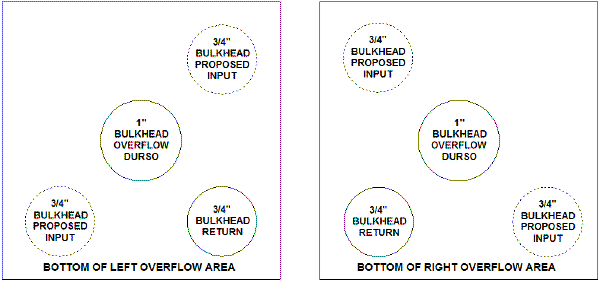
Reef Ready Tanks vs. Standard Tanks 11/12/10 Hole drilling 3/28/09 Re: Hole drilling 3/29/09 Re: Hole drilling 3/29/09 Tempered Glass Panels'¦Just On The Bottom? -- 03/18/08 Hi Eric, <<Hey Linda!>> If a glass tank reads on the bottom: "the bottom of this tank is tempered glass - do not drill" - does this mean the sides are not? <<In my experience, yes'¦especially if this is an 'All-Glass' tank. Most any non-custom glass tank produced today of 75g or more will have a tempered bottom panel, at the least. And as I understand it, tank manufacturers are required to label all panels that are constructed of tempered glass. So if the tank is new, and the side panels are not labeled as 'tempered-glass,' then it's a good bet they are not. But (here comes the disclaimer [grin]), the best assurance is to contact the manufacturer re>> Thanks -- Linda <<Any time. EricR>> Plumbing an Acrylic Cube...Gaining an Understanding of Fluid Dynamics - 03/22/07 I recently picked up an acrylic cube measuring 20x20x16. If math serves me right that equates to around 27 gallons. <<Agreed>> I want to drill the tank and was wanting some assistance prior to taking the plunge. <<Sure>> I have read the boards and have decided on drilling a single overflow hole in the center of the tank. My initial thoughts were to make the hole suitable for a 1" bulkhead and place it approximately 2" below the top. <<If you plan to push more than about 350gph through this overflow you should consider something larger...say 1.5"...with 2" being even better. The larger throughput will make plumbing much less problematic>> I chose the top to regulate the water level, but I've seen and heard people drilling the drain hole at the bottom of the tank. <<Quite common, though not what I like to recommend>> In case of a power outage, wouldn't this drain your entire system overflowing your sump??!? <<If you are not using some type of overflow tower to prevent such, yes>> Regarding the top placement of my proposed overflow/drain hole, I'll use rock to slightly cover this as well as a black background, black bulkhead, black 90-degree PVC and black bulkhead strainer, therefore it should be somewhat invisible. <<Ok>> For the return I was planning on drilling 2 holes for 3/4" bulkhead fittings. I was planning to use a Mag 9.5 and a SCWD on the return line of which both are plumbed for 3/4" connections. <<The Mag 9.5 is too large for a single 1" overflow...unless head-pressure will GREATLY reduce flow>> I want to start an SPS tank so I know flow is important. <<Is important for most any marine system>> Even with a head pressure of 3' the Mag 9.5 will give me 850 gph which is more than 300 gph more than 20x. <<Um, yes...850gph would be about 31x the total tank volume...and much too much for a 1" drain to handle. If you wish to push this much water you definitely need to upsize the drain bulkhead and plumbing>> Would you suggest a Mag 12? <<Not even>> What changes or suggestions might you make to my plan? <<Larger or more overflow throughputs...or a much smaller pump and facilitate flow in some other manner>>>> Should my overflow be larger than 1"? <<Yes...or install three such for this pump>> Should my overflow be drilled in an alternative location? <<Not necessary>> It's not out of the question to drill more holes for a closed-loop, but I was unsure of what an SPS tank of this size would require regarding water flow. <<600gph - 800gph would be fine in my opinion>> I would like to keep sufficient water movement without the use of powerheads if possible. <<Understood...and is doable as long as you understand the fluid-dynamics involved/are willing to deal with the noise and bubble issues from pushing high flow-rates through small sumps. If you haven't yet, I highly recommend you spend time reading through our articles and FAQs on plumbing marine systems>> Thanks so much, Shane <<Quite welcome, EricR>>
New 125 Gallon Setup II - 02/09/06 Dear WWM Crew (Eric) <<Hi Andrew>> Thanks for your reply. <<Very welcome>> Unfortunately, I am not going to be able to get a 125 gal. <<Bummer dude>> But the good news is that I am going to get a 90 gal. <<Cool!>> I contacted the supplier and found that it is the same deal. If drilled it comes with two 1" bulkheads and two 3/4" bulkheads (for returns). They also said that you cannot have them increase the size or number of bulkheads. <<Sheesh! I would consider looking to a different manufacturer.>> Quite disappointing! <<Agreed mate>> So I was leaning more towards buying a standard aquarium and having it drilled by a local glass shop. <<This (to me) is a better option than ordering a tank that you already know won't fit your needs.>> They can drill any number of holes and any size up to 4". But they also warned the more holes and the larger the holes the riskier it gets. <<Ok>> I was thinking of drilling two holes for the drainage into the sump. If I wanted roughly 1000 GPH of flow how large of bulkheads should I get? <<1000gph total? A pair of 1 1/2" bulkheads should handle this fine. You'll find flow calculators that will tell you two 1" bulkheads can do it, and yes, they would...but with much difficulty/fiddling/noise. Take my word and go with the larger bulkheads. I also want to mention, 1000gph through your sump is likely going to make a heck of a racket...do consider using one bulkhead for the sump return (300gph-500gph pump) and the other for a closed-loop (1000gph pump). Your decision...just a suggestion.>> Also, in your last e-mail when you responded: "I was thinking several layers of mesh. Would this be the proper type of setup to include the bio-balls or something similar? <<I would forego both of these and employ one or two fluidized-bed filters for additional bio-filtration and a canister filter for chemical/carbon filtration..." Did you mean forego the sump or just the bioballs and mesh? <<The latter. The mesh will be maintenance hassle, and the bio-balls (submerged) will be of little value (much better to add a few pounds of live rock).>> I could go without the sump but thought that the larger the volume of water the better. <<Indeed, do keep the sump.>> I didn't think the system could function optimally on a canister and a fluidized bed filter. <<Used in conjunction with the sump these will benefit a FO system greatly.>> Otherwise I am in the planning stages of the rest of the aquarium. Feel free to correct or add anything) <<There you go...giving me free rein again <grin>.>> I was thinking a thin layer of crushed coral for the bottom. <<1" or less...>> I already have roughly 40 lbs. of live rock and may get more. <<Excellent! Just don't forget to leave swimming room for the fishes...the 40lbs. may prove to be plenty.>> I was thinking of just a heavy duty plastic container for the sump (With some modifications for skimmer) mostly just to increase water volume. <<This is what many hobbyists do.>> But most of all, I have been thinking about and researching the inhabitants. <<That's good to hear.>> They are as follows: 1. Maroon Clownfish 2. One of the following: A. Blue Tang B. Yellow Tang C. White Cheek Tang D. Convict Tang <<'B' or 'D' are your only choices for this size tank, in my opinion.>> 3. Flame Angel 4. One of the following: A. Auriga Butterfly fish B. Teardrop Butterfly fish <<Both are very good choices as butterflies go...glad to see you did your research.>> 5. Maybe a few Damsels or other small schooling fish. Thanks in advance for wading through my jumbled thoughts and answering my questions. Best regards, Andrew <<Is my pleasure to assist Andrew. Regards, EricR>> Acrylic gluing... plugging holes. 1/22/06 Howdy folks, <Paul> quick question about my tank. I have two bulkheads in my 90 gallon reef tank that I don't want to use anymore. They are on the back of the tank, one near the top and the other near the bottom. Can I remove the bulkheads, then get two small squares of acrylic and use Weld-On glue to cover up the holes? <Yes> Will they hold once the tank is full? <Hopefully, yes> How big should the squares be? <An inch or more beyond the hole diameters> On the outside back, there will be the openings where the holes used to be. Should I add something on that side in case? <Could, but not necessary> Is there another way to close up the holes? One bulkhead is 1" threaded, the other is 3/4 non-threaded. Is there some sort of plug that could be put in there. <Yes... a piece of pipe in the non-threaded one with either a threaded or not terminus with a cap... the threaded one with a threaded cap, Silastic for "pipe dope"> What if I just cut the pipes (the ones coming from each bulkhead) from the back and cement them up with a PVC cap. <Could be done> I could leave strainers on the inside of the tank. It would be kind of a dead spot in terms of water movement (only an inch or two deep though), but nothing would get in there. What do you think? What would you do. Thank you very much Paul <If I was very sure I'd never want to re-use these through-puts I'd solvent the covers over, if not, cap them... Bob Fenner>
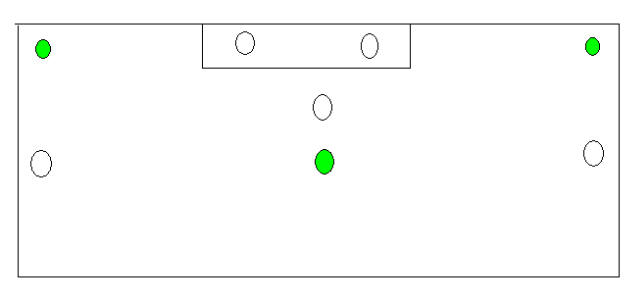
Drilling holes in non-tempered upper back wall of tank 2/17/06 Building a tank 72" x 30" x 30" glass only with 1/2" glass. I am planning on 5 holes 2 3/8" for 1.5" bulkheads <... don't need to be this diameter... for Schedule 40 through-hulls two inch ID will do> spaced evenly across the top back tank and likely 2 other holes 1" and 2" for two bulkheads half way down about 1/3rd in from each side on the back. <? for what purpose?> Tank will be Euro braced and likely center braced as well. All panels will be resting on top of the bottom plate. <Okay...> Will this many holes compromise the strength/integrity of the tank? <Possibly> Is 1/2" tempered glass strong/thick enough for the bottom plate? <I'd spend a bit more money and have a thicker bottom... and a bit more time in making my plans re plumbing/holes before drilling. See WWM re. Bob Fenner> Re: drilling holes in non-tempered upper back wall of tank 2/17/06 The hole diameter was for Marine Depot/Dr. Foster & Smith bulkheads per their specs. <... something is off here... Even Sch 80 (which you don't need... don't want, as the larger holes are more a problem with structural integrity) don't require such large holes. ... I'd look for Sch. 40 gas/jacket fittings as for spas and cut or have cut the smaller, 2" diameter holes> I intended to have 2-3 drains & 2 returns (might cap 1 for possible future flow increase). The other two holes midway down would be also intended for possible closed loop/addition flow at some future point (likely capped to begin with). <... I would not drill these... for structural and functional reasons... can/should be placed near/er the surface, just below the overflows height, but spaced away...> Planning on using sequence Reeflow dart for return pump from sump( will have skimmer, refugium in sump). <A good product, company. Bob Fenner> Plumbing! Help =) 4/13/04 Hello Wet Web Crew, Your site is awesome! <Thanks! Glad you enjoy it!> Just wanted to run some plumbing parameters by you. My new tank is a 120R (48x24x24) FOWLR to be any day now. There is a trapezoid in the back and will be three holes drilled. The drain will be 1" and the two returns will be 3/4" run off of two Sedra 9000's (900GPH each). One return will be directed to the front face of the trapezoid in the upper part of the tank, and the second return will split to each side of the trapezoid in the middle portion of the tank. Now for my questions: <Sounds good, but if it isn't too late, I would size up to 1.5" drains and 1" returns. You can always adapt down the size if you want, but it is really hard to go back and make them bigger. Unless you have really dramatic head losses, you will be running very close to the capacity of your drains which makes it very hard to sleep well at night.> 1) Is the drain bulkhead size sufficient? (I plan on placing a Durso standpipe in and his website recommends 1" drain bulkheads.) Will there be sufficient drainage for this size tank? <They will probably be sufficient, especially if using a "Durso standpipe", but I personally am a fan of overkill (within reason).> 2) Should I place more than 1 drain bulkhead? <Definitely yes! Particularly if you are using 1" drains, I would only count on each drain to be able to handle the flow from one pump. Be sure that you got the correct impression from the Durso website. I suspect that the recommendations there would have fallen in line with one 1" "Durso" per each 900gph pump.> Should I move up to the Sedra 12000 x2 (1200 GPH ea)? <If you like, but if so, I would definitely size up to 1.5" drains.> 4) What do you think of the return configuration? <Sounds fine. You have to compromise between evenly distributing flow and having enough velocity to produce good turbulent flow. Using some kind of flexible (aim-able) outlet like loc-line adds a lot of flexibility.> Thx again, Tom <Always a pleasure! Best Regards. Adam> - Plumbing and Overflow Design - Hi all, I am in the process of building a 110 replacement for my 65 gallon reef tank and I wanted some sanity check on the plumbing I have planned, I have read the FAQ's until I can no longer make sense out of it all so I thought I would just ask outright. Background information: 110 tall tank 2 X 250 Watt HQI XM 10000K 100 Lbs Fiji LR Tomato Clown and Black Sailfin Blenny Planning a 40 breeder tank as sump / refugium 1000 Turboflotor Classic. I have a 48 X 18 X 30 All-Glass tank that I have had (5) 1" bulkhead fittings fit into the top rear of the tank 3.5" down from the top. My plan was to use the middle 3 for an overflow from a culture shelf type of weir that will be 4" high and extend 3.5" out from the back wall and 39" across the tank back. Question 1: should the front spill edge of the overflow wall glass be smooth or are "teeth" serving some purpose I do not know about. <The teeth act as a coarse filter - saving most fish from a free ride to the sump.> Question 2: both remaining 1" bulkhead fittings are for return plumbing and I am thinking using one for a manifold around the top of the tank with 4 or 6 outlets, and the second diving down and feeding another form of manifold just above the 5" DSB Southdown topped with aragonite special seafloor mix to keep the deep tank flowing. I will be reducing flow with the elbows and such, but hopefully delivering the flow more precisely were it is needed <I think I missed the question there...> Question 3: Pump output recommendations at about 5' of head (30" stand and 30" tank) thinking about 1200 to 1500 GPH to allow some SPS or should I go all the way to 2200? <As much as is practical.> tank to house combination of Zoo's, Mushrooms down deep and Xenia, and a few SPS up on top. (Not sure if I'm ready for SPS) <Until you have the metal halide lighting, you will not be ready.> Question 4: do you have a link to a good picture of an internal overflow / culture shelf picture? <I am not aware of any... perhaps one of out readers will send in a link.> Thanks for your time and patients with us and our thousands of questions, if not for you folks I would have hung up this fascinating hobby/obsession long ago and missed out on all pleasures it brings into my life. Forever in your debt, Todd <Cheers, J -- > Going Larger - UPGRADING 4/2/04 Hi Guys, Short question here. I currently have a 100 gallon reef tank using a refugium for my filter. (I mainly keep tangs and a few corals). I wont go into lighting etc.. as my question in basically on the new setup I am getting. I just ordered a 200 gallon oceanic tank (8 ft long x 24 x 24). The tank has a double overflow boxes. Should I run one large sump that I wouldn't be able to get out easily once it is in or should I run two sumps - one on each overflow box? <If you run two sumps, you must connect them. If you run two unconnected sumps, and one of the pumps stops, that sump will overflow since the other will continue to pump water up to the tank while part of it is draining to the sump with the broken pump.> Also, what do you think about adding a few holes in the upper back for additional pumps coming from the sumps or closed loop for more flow (instead of power heads?) <Extra holes are a great idea for many reasons, but it would have been very advisable to order the tank with the holes pre-drilled. Keep in mind that wherever you drill the lowest hole, that is where the tank could potentially drain to in case of a leak. Placing the holes up high and then plumbing down to where you want the inlet or outlet to be is much safer.> I am looking at Nemo or Shea pumps for my main returns and Mag 24 or something for the holes in the back instead of the power heads. Any other tricked out ideas I came to try them. Thanks, Steve <I am not familiar with Nemo or Shea pumps. Do consider Sequence for their high flow rates and low noise and power consumption and better reliability compared to equivalent Dolphins. In general, I prefer external only pumps like Iwaki over submersible types like mag drives for better reliability and less heat transfer. Best Regards. Adam> Overflow from Down Under - 6/24/2004 Bob: I recently read a response from you on an old FAQ titled "Overflow tower with "over-under" divider". Here is an excerpt: "...you says a better overflow tower had an over-under divider in their fronts to return water to the sump from the bottom layer of the tank water. <Yes... to bring at least some, if not most of the water from the system's bottom water layer... to the sump, outside the tank>". Questions (Sorry, I started with only 3): 1) I gather from the current "reef-ready" overflows, that this still holds true, yes? <Yes> 2) On these overflows, the bottom slots will pose a problem/be covered by a DSB in display, won't they? <Mmm, not if they occur above the DSB area> 3) I am considering a custom drilled tank (around six 1" bulkheads on a 6' long 125gal), with the "internal skimmer box", a la Anthony Calfo. Is it an issue having all water overflowing from the top of the tank? <IMO/experience it is better to have water from both the surface and near bottom> 4) If so, is this "problem" solved by vigorous flow? <Could be> 5) Do you think six 1" bulkheads will allow me to do almost anything in this tank, flow-wise? <... I'd likely go with three 1 1/2" (pi R squared... actually much more surface area, flow capability...) than the six one inchers... one right, left, about middle> 6) Would you have a different drilling preference (to be prepared for the most flow-demanding livestock in the future)? <As stated above, yes... and consider the alternatives to the ends/discharges... there's a larger SCWD on the horizon (per chatting with Bob Stern at Interzoo in May...)...> 7) If you were to suggest larger bulkheads, how much more noise are we talking about here (or am I at toilet-flush level already)? <There are various means to quiet down these downspouts... aspirators and open tees to the surface principally... worth looking into and employing> I am pleased to be able to state here that your website and books have been a boon to me and so many others. Your contributions have saved untold lives, and I am forever grateful to you and your volunteer crew for what you have provided. Sincerely, Rich Licari <Thank you for your kind, encouraging words my friend. Service to you. Bob Fenner> Bulkheads in tank with built in sump Hi all- Bob and Anthony enjoyed hearing you speak at the IMAC. <cheers, Andrew... it was a great time for all of us :)> I am being aided by my LFS but I am about to drill the bottom of my 65g acrylic tank and wanted a second opinion. The back wall of my tank has a sump built into it (IFS). That's where the protein skimmer and return pump are located- I threw out the bioballs. Well after adding an upstream refugium it became more imperative that I make some plumbing changes. The third section of this in tank sump has about 5 inches of water covering two Rio 1700s. So I have now bought an Iwaki MD 55rlt it will pump water into my main tank thru two outlets and into the refugium. <very nice> I was going to try a J tube to get water out of tank but now I plan to drill and add some type of Rubbermaid container as a proper sump. <whew! avoid siphon/J tubes at all costs... risky in the long run> So the question is will two one inch bulkheads drilled in the bottom of the tank flow enough water into this new sump? <not sure... you need to add up the numbers on your plumbing size and run plus elbows, etc to calculate head and actual water flow... then compare that against the mfg specs for the bulkheads sizes you choose to rate them. There are calculators for this on the big message boards like reefcentral.com and in fine books like Escobal's "Aquatic Systems Engineering"> The refugium is 27 gallons so with 90 gallons of display water I'd like to use as much of the Wake's flow potential as possible. I have seen one inch bulkheads rated from 300 to 1000 gallons/hour. <there is no prayer of a 1" bulkhead coming anywhere near 1000 gph. 300PGH is the safe number bandied about which I agree with... and they can go as high as 600 PGH although quite noisy at that> Should I be expecting the low value because my bulkheads will be located in a small section~roughly 4inx12in? I hope this makes sense-the sump built into the back of the tank always seems to confuse. Basically I just want to be sure that my plan matches expectations before I drain, drill tank bottom, I have to cut stand too..., plumb everything well you know Alright thank you very much and sorry I if I'm making a simple question way too long. Andrew <no worries, my friend... its a challenge at first, but worth doing the math. My impression is that 2 1" holes is nowhere near enough here. Larger bullheads or more small ones are needed here IMO. Kindly, Anthony> AGA Dual Overflow Hi, I am new to Lg. Saltwater setups so sorry if this sounds dumb. I ordered from a local store a 125 AGA with dual overflows that are rated at a max flow through of 600 gph per overflow. The store is telling me that I need a pump rated at 2400 gph for each overflow, is this correct? It sounds like over kill? That would mean if I used one pump it would have to be 4800 gph... wouldn't the tank fill faster than it could empty? <Mmm, yes... even discounting for less than rated "performance", head, induced drag in the plumbing lines... I would NOT get/use a pump with more than 1,500 gph rating> Sorry for a stupid question! Kerrie <Doesn't seem stupid to me... Bob Fenner, who has mopped, vacuumed up many, MANY gallons of water from floors> Plumbing an overflow for a 72 gal Hi I recently replumbed my 72 gallon bow front tank. I used 3/4" pvc down the middle in the back to about 4" off the bottom and then ran a T to run to both sides along the back with about 3/16" holes drilled along it all around about 15 to 20 holes on each side. Is this in a good place or should it be up higher in the tank.? << Well I'm not sure I follow the design. If you have holes drilled up high in your tank, then why have a pipe run down into the tank? The main idea is to take the surface water right off the top of the tank and overflow it into the sump. >> I am running a Little Giant pump at a about 450 g/ph. Do think the pump is enough? << No, I would at least double that flow. But hey, that is just me. Give it a look and see if you think it is enough. >> Thanks << Blundell >> Rodney Reible Overflow holes on glass tank plus closed loop Hi crew! <Peter> Great website! I love that you guys cover everything from the most basic to advanced stuff! But of course, I'm writing with more than just compliments :-) I had a few ideas I'd appreciate any input on. I'm having a 115 tall glass tank made (48" x 18"deep X 30" tall). <Bet you'll soon wish this was eighteen inches tall, 30 deep> Since it's being custom made (Starphire front panel) I'd like to take advantage and have the back drilled (like in Anthony's Coral Prop book) instead of an unsightly clear internal overflow box. Before getting into the hole size/type questions, I guess I need to ask about flow rate. I love the idea of a closed loop/external pump system (have one currently on my 20gal). If I get virtually all my flow in the tank from a closed loop system (up to 30X tank volume), how much flow do I actually need to have going through my overflow/sump? <What do you want to do with this flow? 2-3 volumes per hour will do for a refugium for instance> Is it dependent on protein skimmer pump/size (i.e. volume processed by skimmer vs. volume flowing through sump)? <Yes... if that's what you want to service... let's say rather than a hang-on> Or just enough so the heater in the sump gets enough flow? Any thoughts? <Lots. For heating you don't need much flow either... water is the standard for specific heat... retains thermal energy better than any other substance known> So then, if all I need is minimal flow going through the overflow holes in the back, would 4 - 1" bulkheads be sufficient on this size tank (haven't bought the return pump yet for this reason)? <Fewer, larger would be better... like two 1 1/2" toward the upper, back corners...> I noticed in searching through previous questions that 4 - 1" bulkheads (holes drilled 4 inches from the top of the tank to the middle of the hole) were mentioned as sufficient for a 120G tank. What GPH would I want to be going through these, assuming I want them skimming mostly surface water, and to keep them from being too loud? <More to be considered, specified... like where, how does the water transit from there? How much higher will the water be over the edge/lip of these through-puts? Will there be any plumbing running horizontal from them? Practically speaking the two 1 1/2" fittings will allow much more than the 4 one inchers... a good six hundred gph... if you want more, think you might later... have them drilled for 2" inside diameter bulkheads> Also, how necessary is it to have a shelf/baffle running across the entire back top of the tank to skim the water? <No> I'm thinking 4 - 1" bulkheads with minimal flow will be sucking mostly surface water anyways, right? <You don't want this to happen... too much noise, too great a likelihood of something getting trapped there, too hard to rig intake screens> Thanks for any input! Peter <Read over the archived "Plumbing FAQs" (there are many) on www.WetWebMedia.com until you are centered on your options here. Bob Fenner> Re: Overflow holes on glass tank plus closed loop Hello Mr. Fenner, <Peter> Thank you for the reply. Only after reading your response do I see how vague my questions were. So let me be more specific. Yes, I would rather have a deep tank instead of tall, but apartment constraints dictate size. So I figure rather than have large sump or refugium volumes, I'd put my extra volume on top, so to speak, therefore treating this tank like a 60 gallon with lots of swimming room on top :-) <I see. I hope you have long arms!> As for the plumbing...the plan is to have the tank drain surface water to a sump, where there will be a protein skimmer, heater, and media like carbon. Dedicated pump will then return water to tank. Refugium will be separate, with a small dedicated pump from the sump; exiting water flowing back to the sump. <Good arrangement> If all circulation in the display is provided by a closed loop, then I can get away with how many gallons running through the sump? <Depends on the size of the sump, fittings, plumbing... there are "average" minima (3,4X), and maxima (10,20X)...> Let's say 600GPH is sufficient. Then, the drains from the main tank could be 2 - 1.5" ID holes in the upper back corners of the tank (how far from top/edge is safe for drilling/final water level)? <Again, depends on the sump somewhat... Imagine a power outage, or outright failure... the water above the lip of the through-puts is going to drain down into the sump... need to test, mark the highest level the sump should be filled to prevent flooding... That being stated having the edge of the cut out down two inches and over four or so is about right> I currently have a small tank plumbed like Anthony described in his book, with a simple horizontal line coming off the back of the near top of tank drain hole, then down to the sump. This is SO LOUD as air gets sucked in just under the upper lip of the bulkhead inside the tank. Is this because there is too much flow running through a 3/4" hole? <Only to a secondary extent> Or because I should have put a T on the bulkhead on the back of the tank, with one part pointing up for air intake, and the other pointing straight down for the water? <This would help... but what you really need is a larger diameter fitting/plumbing, all situated further down in the tank, a "Tee"/Durso fitting, AND a mechanism for silencing the water dropping (an aspiration tube)> I think that if the hole was larger, the water would simply flow down, half filling the drain line, and not making the vortex of air effect it does now. Is this correct? <Yes, possibly> This is why 2 -1.5" ID holes would be OK for apprx. 600GPH? And a T on each drain coming off the back of the tank would not be necessary then? <I would use this, yes> These 2 drain holes would then determine the display water level, would they not? <Mmm, only to an extent... the pumping mechanism is at least as important> I did not understand why you asked in your reply how much above the holes the water level would be. How could they be higher than the drain holes, unless the flow was too great (eek, overflow!), or the exiting drain lines curved up first? <Bingo on both counts> Thank you for any help you can afford me. A realize I could try things, and learn with trial and error (i.e. my super loud 20 gallon, doh!), but I'd prefer not to mess around with this new tank, especially glass. And I'd really like to avoid a large internal overflow box in an already "thin" aquarium. Sincerely, Peter <Have you read over the materials stored on WWM re marine plumbing? You should. Bob Fenner> Building a large glass tank I am planning to build a 180 gallon glass aquarium. <Hey Mike, MacL here with you today.> I am new to the hobby and have tried to read as much as I can on water circulation/overflows. <Very smart.> I plan to do FOWLR, but would like to plan for the eventuality of going reef. There is a lot of articles discouraging the use of hang on overflows. <I think that's because many of the overflows have problems.> I have read a little on Durso overflows, horizontal overflows, some of the DIY overflow designs. It has all become a little confusing. <I can see where that would be.> In your experience/opinion, what are the best options for high flow, and as silent as possible overflows. <Personally I would drill the tank for optimum overflow and I'll be honest and tell you that my first tank originally was set up with a corner overflow and I will NEVER do that again. I have ended up with a lot of detritus that I cannot get to clean it up in the overflow and I hate it. My newest tank will have the holes drilled into the main part of the tank and on the back. Let me know what you decide and if you have any more questions. MacL> - Tank Modifications - Holy moley what a site!! You guy's really put a lot of effort into this stuff and I sure appreciate it. I have a 58 gal Oceanic tank that I am going to drill to mirror Mr. Calfo's design. If you could spare a couple of moments, I would like to get some clarification on a few specifics: 1) For the internal overflow, can I use acrylic or should it be made of glass? <Acrylic would be fine.> If acrylic, can I use Weld-on for adhesion to glass? <No... Weld-on will not bond the acrylic to the glass. You must you silicone adhesive... 100% pure, made for aquariums.> 2) Should "teeth" be routed into the acrylic/glass? <It would be best.> If so what do you believe is optimum spacing and depth? <I'd say at least one inch in depth... spacing is really up to you. What "optimum" is varies to much to say.> 3) I am planning on drilling 3, 1" ID (1.75 OD) holes for 1" bulkheads. Does the internal overflow have to span the entire length of the aquarium or is this merely suggested? <That would likely be excessive... probably better to use the shelf design proposed by Mr. Calfo.> If it is best to span the entire back of the tank, where do the returns come in if I wish to use Sea Swirls? <With Sea Swirls, you have no choice - they have to be positioned somewhere along the top of the tank... seems like you need to make some decisions - some part of your plan needs a drastic change.> 4) As for the bulkheads, I plan to cut them 2" down (center of hole) from the top frame and evenly spaced from the sides (not to come close to 2" from either side). Does this sound ok or is 4" to center better? <Sounds ok either way.> Like all others before me, I appreciate the time you spend to answer these questions. Mark <Cheers, J -- > - Tank Modifications, Follow-up - Thanks for the prompt response. <My pleasure.> Just one point of clarification. <Sure.> I meant to say that I would be using the shelf design as outlined in the book. My concern was is it possible to drill the holes needed centered on the back wall, 2" down from the top and sufficient distance from one another, and have this shelf built to span only what was needed to cover those drains (I.E. 12" - 16" of shelf covering the drains along the back wall)? <Should work fine, yes.> Then I would have space at either side of the shelf for returns, be it Sea Swirls or whatever. What do you think? <Yup, makes sense and will allow for the Sea Swirls.> Lastly, how far down from the bottom of the bulkheads can I end the shelf? <Likely right below the bottom of the flange.> In other words, if my drains are cut at 2" - 4" at center and the bulkhead bottoms are at 3" - 5", can I end the shelf just below the bulks? <I think so, sure.> Will this hamper water volume/flow in any way? <It may, but the beauty of silicone is that you can remove, re-glue if necessary. You are going to do a full set of leak tests before you fill with saltwater, yes?> Thanks so much for al of your help!! <Again, my pleasure.> P.S. Do you know any tank drillers in Northern NJ? <I don't - you should check on some of the forums, I'm sure you'll find someone in your area capable of doing this.> Thanks again!! <Cheers, J -- > Ordering tank today - would like expert opinion on drilling plan ! Hi guys and thank you so much for the information you are providing for all of us around the world! I'm going to order a tank, probably today, and I'd love to get your opinion on the drilling plan I have laid out. The main constraints are: 180g tank, holes in bottom only, single end overflow, reef ready flow rates with minimal noise. My plan is to provide for two 1.5" drains and two 1" returns in overflow and then a closed loop of 1.5" intake and two 1" returns. Here is a PDF of the plan: XXXX, <has address info.> Any input would be appreciated, although I may have ordered it already! Thanks again, Randy <All looks good w/ the exception of the two "middle" 1 3/4" holes. I would not drill these... structurally not a good idea, not needed. Bob Fenner> I just remembered that the PDF I linked to in my previous email contains my name/phone/address - please don't post that on the web site! Thanks! <Thank you for this. I omitted the link ref.... would like to include just your graphic if you can/will send this along. Bob Fenner> Re: Ordering tank today - would like expert opinion on drilling plan ! Hi and thank you very much for your reply. I have revised the pdf to remove the personal information. I can also send you a JPG if that would be better. <Either one... the jpg would be better> I have some more questions about the 180g drilling plan if you have the time. I thought I would need at least two 1.5" drains into my sump. However, I have received some advice that I only want about 1000 gph through the sump and I think a single 1.5" drain should handle that flow, right? <Mmm, better to have two... less noise, less possibility of real trouble should one become occluded, slowed> Then I would need another 2000 gph through a closed loop if I want "decent" flow, but even that would note be quite 20X. I just can't seem to get enough holes through the bottom of my tank with just a single end overflow. I also want to avoid having the overflow go completely across the tank, visually I don't really want to see that from the sides. Is it OK to have the closed loop intake drilled through the bottom near the far corner (away from the overflow)? <Yes> I'm not sure if you saw that one or not... <Did> I'm also looking at ways to have the closed loop intake come through the front of the overflow in two places (my overflow is getting crowded...) My goal was the ability to have 3600 gph, but I don't think I can get that with one overflow and one closed loop. I think it will end up requiring a powerhead in the tank or an additional closed loop somehow... Where can I put more holes in this thing? :) <The other corner...> Thanks so much! Randy <There are some fine "in place" pumps... look to Tunze's lines here, if you find you want more circulation. I think you will be fine. Bob Fenner> Plumbing a 90 gal for up to 1800 gal/hr? - 7/8/03 Gentlemen, I hope your Independence Day was a BANG! <A many entendre well wish, perhaps... at least for a manic ADDH adult <G>. Ha!> I'm planning a 90 gal. reef and was considering running all of the flow (up to 20X) through a 36x12x16 inch sump to be housed in a shed outdoors here in sunny SoCal. <interesting... and have heard of this done by folks in your area. I recall the founder of Aqua C (Jason Kim) talking about doing this for his reef in San Diego area> I'm trying to move much of the noise and evaporation outside and to avoid those unsightly powerheads. <understood and agreed> Does this sound like a "sound" concept? <indeed possible with your climate> If so...... Can this be done through a single corner overflow box and how large? <possible... although it will require some finesse to temper the sound. Do consider a half sized pump for the sump/return and perhaps a second pump on a closed loop on the tank to hedge your bets> Finally, what size bulkhead and drain diameter? <easy to figure, but too much to detail here per many sizes. Do decide on one pump versus two... and then check mfg specs (like Rainbow Lifeguard) for tolerances. 1" holes should only take 300 GPH each at most... but 2" holes may take more than 2X300GPH quietly. Also consider using the Durso standpipe modifications for a quieter overflow. See more info here: http://www.rl180reef.com/pages/standpipe/standpipe_menu.htm Thanks! <always welcome my friend> P.S. I hear Anthony may be guest speaking our SCMAS club meeting soon. I would love to purchase his autograph....especially if there is a book attached to it! <I would love to come back to Cali soon :) Perhaps SCMAS could work something out with SDMAS (San Diego) or even DMS (Phoenix) to save on the airfare. I likely can stay at our good friend Bob Fenner's to save on lodging too. I'm easy <G>. I post my schedule at www.readingtrees.com and love to meet up with fellow fish nerds :) Especially our WetWebMedia friends! With kind regards, Anthony> -AGA new style overflows- This is for Kevin Sliech, if possible: <More than possible!> Kevin: I read an email that you replied to in the dailies on 6/24 (sorry, I am behind). I was wondering where you got your information on All-Glass' changes, <Straight from the horses mouth, our regular tank-delivering wholesaler along with a pamphlet from AGA. I don't believe they're available yet, truck loads had supposedly left but we still continue to receive old-style tanks as they blow out their stock of them.> and if you can point me to a link or elaborate further? <It appears that AGA has yet to update their website this decade, so it will be little help to you. In short, the overflows (now called Megaflow or something fancy-pants like that) will be located on the back tank wall instead of in the corners. On tanks with a single overflow it will be centered on the left (I think left..) back half of the aquarium. On the 4' tanks that require two they will be each centered on a half of the back. On the 6' tanks, it appears that instead of centering them on two 3' sections on the back, that they're instead centered on the first and last 2' sections. I hope this makes some sense... I believe the drilled holes will be the same, but due to the shape of the overflows, there will be many more slots. This is great for folks like me who have all kinds of crap growing and blocking them. The accessory kit has the "Durso" modification to silence the gurgling. I hope this long winded response helps! -Kevin> - Overflow Planning - Hi Guys, <Good morning, JasonC here...> Great FAQs! Unfortunately I didn't find anything pertaining to my situation (searched the internet as well). I've been in the hobby for about 30 years, devoting the last 14 to reef aquariums. I'm in the process of setting up a 375 gal. acrylic tank and have some thoughts about the overflow/surface skimmer I wanted to bounce off you. I've always used over-the-top suction type overflows in the past and they've served me well (with proper maintenance), but plan to use drilled gravity overflows with this system but with a different twist as I'll explained below. I didn't want anything inside the tank so I've ordered it without a built-in overflow. I'm also installing it in a wall to be viewed from front and back so any overflow will be in the end (or ends?). I have two ideas as follows: 1) Drill a series of holes (3/16 or 1/4 inch) at the desired water height in the end of the tank and build/attach the overflow box to the outside. <You'd almost be better off putting in a divider at one end that would act as a spill-over and having an overflow the width of the tank, then hide this portion by the wall, rather than trying to add something to the end of the tank.> 2) Install bulkheads (1 1/2 or 2 inch) with strainers at the desired water height and plumb to the sump. <Or you can do this - the quick and easy solution.> Whaddaya think? Any thoughts on the number of holes/bulkheads? <On one end, two, 1.5". On both ends, one each would be fine.> Whichever system, I'm thinking I should use both ends of the tank for overflow? <Ideally, but it wouldn't be difficult to use just one end - just add a slight slope to the tank so that gravity helps move the water to that end of the tank.> Thanks much! E. Russell <Cheers, J -- > - Overflow Planning, Follow-up - Hello again! <Hello to you.> Thank you for the reply. Sorry for the resend earlier, just not patient enough some times. Anyway......I would like some clarification on your earlier reply, if I may? When I suggested installing large bulkheads with strainers through the side of my (acrylic) display tank at the water's surface as an alternative to an internal overflow your response of "quick and easy" leaves me to believe you don't think much of the idea (correct?). <No... what's wrong with 'quick and easy' - nothing wrong with bulkheads.> I'm interested to know your opinions on why you would or wouldn't use this method. <I think you misunderstood.> I really would prefer not to install bottom plumbed overflow boxes inside the tank and don't want to diminish tank space with an internal divider/spill-over on one end. If you have any alternative ideas for a "through the side" gravity overflow/skimmer system I would love to hear them as well. I'd also like your opinion on skimmer size. The tank is a 375 gallon reef. I know what the marketing literature says but I'm curios to know if you think the AquaC EV-240 would be large enough or if I need to spring for the EV-400? <Think it would be worth it to have the EV-400.> Thanks again for your time. Eric <Cheers, J -- > - Overflow Design - Hello Bob! - Please forgive the intrusion, I do normally post my questions to the "Crew" in general. <Well, it's JasonC here this time... hope you don't mind.> I'm looking for help with designing the overflow/s for my aquarium. I'm in the process of establishing a new reef setup (seam rupture on previous 14 yr. old tank) that will be installed in a wall and viewed from two sides. I awaiting the arrival of a 375 gal. acrylic aquarium from Tenecor (ships next week) which I ordered sans overflows. I did this because my plan was (is) to utilize some type of "external" overflow system. The dimensions of the tank are 96x30x30x3/4, of course the overflows will be installed on the end, or ends. My idea is to drill a series of holes at the top two inches of the tank to function like the teeth on an internal overflow, and attach the overflow box (drilled for bulkheads - 2 x 2") to the outside of the tank. If this sounds feasible to you, what would your recommendation be for the size of the skimmer holes? <It's kind of a sketchy plan... you will need to 'attach' the overflow box just as if it were part of the tank - with acrylic cement, otherwise it's going to fall off... you should consider just having this built onto the tank.> How many and how far apart (without compromising structural integrity)? <I'd go with 1/4-3/8" holes, as many as you want, not too close to any seam or edge.> What's the max flow I could expect through these holes? <Depends on how many you drill, but the number would be pretty high to match your expectations... perhaps 20-30 per end.> How big should the skimmer box be to handle the flow (say - max 2000gph)? <Well... drilling small holes isn't going to get you this high a flow rate unless you drill a lot of them - with standard bulkheads you need two to three 1.5" holes to reach a flow rate that high. Additionally, flowing this much water in and out of the tank is going to be very noisy... I would consider lowering the recycle rate in favor of some strong water movement within the tank via strong powerheads like the Tunze Stream Pumps.> Thickness of the acrylic? <I assume you mean for the overflow box... 1/4" would work - doesn't need to be heavy duty because it won't be holding much water at any given time. And... as I mentioned before, you will have to bond this to the tank with acrylic cement.> Have I missed anything >:-) <How about three large holes with bulkheads and strainers, plumbed directly to your sump?> If you think this is a bad idea my second choice would be to utilize an overflow design like Anthony describes in his coral propagation book. <I'd rather see you do this.> Saying that, what would be the measurements of this design? <The same as the width of your tank.> I would want to keep the dimensions to a minimum for aesthetic purposes. <Again, and I think we've discussed this design before... you should really be working with the people at Tenecor to help you realize this design rather than trying to augment the tank after its arrival. Add a couple of inches the length and this portion will be hidden behind the wall - this way you can have either a standard overflow on each end or perhaps something similar to Anthony's design. Any attempt to attach something to the side of your tank is ill-advised - if you have little or no experience with acrylic adhesives, you could potentially ruin your tank if you are not careful. If you've never worked with acrylic before, it's actually not that easy to make a five-sided box that doesn't leak - and you're talking about a four-sided box that needs to be attached to the tank.> If you have other ideas please feel free to expound. <My thinking here is that you should just keep it simple - drill two 1-1.5" holes on both ends - add bulkheads with strainers, and plumb these to your filtration system.> Any assistance will be greatly appreciated. Respectfully, Eric <Cheers, J -- > - Overflow Design - I'm about to have some large tanks made and was wondering - is there any reason to build these tanks with conventional overflows, i.e., hole in the bottom of the tank with a stand pipe and overflow baffle? Would not a hole (or 2 or 3) in the back of the tank with a bulkhead and strainer located at the waterline accomplish about the same thing? <Indeed... as they say six of one, half a dozen of the other. Either would work fine. Cheers, J -- > New All-Glass Tank Overflows - 9/19/03 Thanks for your reply Anthony. I have to know your opinion on the new all-glass tank overflows. I do plan on upgrading my 90 gal reef to a 120 in a few months. My question is to you do you approve (or like) the new design location of the overflow boxes on the reef ready tanks. Would you get one of the new ones or get an old one, what are the drawbacks of them being in the middle back of the tank? I don't know if I like how they put them in the middle of the tank. Do you think I should get one of the older styles while I still can , that is if it will suit the reef keeper better than the new style. <I'm grateful that they have addressed the issue in the hobby of having/providing drilled aquaria. My opinion of their old and new styles however, like any other commercial one I've seen, is that they are insufficiently drilled - lacking enough or large enough holes. What happens then is that aquarists often buy a properly sized sump/return pump for their display... but learn that the drains cannot handle them. So they throttle back the pump and need to add powerheads in the display... how ironic! And they are nearly as ugly, IMO, as those glass overflow towers <G>. My preference is to have overflow holes drilled high along the back wall... not the floor with a glass tower. I described modifying this with an internal horizontal overflow (more discreet and efficient) in my Book of Coral Propagation. We have several messages about it in our archives here at wetwebmedia.com too... do check them out with a keyword google search - toggle terms like "internal horizontal overflow" and see what you get. Hmmm... not sure if I've helped here or not. Holler if not :) Anthony> Overflow Dilemma - Dear Bob: <Actually, JasonC today...> It's been several weeks since I e-mailed you but I have another question that I have been unable to answer. I have just about everything ready to go for a new 180 gallon marine aquarium (FOWLR) that I have been setting up. With your input I decided to purchase a Euroreef CS8-1 Skimmer as you may recall from my prior e-mails. It will be placed in a 50-gallon sump in a stand beneath this aquarium. My question deals with the tank itself. It is from All-Glass Company and features two corner overflows (not the newer center-located overflows that are found on their newer tanks). The Mega-Flow Overflow Kits that the dealer sold with this tank are a tight fit since All-Glass now uses the Durso standpipe system because of noise concerns, etc. As you know, these feature a 1" bulkhead fitting in each corner and a 3/4" PVC return line. The numerous postings on various websites regarding flow rates for this and other drilled setups has my head swimming! The nice folks at All-Glass indicated that each overflow can handle a flow rate of 600 gph -- 1200 total for the tank. The many letters I have read seem to present a different picture, indicating flow rates as little as 200 to 300 gph. <Nah... a total of 1200 GPH is about right.><<Mmm, nope. The earlier guesstimates are closer to reality. RMF>> I have a Mag 18 ready to use for the return plumbing to the tank. I made this choice after calculating flow loss due to friction and head pressure through the 3/4" return plumbing. The return line will use a 'Y' connector to split the flow path and eventually bend thru the 90 degree elbows near the top of the tank. I estimated a return flow of about 820 gph -- or roughly 410 gph for each return line. Based on the lower flow rate numbers from above (draining thru the 1" bulkheads) I am now concerned that this pump may be too powerful. If this was your setup would you install a ball valve to control flow? <I'd install one for other reasons... being able to take the pump out to service it, etc. But again... I think you'll be fine with your pump selection.> I'm not sure how mag drive pumps can handle any type of back pressure, so I'm reluctant to do this. Or, do you believe these overflows can handle a Mag 18 without interruption? <No worries.> Just to note the Mag 18, according to the manufacturer, has a flow rate of 1200 gph at 5', and 825 gph at 11' (which is the figure I used). Thanks for any advice you can offer. Sam M. <Cheers, J -- > - Overflow Calculations - Hi Crew, Would you kindly check my calculations/idea? <Sure.> I am setting up a 75 gal non reef ready tank. As such, I need to use a hang on overflow siphon box (yuck). I really don't want to risk drilling the back unless you think it is worth taking the chance? <Not a chance you or I should take, but if there's no water in it I'd take it to a glass shop and have it drilled.> Anyway, I wish to set up a 15 or 20 gal sump/refuge. As the tank is in the living room I would not wish to have any flooding to explain to my wife! <Understood.> If I keep the water level 2 inches below the top of the tank this would be about 7.4 gals short of overflow. If I then keep the submerged pump in the sump 6 or 7 gals below the sump high water level, then there should be little chance of the tank overflowing in the event of a siphon break? correct?? <Only if the water remaining the sump is not more than the 7.4 gallon margin of error in the top tank. Sounds risky to me... evaporation and top off will be your biggest issues.> The only worry would be the pump running dry and burn out? Which I could live with. <If that happened, you could lose everything in the tank.> Does this sound correct or am I missing something? <It 'sounds' correct but still more risky than I would be willing to tackle.> Also, when adding make up water, would I add to the tank or sump? Does it matter? <Doesn't matter.> Thank you for your assistance. Happy Holidays. <Cheers, J -- > 120 tank drilling 2/24/04 Hello Anthony, I really like your idea with doing away with the "reef ready" tanks with the unsightly overflow towers. I plan on ordering a 120 from my LFS, I currently have a 90 dedicated to LPS only and do plan on keeping it that way (no mixed garden here, thanks to you, and the rest of the crew) , <excellent to hear!> but I'm running out of room and plan on transferring the inhabitants to the 120 one of these days. <its one of my fave size/shaped tanks: 2X2X4 feet><<... four by two by two... LWH. RMF>> I would like you're opinion on how I should have the tank drilled , I plan on ordering the tank from all-glass and having them drill the back walls at the top to accommodate 1 1/2" bulkheads that have strainers on them for the overflows to the sump, how does that sound? <exactly the way I'd do it> or is there a better way that you would recommend? <spot on. And if it goes reef... then include a slender horizontal overflow sealed in front of the bulkheads for better skimming (see this in my Book of Coral Propagation or write back for the passage to be e-mailed to you)> I was thinking 4 or 5 holes would do? too many or too much? <hard to say.. you need to determine what corals you will keep, what flow they will need, and if you want to/can run all of that flow through the sump (versus less holes plus a closed loop and second pump). No powerheads regardless> Would you have a better idea than drilling then with a 90 degree elbow and a strainer on it to get this down to the sump to allow for more water flow (and a bigger pump) or do I not need this as much with LPS ? <good skimming is needed with all truly> Also I was thinking about drilling for the returns , should I do that or should I just run the piping up from the back of the tank? <that one is really just a personal preference. I favor up over the back and drilling less holes> I was thinking about you're closed loop manifold, if that makes a difference. thanks for you're help. <best of luck! Anthony> 120 tank drilling II 2/27/04 ok, thanks Anthony. You mentioned that I should install a skimmer box in front of the bulkheads, <not needed but helpful... much better skimmate> I do have your BOCP, I looked at it, but how can I build this?? and how do I secure it to the tank?? <its simply siliconed cut and seamed glass in a dry tank (or low drained tank)> One more thing, I asked if I should go with 4 or 5 1 1/2" bulkheads drilled, you needed to know what kind of animals I intend to keep in there to determine if I should go with that or less.... well I am going to keep it a dedicated LPS tank, so how many should I go with here to provide the flow these plump, fleshy corals will need?? <You really need to pick the corals by species name my friend... not just saying "LPS". That could mean Nemanzophyllia which suffers from even moderate water flow, to Hydnophora which requires remarkably strong water flow> Also my sump should be able to handle the flow right?, <yes... if designed well. Diffused flow to prevent excessive turbulence and bubbles being aspirated> as long as my pumps can put it out right? I could also lets say have 5 holes drilled and plug them if I don't need them, or if I someday want to add a closed loop pump to the system right? thanks once again. <all of these questions are really simple to see/understand if you'll take the time to visit some LFS shops to peep their functioning systems... better still, a local aquarium society with fellowship from local members to show you their tanks and systems. If none of this is possible, you can start or follow a thread with pictures on message boards to see how others do their systems. We are such visual creatures.. you need to see these systems in action and all will be so much clearer. Anthony> - 135 Set-up/Plumbing - Hi guys! Thanks for your great site!
I've poured over it as well as others gathering info and have a few
questions for you regarding my set-up. First off, this will be a
freshwater tank which I will later turn into a reef. For now though I
want to lay a good foundation to make the change easier and to have a
great, clean, low maintenance and well set up tank. The tank is 72L X
18W X 24H and came with an Amiracle wet/dry with a single drip plate
(24x12x14). This tank has one back/center overflow (3 sides at 6"
each) I want to have at least 1350gph(10x) flow rate and am debating a
bunch of plumbing, pump, filter issues: 1.. OVERFLOW: Considering my
desired flow rate and current overflow box, what alterations to it
would you recommend? <Get a second overflow installed? I don't
know... not sure this single overflow will be up to your demands.>
What's the max for this overflow and what diameter bulkhead should
I use for it's downspout? <Uhh... you tell me, how big is that
hole at the bottom of the overflow? I'm going to guess an inch - if
larger, that is better, but if only one inch, then expect about 900 GPH
max.><<RMF says 600...>> 1st concept: I've always
wondered about the possibility of drilling intake bulkheads near the
bottom of the tank and plumb them to the backside of the in-tank
overflow box at the waterline - a sort of below the waterline overflow.
My thinking is that this will aid in the removal of waste. <And
water.> I'm not used to overflows and can't imagine
effectively removing waste by only skimming water from the top.
<Well... it's been working well enough for long enough that
there are no significant changes in the design. I would caution you
strongly about plumbing bulkheads well below the water line. Do make
sure you have redundant valves and fittings beyond the bulkheads as a
failure in anything attached to that bulkhead will result in draining
your tank onto the floor.> 2.. RETURNS: For the returns I was
thinking of using the manifold set-up. 2nd concept: create a spray bar
along the back of the tank just above the sand level, elevating the
rock structures just above the sand level with pvc stubs glued to the
bottom of the tank. The idea being that this would help eliminate waste
build-up and keep it waterborne. If I did this could I link a water
level return between it and the pump to avoid back siphon during pump
failure, would this work? <I think that in theory it will work -
practical experience will tell the tale.> 3.. FILTER: How much
additional sump will I need (something that I could later use as a
refugium)? Do you think the single wet/dry will be ok for now (handle
1350+ gph?), what other additions or modifications should I look into?
<Consider something other than a wet/dry if you plan on building a
reef or refugium... look for a sump that is better adapted to this use.
Wet/dries do not convert well to other uses.> (I know I'll need
to get rid of the bioballs when I go reef.) <Actually, because the
tank isn't set up yet, I'd recommend you just get rid of the
whole filter and look for something else... don't wait to "get
rid of the bioballs" - toss them now.> I want to keep
mechanical filtration simple (such as drip plate or some other
prefilter.) <How about a Berlin sump... simple micron sock to remove
the waste.> I basically want to eliminate the need to vacuum and
keep the tank as clean as possible. Suggestions please. <Cleanliness
is only next to sterility in a marine tank. Sterility is not your
friend or ally in marine husbandry.> 4.. PUMPS: I know you suggest
Iwaki but I'm thinking (until I go reef at least) of going with the
much more affordable "quite one" pumps. Unless you happen to
suggest another better but still inexpensive pump. Would having two
(redundant) pumps be overkill? <No.> I'm a little worried
about depending on only one pump to run an entire system. What float
switches do you recommend for preventing low sump/pump burnout?
<Don't have any favorites here.> Thanks for the time and
help! J
Tank Modify Anthony thanks for the help. Follow up to previous questions. I called the manufacturer of my 75 gal tank (ALL GLASS) and they said that the sides were not tempered glass so I think I'm going to have it drilled for overflow. One concern I have is a prefilter, should there be much of a problem if I have just a filter pad in the sump? any suggestions here? <Emperor Aquatics makes filter socks that attach to PVC pipe and catch everything that drains down. Here is a link to their description http://www.emperoraquatics.com/mediafelt.html Emperor Aquatics calls them "Filter Enhancers Super Filter Felt Bags". Another question is how many gph would a 1.5" bulkhead handle, I was told a 1" would handle @300 gph. I was thinking 2 1.5" bulkheads on each side of the back glass about 2/3 the way up... sound alright? <I would put them as high as possible to fit the bulkhead in with the tank trim. I just had a 120 drilled to house three 1 1/2" bulkheads and I expect to run 2400 gph through them. This was an educated guess I my part from other people I had talked to. I will also be venting the drain pipe, so that when the water rushes in, the air pulled along will have a place to go.> Since I don't want to "T" them together how should I make the flow to the sump...2 separate lines to the sump? <Separate lines to the sump is best.> Thanks again Bryan <You are welcome. -Steven Pro> Tank Modify Bryan Here, Great info guys, w/out this site I would be lost. Trying to piece everything together on the modification of my 75 gal Tank. I want to run this by and see if it sounds good. For overflow I'm having the tank drilled for 2 1.5" bulkheads on both sides of the back of tank towards the top. 1-1.5" PVC/flex line down to the sump (separate lines/ emperor aquatics filter bags. In sump have mechanical and chemical filtration. Small submersible pump (@250 gph) to a small 20 gal refugium (raised higher than sump) contain a DSB of 4-5" of Carib sea special grade <I have this sand in my 55 and have not been very impressed. I have seeded it numerous times, but the critters do not seem to like it and its coarseness allows detritus to settle between the grains of sand. Go with the Aragamax or other similar fine grain sand.> and LR w/ a 1" bulkhead allowing for gravity to flow back to the sump. External Mag 9.5 for return flow to the main tank w/ check valve after pump. Possible "T" off to 2 PVC returns of 3/4", <Start with 1" pipe off of the Mag-Drive and then at the T go to 3/4".> to each side of tank for circulation/return w/ water blowing towards each other. 3 maxi jet 1200 PH in tank..2 at the back corners w/ flow to the middle front and 1 PH located more towards the bottom of tank. Aqua C remora hang on skimmer. 1/2-1" of special grade sand in the tank and LR added. Hope not to hard to follow. Any suggestions? <See above> My concern is placement of valves to limit flow in any area, and what to do to prevent an overflow of sump from the drilled overflow in tank if s/t happens to pump. Thanks again Bryan <When you first fill the tank up, only add enough water to get the return pump to operate. After it is working for a few minutes, shut everything off. This will allow the water to back siphon down (simulated power outage). Once water has stopped, fill the sump. Now turn the pump back on. When it has reached an equilibrium, mark that water level. That is now your maximum fill level. Best of luck. -Steven Pro> Tank modify follow up <Anthony back again> Bryan again, Thanks for the very speedy response Steven. Couple of follow up questions on earlier e-mail. I'm having trouble on how to tie in 3 overflow holes to the sump. Would some type aft" work? <never use "tees" on an overflow... an accident waiting to happen> Need a little help on this issue. Also in what part( or configuration) would the bulkheads be located on the back of tank. On each side and middle and how high on the tank should they be placed. <no on has ever demonstrated an advantage to any specific distribution of holes that I am aware of> One last question Steven. Would going to 2 bigger bulkheads, say 1.5 to 2" work w/ as far as gph instead of 3 1" bulkheads. <possibly, but check fitting specs to confirm> Thanks for great info Bryan. P.S Is putting a ball valve after each bulkhead a good idea or not? <very dangerous...please don't...risks clogging/overflow and flow can be controlled on outflow side of pump with a gate-valve (restricting water that will overflow eventually. Anthony> Tank Modification Hey Bob, Bryan here. <Hi Bryan, Steven here.> I am in the process of redoing/upgrading my 75 gal tank. The last few days I've been coming up w/ some ideas. The main one I want to run by you is this. I was using a CPR overflow down to my sump. I would like to drill a hole or someone else) in the glass tank, attach a bulkhead with PVC and let gravity do the work, plus it would clean up the inside of the tank. I was thinking about a hole to fit 1" bulkhead w/ 1" PVC to the sump. Does this sound fine? Big question is how far up on the back should the overflow hole go. clear towards the top or about 2/3 of the way up going to use a Mag drive 9.5 for main pump. Last and most important question.. can my glass tank even be drilled, I believe it is tempered glass. Thanks again Bryan <Tempered glass cannot be drilled. Check with the manufacturer as most do not make the entire tank out of tempered glass. Most times it is just the bottom or the long sides, but it varies by brand and model. Each 1" bulkhead can comfortably handle about 300 gph. I have and would recommend drilling 3 holes in a 75. -Steven Pro>
Drilling Aquariums for Overflows Hi Anthony... Hope you are well! <cheers, Jenny! With hope you are too> I sent an e-mail to you at your home address regarding further info I needed for my new tank. As I have not heard from you I guess you didn't get it or you have been to busy to check your mail there. Should I not have sent it there? <my sincere apologies dear... I did receive it but have been buried in communications as of late. It has been a struggle just to keep[ up with our WWM mail. My apologies again> I thought I would because it is the same subject I have been asking about and so thought you wouldn't want it on WWM to bore your readers with. <not at all... we prefer to share all with the WWM readers for our mutual benefit and information exchange> In short the LFS I'm getting the tank from say that the tank manufacturers won't do the spec he has sent them (which sounds like 6 holes of 53mm) without a signed waiver in case the tank fractures. <not a surprise...they are all conservative... and look for ways to skim extra profits on "custom" orders.> They say there must be a second 10mm back panel of glass siliconed to the first and also a 6mm safety panel in the overflow shelf you recommended (don't understand or see the need for the overflow shelf bit) <I totally agree... the extra back panel is sensible... the internal piece is a sham> This means 12 holes in all at a cost of approx. 22 USD per hole i.e. 264 USD just for holes! <that's ridiculous... they should have just suggested 2 large holes instead and none of this would be needed. The number of holes is unimportant when an internal overflow box is used... that's what stretches the skimmed water and concentrates it. I did not/cannot recommend a specific hole size as I am not familiar with the available metric plastics/bulkheads in the UK. Still... you get the point from the diagram: any number of holes large or small to get the flow you need. Mfg specs for bulkheads will confirm flow ratings> Can you just tell me a safe number/size of holes to drill to give me the flow rate of 2000 gph without the need for all this reinforcement they are saying is needed (6 holes sounds a lot to me anyway). <six small holes (1"/25 mm) would not be a lot for this tank. But 2 or 3 larger holes (say... 40-60mm) would likely work as well> If you can tell me this then I will tell them to do it and sign whatever they want just to get my tank! <If the back reinforcing panel is not expensive, it is sensible and worthwhile. Too bad the extra hole drilling is priced so ridiculously. It sounds to me like this manufacturer does not have much experience with custom work. For this we are blessed here in the US, I suppose> Anyway thanks a million for all your help and I promise not to bother you with this one again. (notice I only said this one) Thanks again - Jenny <no bother at all, my dear... best regards! Anthony> Great plumbing article Hey folks, Thought I'd pass this along. Advanced Aquarist's Online Magazine has posted its latest issue, with a number of good articles, including "An Engineering View of Aquarium Systems Design: Pumps and Plumbing," by Sanjay Joshi, Ph.D., Nathan Paden & Shane Graber. It can be found here: http://www.advancedaquarist.com/issues/jan2003/featurejp.htm I only scanned through it, noting that it has a lot of equations and tables, and is based on fluid dynamics and hydraulic engineering references. Should be great for those with technical circulation questions that I see pop up in the dailies from time to time. Hope you can pass this along to those who need it. Later, Jeremy M. Dawson, Ph.D. <Thank you for this lead. Will post the link. Bob Fenner> Can anyone guide me on a detailed, photograph rich diagram on how to drill a hole in the bottom of an acrylic tank, install a bulk head and perhaps a stand pipe or something similar? <Hi Steve, I don't know of any photograph rich web pages illustrating this, but it is as simple as drilling a hole with a hole saw, installing the bulkhead and gluing/threading pvc pipe as the standpipe (as tall as the desired water level) and the plumbing from the bulkhead to sump. Make sure you put tape on both sides of the hole to avoid the acrylic chipping when the hole saw breaks through. Glue the fittings ahead of time so they have time to cure before you install them.> I'm having SERIOUS problems with my siphon overflows failing once power comes back on after a power failure. They lose their prime, and then the tank overflows as the return pumps water into the main tank from the sump, with no way for the water to return back to the sump via the P.O.S j-tubes. <The other way to solve this is to put airline fittings in the top of your J-tubes (drill and glue) and connect them to venturi powerheads that will pull the air from the j-tube upon powering up after a power failure. This will restore the siphon and avoid floods. This is the second best way of doing this after drilling the overflows.> I'll be doing this job today, as it is my only day off. I'm in hell. Thanks, Steve <Hope this gets you to a cooler spot! Craig> Overflow modification Hello again... <cheers> I have a question about one of the FAQ's I read in regards to the overflow described in Anthony's book. The person wrote that he wanted to set his tank up without the overflow box on the upper back wall, just have the bulkhead holes with screens over them. My question is, won't this keep the water level too low? <Well... it could be too low for aesthetics IMO and it would at that point have none of the benefits of the horizontal overflow described in my book. It would simply be a traditional bulkhead application. Those bulkheads could simply have an elbow with a screen strainer turned upwards to raise the water level (and in fact give control over changing that level by swiveling the elbows higher or lower... some advantage there)> If you have 4 1.5" holes about 3" to 4" from the top to the center of the hole, the water level will never climb much higher than that, right? <correct if screen only are used... but elbows with screens can correct that (raise water level)> If you do fabricate one of these overflows, I assume then that it should only touch the back wall, <capturing the bulkheads yes> hence your reference in my prior email to it being almost 48" in length. <indeed.. thinning the overflow water and improving proteins collected> Then I don't have to worry about the tank bowing and the overflow separating from one of the walls, correct? <correct... the flow of the long horizontal overflow is a tremendous support... prevents bowing> Thank you! <Best regards, Anthony> Re: Almost made a big mistake (big tank plumbing) First off I'd like to say that today was the first time I've visited your site and I'm totally blown away by the wealth of information offered. I will definitely make this my first (and quite possibly ONLY) destination when posed with aquaria-related problems. That said, I am building a 300gal "freshie" tank to house my ever-growing Clown Knife, and would like to bounce my ideas off someone who knows their schtuff. My original plan incorporated a CPR Overflow Bow with two 1" outflow bulkheads rated at 1400 GPM. <Mmm, do make this two overflow boxes... just in case one fails... you are likely familiar with how "frisky" Clown knives can be during the night... One unlucky swipe at the single box might knock it out of commission... the pump/s below will continue pumping, overflow the main tank, drain the sump/s...> The 1" lines would run to two separate 30gal sumps, each containing a Quiet One Pump (an okay choice for freshwater I'm assuming). <Yes... but please do check around re this pumps reliability... and consider other makes. The bulletin boards are great here for input. Ours: http://wetwebfotos.com/talk/> The pumps(2) are rated at 750GPM at 4' head height, so with my head height of 5.5' I was counting on getting that down to under 700GPM per pump so that the CPR would keep up. <Best to tie those sumps together (thru-hulls, pipe) in case of mechanical failures... am an old worry-wart with plenty of water damage clean-up experience...> Now my problem: I've read over and over that siphon tubes (especially the CPR models) are nothing but trouble waiting to happen. I am re-designing my setup to incorporate holes drilled into the back of the tank just below water level to allow gravity flow to the sumps (which will be easy as my tank is of mostly wood construction w/glass front). Since the CPR box has two 1" bulkheads, and claims a 1400GPM flow rate, am I wrong in assuming that two 1" holes drilled in my tank will provide the same flow? <Please oversize them... 1 1/2" inside diameter is much better... easier to arrange to not make a bunch of noise> Also, if the holes are below the water line, and I make them too big, wouldn't that cause more water to enter the sumps than the pump could remove, causing sump overflow? <Mmm, no... at least if you don't "overfill" the sumps... the amount of water "in play" is all you're concerned with. Start the pumps with the sump and main tank full, mark the sumps at the level they drain down to with the pumps on, and never fill the sumps beyond this level... the transit volume of water is the difference in starting, pumping levels> Would using ball valves on the line to the sump and the line to the return head allow me to achieve a balance? <Don't count on this... or even float valves... count on gravity and what sources of blockage, trouble you can anticipate. Bob Fenner> Thanks for your help, Brand Smith - Anderson, Indiana Re: Skimmer Box / Overflow design Hello WWM Crew! I'm pondering an approach to get water out of my tank and into the sump without using a siphon-based design and without drilling the bottom of my tank. I've attached a design in both PDF and JPEG format and I'm hoping you can give it a sanity check. The goals are to achieve a good flow and to minimize noise. A couple of points I'm wondering about are: - Is the (downward pointing) elbow in the skimmer box necessary, desirable, or irrelevant? (I borrowed it from the Durso design without really knowing why) <It's not necessary, but reduces sucking air sounds at water surface, esp. if the skimmer box has enough capacity to feed bulkhead flow. Box size should be large enough to accommodate flow, plus. The deeper in the box the bulkhead is placed, the less this is needed. They sell bulkhead with screened intakes which could/should replace the filter/screen/light grid idea which will cause problems. Install a drip plate in the sump if you want this.> - Is the tee with vented cap necessary, desirable, or irrelevant? <Absolutely, this is where the venting/air will come from with a submerged bulkhead skimmer box/intake, so the water can drain into the sump.> - Should the tee w/ cap extend above the top of the skimmer box teeth? <It should rise above tank water level/skimmer box teeth by a few inches or water will drain out of the vent.....> - Would fixing an air valve into the cap to allow adjustment of airflow be a good idea? <Nope, you want a 1/4" hole that will allow air to enter and exit at will. The air must pass through this hole to equalize the pressure in the drain.> - Should the outtake, tee, & drain pipe be the same size or should there be a reduction/enlargement somewhere? <These can all be the same size, as long as they are sized for the desired flow rate.> - Is having a pre-filter here a good idea? I like the idea of keeping gross objects out of the sump & drain line with the understanding that the pad or piece of foam will need to be rinsed frequently. <Try a micron bag or drip plate in the sump instead.> - If so, is a simple piece of light diffuser (egg crate) resting on small ledges inside the box a reasonable choice for supporting the filter media? Is this material generally considered to be aquarium-safe? <Yep, as above.> - Assuming a bulkhead sized for a 1.25" opening, how deep would you make the skimmer box and where in relation to the top of the box (waterline?) would you make the centerline of the outtake pipe? <Many make these full tank depth. The depth is related to overall skimmer box size/capacity to feed the bulkhead water without sucking air at water surface or outpacing the box capacity. This is also true of bulkhead depth. The large the box and deeper the bulkhead, the better. Some skimmer boxes run the full length of the tank. I would prefer a deeper box and bulkhead near the bottom. In the event of power outages, the water will stop siphoning at the bottom of the box teeth. You don't supply tank size or flow rate, just oversize box and plumbing to accommodate needed flow rate. Shop siphon type overflows to see what plumbing sizes/capacities they use.> Well, that's it. Any other thoughts or comments you might have are highly welcome. Thanks as always, Tim <Looks good Tim, have fun! Craig> R: Overflow Question Thanks! Just to clarify, there won't be any no problems (noise or otherwise) with having the 3 2" bulkheads installed on the back wall of the tank, at the water line. With this configuration, no overflow will be set up. The water will free flow through the bulkhead into the vinyl type pipes behind the tank, into the sump below. <Should be sweet, esp. with vents (similar to Durso) just above the vinyl pipe fittings. A tee with riser and a drilled cap (1 - 1/4" hole) works great. I like ells in the tank, but they can introduce water noise. Will 3 2" free flow piping handle 3000 gph? <Sure. To double check look at the overflow rates of aftermarket boxes with 2" pipe. My vats use 2" overflows and they handle around 1400-1500 gph +/- . Craig> Re: Overflow via Durso vs. Back Wall.... Greetings to WWM, If you were setting up a new tank which would you go with... Either 2 1.5" overflows w/Durso standpipes or a couple of bulkheads at the top back of the tank? <Either will do the same thing. One is less expensive than the other unless you use overflow boxes in which case they are roughly equal in cost/flow/noise, depending on size (of box and plumbing/bulkheads), depth (of overflow box and how far, if any distance, the water falls into the boxes.> Rather than personal preference I am looking for the configuration which will A. minimize the amount of overflow in the case of power outage and B. minimize the amount of noise. <This depends on how the boxes are set-up and the height of the overflows/Durso pipes. The water will only drain as far as the top of the overflows unless it is designed differently AND if there are holes drilled in the *pump returns* just below regular operating water level so the pump return doesn't also siphon water into the sump, backwards through the pump.> Is there an inherent problem with having your gravity fed overflows high on the back of the tank? <No, unless you want to make them adjustable, in which case having a 90 degree ell (coming out of the bulkheads) and perhaps a threaded screen/pvc fitting will allow you to raise and lower them to the desired height.> I built a sump/refugium this weekend of about 18" in height and my first baffle is 14" tall so it doesn't have a lot of room in case of power outage which led me to the back drilled idea... any comments, suggestions? Thanks Guys! Your invaluable! <Just remember, gravity and siphons are very reliable. Make it work for you! Let us know if you need more assistance. Craig> Re: Overflow Question I'm looking into replacing my current 180 gallon aquarium with a new one. Would like to know the differences between the standard corner in tank overflow versus using standard 2" bulkheads (x3) drilled into the back wall along the top at water level. Obviously both will serve the sump below the tank. The main thing I'm concerned with is the noise level. The corner overflow in the current tank uses a Durso stand pipe, so it's relatively quiet already. Sincerely, Craig <There is no real difference between the two. The bulkheads can also be enclosed in a skimmer box like the corner boxes if you wish. The noise depends on how the overflows are vented and the size of the overflows/boxes, and how far the water falls into the overflows/boxes, if used. Hope this helps you out! Craig> Overflow Prefilter Greetings, <<Hi, Don this afternoon>> Always a pleasure to read this web-site. It is great to see that you have some more "Pros" other than Steven helping out. yuk yuk yuk! <<uh, Thanks, I think, Oh, Pro, now I get it;)>> I have a overflow box that has a coarse sponge pre-filter. I typically rinse this about once a week. It always has some decaying food and mulm attached to it. I think that it needs to be cleaned more frequently maybe even daily. For a lot of reasons like travel and procrastination, daily cleaning of this pre-filter won't happen. What are my options? The overflow feeds into the sump where I have a protein skimmer. Should I remove the coarse pre-filter to provide more "raw" water to the protein skimmer? <<Recommended course. See here for more http://www.wetwebmedia.com/marmechf1.htm>> Knowing that food gets caught on the pre-filter....will the protein skimmer collect the food or will the decaying food just get moved to the next coarse pre-filter just before the return pump? <<Ahh, maintenance never stops eh? You can try a micron bag on the end of the overflow into the sump to catch crud, but it too will require regular (every other day if not every day) maintenance. Maybe best to go without either and try to get to the other filter more often. >> Also, I would like to drill the 40 gal glass tank for a 1" overflow.<<Just an observation as I don't know what your intentions are, but maybe two holes? easier now than breaking it down, again, later>> My understanding for this procedure if you do not want to remove everything from the tank and there is adequate space to drill the hole is: 1. Drain the tank well below the overflow - add filtration and heat to the lowered water 2. Clean the inside surface where the overflow box will be mounted 3. Silicone the overflow box 8"W X 5"H X 3"D in place 4. Drill the hole using the overflow box to catch debris on the inside of the tank 5. Install the bulkhead in the hole ensure that the bulkhead id is at least 1" 6. Attach plumbing to the bulkhead to the sump 7. Ensure that the silicon is dry (6-8 hrs) <<I would wait 24 for any silicone job>> 8. Re-fill the tank and restore heat and filtration in the sump. Where is the best place to get the glass bit and lubricant? <<I used water>> Is the above too risky? I do have a 20 gal tank that would be ready in case of a serious (i.e. crack) situation.<<While the above may work and for others successfully, I would not advise to drill anything but an empty (completely) tank. I got the first hole drilled in a 20H for a refugium and about half way through the second, BOOM, well, lets say I then waited for the glass shop to get a replacement cut for me. I got a bit locally, but there are many web sites selling them. Google search? Also, see if you have a marine society in your area, they may have some you can rent/borrow>> Again, thanks for the help. << Happy glass drilling Don>> Kinzie Re: DIY bulkhead overflow HI guys, Don thanks for the support about my bulkhead overflow idea. <<My pleasure, glad you were able to follow the ramblings of an old man>> I had thought about just placing a box around each bulkhead, but then Don made comment, and I remember Anthony touched on in his book, that an overflow the length of the back of the tank is a lot more efficient. So...I did some measuring today to start making plans. This is what I have so far. I have a glass 75 gallon tank w/ 2 1.5" bulkheads about 3" from the top of tank on each end. I want to make this out of acrylic. The overflow about 44" across to each side, roughly 5.5" tall/high and the top lip of overflow about 3/4" or so from the top of the tank. This is where I need a little help. How wide/ deep should this thing be? <<Obviously, enough to handle the elbows. 4x4 or 5x5 I would think. Unless I am missing something here>>I remember my CPR siphon overflow and even though it hung on the tank the overflow part was probably 1/2" or so wide where the water flow was. So I was thinking between 1/2" and an 1". This is the big question. How to attach to the tank? Right now I'm thinking about adding/connecting 1/4" to 1/2" edges/strips to the back of the overflow that I described above, so that now, I only have to silicone 3 edges to the tank (2 sides and the bottom)...(hope you can follow) instead of a whole big piece the length of the tank. How does this sound? <<Sorry Bryan, can't say I have ever read/heard positive thoughts about using silicon to attach acrylic to glass. I would think you would be better off using glass. Or, figure a way to support the acrylic overflow with brackets>> any suggestions/comments? See any problems or change anything? Thanks Bryan <<Sorry I didn't have better news, Don>> P.S Craig, the elbows on my bulkheads worked. I filled the tank like you said and everything leveled out. sump and main. Thanks for your help. <<Ain't he something :)>> Re: DIY bulkhead overflow (part III) Don thanks for quick response about my DIY acrylic overflow for my bulkheads. <<Glad to help>> Let me run a couple more things by you. <Walk please, I'm an old man and can't keep up>> I forgot to add that I 'm not going to use the 90 degree elbows on the bulkheads with my overflow. <<OK>> I thought that this would make it not as wide/big. Have the bulkheads open or bare and let the flow go over the acrylic overflow and down the bulkheads to the sump. <<Ahh, good>> (this way I can make it say 1/2" to 1" wide and won't take up a lot of room or be that noticeable.) Does this sound fine or are there any problems you foresee? <<IMO it is better to over design than under. Last thing I want to do is tear down/redo stuff. Experimentation is good though too. Let me know how this works for you>> I was a little disappointed that people don't have luck with glass to acrylic silicone contacts, sooooo, back to the drawing board. OK I'm at the drawing board, <<Quick Trip!>> what about this? Add or put brackets to the overflow so that its main support is by the brackets on the tank, then use silicone around the edges of the overflow so that flow does not seep in around the sides (only over the top) and that way if in the event of a power outage there is no flooding of water seeping through the sides of overflow down the bulkheads and into the sump. Does this sound like it might work? <<Again, hate to be the devil's advocate, but remember Murphy? Well, when the thing misfires, if it ever does, it is gonna be while you are asleep or at work. At least that is my luck :(>> Oh yea, last thing. I posted this overflow idea on reef central and someone thought I was crazy for wanting to do this b/c I should be getting enough surface skimming from my bulkheads and elbows, what do you think? <<To each his/her own. Different folks, different experiences. Maybe you should try the open bulkheads first and see if that works for you. Make sure to screen for livestock benefit. Add the overflow later if the open bulkheads are not to your liking>>Thanks Bryan <<Forge on, and let me know how it comes out, what you decide. Don>> Bulkheads and return flow Hi guys have some questions regarding bulkheads and my return flow. I have 2 1.5" bulkheads drilled into the back of my 75 gallon tank. Can you possibly tell me how many gph I am getting thru each bulkhead? B/f I had it drilled I ran by WWM about 8 months ago and they said a 1" bulkhead can handle 300gph. Reason I am asking is b/c I have run into a little problem. I'm finishing upgrading my tank and have the 2 bulkheads going to a sump @25-30gallons. return flow is by way of a Velocity T4 (about 6' of head) BUT....when I fill tank and turn everything on, my 2 bulkheads are draining more than my pump can pump. Each time I have to turn everything off and drain part of the water so my sump doesn't' overflow. This is my 3rd pump (I love how quiet the T4 is...had a little giant 1st) I may have to go with a dolphin Ampmaster pump (2100gph) and try to adjust the flow on the return w/ a gate valve. <Bryan, regardless of the pump, you should be able to put a gate valve on the output side of the pump on the return line. Use this to govern flow Don><<Mmmm, actually the "problem" as stated is one of excess transit volume... per the placement (and size to an extent) of the through-hulls, the main tank, plumbing... and too-small capacity of the sump... Put simply, there is too much water "in play" with the system going for the sump to accommodate the transit volume with the pump turned off... or too little for it to hold once it's going from a standstill (powered off) to supply the return pump... the likely solution here is a much larger sump... This or possibly threading street ells into or pushing slip ones into the inside of the through-hulls in the tank to raise the water level... RMF>> Thanks Bryan DIY overflow box Real quick one here. I have 2 1.5" bulkheads on the back of my tank, and about 3" or so from the top of tank. I have added some 90 degree elbows to function as overflows and surface skim. I got to thinking tonight. I have a lot of extra acrylic from my sump I made, and thought...maybe I could make some overflow type boxes to put around the bulkheads. What do you think? can this be done? Main problem I'm having is how to attach around the bulkheads so flow only comes over the top of overflow. any suggestions? << Hi Bryan, Oh YEAH this is a good idea. Make a slotted dam/weir along the back wall deep enough to accommodate the bulkheads, elbows. Quite beneficial. See here for ideas http://www.wetwebmedia.com/plumbingmarart.htm. Note on the diagram that you can extend the bottom of the internal skimmer box and make a shelf for coral, etc to help hide the box. You say 'around the bulkhead'. You want to skim as much surface as possible. A small 4-5" box around each bulkhead is not going to do nearly as much good as one the length of the tank. Gonna make a leap here, the tank is also acrylic? You can try silicon, may not hold acrylic. If not, me thinks the next step is 'gluing' with acrylic solvent.>> Thanks Bryan <<My pleasure, Don>> Drilling size Thanks for another quick reply....I just got off the phone with the salesman....he told me the largest return openings he could drill for was 1"....then he mentioned that neither he nor 3 other wholesalers carried 1" lock lines. He advised me that 3/4" lock line is what everyone uses and that he couldn't even find 1". He then advised that the way the system comes drilled standard is 3/4" returns and 1" drains so draining won't be a problem. <<They're incorrect... RMF>> <Just have enough drains to drain more than the pump capacity and enough returns to use the full capacity of the pump. Remember, the return is pressurized, the drains are *passive*. It's really just a matter of quantity now, not size.> He also advised that 2100 GPH was a ton of flow....said 15.5 turnover was way plenty and that if I wanted more current I should be using Powersweeps on either side to get the current rather than using the recirculation pump to get it. <I wouldn't waste a single cent on Powersweeps, they are complete trash and will last no longer than three weeks max. The required flow is 10-20 times, so 15 X isn't a big deal. Your LFS needs to update info! Regardless, 2100 GPH is sufficient for most corals, perhaps not for others, like SPS.> AND he also mentioned that I may have wasted 800 bucks on a chiller... With a 14" high canopy and 3x250 MH I could have used a fan to keep the temps down. He advised that even if the temps got up to 82-84 degrees I still wouldn't have to use a chiller, I could just keep the temps around 82-84 all the time. I dunno...maybe I need to look into sending back the chiller and get more live rock!! <Well, depending on where you live and your summer temps, he may be right! You can use fan(s) inlet (pushing) and outlet (pulling) to keep the hood/air cool. I would still shoot for enough fans to keep it as close to 80F as possible. Up to 84 for short-term is alright. I would return it myself unless you live in FL or CA. without air conditioning. Craig> Re: Drilling size Hey guys, me again I ordered a Clarity Plus acrylic 135 Long tank, I believe the mfg puts the center positioned box in the tank, but as I understood the salesman, the drain and return holes are drilled by the salesman not the mfg. <This is good, it will give you some time to plan your circulation.> Either way the tank hasn't been made yet, what diameter holes for drains and supply should I have them drill for? <You will need anywhere from 1350 to 2700 gph for a reef, depending on your chosen inhabitants and their needs. I advise planning to accommodate the upper end which gives you the ability to update/size your equipment. It's not difficult to get more water pumped into the tank, the limitation is drilled drains, so plan those to take 2700 gph and you should be safe. Go to one of the WWM sponsors that sell add-on overflows, match your desired flow rate to the closest box9s) at or over 2700 gph and see what size plumbing they use to drain them. Perhaps oversize one size.> I ordered the tank originally with 2 drains and 2 returns. At the moment I have only the Ampmaster 2100 pump which should have a straight shot up to the outlet at no more than 5ft head. At that rate I should be getting 2100 GPH according to Dolphin, that's assuming I'm using 1.5 inch piping. <Slightly less due to plumbing loss, but close.> Should I have them drill all holes to 1.5" , 2 returns and 2 supply using that pump or in the future if I wanted to add another pump I would just add another 1.5" pipe for return? My first intention was to Y from the pump from 1.5" to 2 1" but if you suggest 1.5" holes then I'll just Y from 1.5 to 2 1.5......I guess I need to let them know ASAP. And should that 2100 flow be enough for a 135 reef at a listed 2100 GPH? Thanks again and again <All you really need to hassle is the drain/overflow size(s). You are wide open on return designs with no holes drilled! Your Dolphin at 2100 gph at 5' is likely fine for now. If you really want more you could add a closed loop with a pump in the overflow box, a manifold, etc. Take your time on the returns and think about what you want to keep. Think about your rock work, circulation, dead spots, etc. 2100 gph seems like a lot of water, until it gets divided up into all the necessary places! That additional 600 gph or so can come in handy if you are inclined to additional. redundant pumps. Redundancy can be good when a pump goes out, but it is rare...and added expense. Again...2700 gph is the upper end, plan to drain 2700 gph and how you get it there is much easier to plan and plumb anytime. Splitting the existing 2100 gph return with one pump will work and then your drains will easily handle it. You really need more than two return outlets. Please see WetWebMedia.com google search on "marine set-ups", refugiums, sumps, plumbing, for much more info and ideas on circulation. Hope this gets you there! Craig> How much rock and drilling tanks.. 3/10/2003 Hey Guys...hello from Bonnie Scotland <Hey!! And you got Scott V., the Scottish guy. Not to get too far off track, but I really am and have only been able to visit there once so far. I can't wait to go back! I just need to know in advance this time how many beers I need to drink to see Nessie. I guess I didn't have enough when I was there!> I am very new to this scene, and am getting excellent information from your site, IMHO it seems to be the most informative of all the sites I've trawled through, and I'm delighted to have found it. <We're glad you found it too> With regard to being new to the scene, I mean Marine, many years ago I had up to 3 tropical tanks on the go, two 4 foot, and one 2 foot hospital/breeding tank. However, once I had seen my first clowns playing around their anemone in my LFS, well over 10 years ago, I always knew this day was going to come (yeah, I know, better late than never). <Well, welcome aboard then :)> My old ball and chain <You don't get in trouble for saying that?> and I got a new house, and finally I found the right spot to situate my dream, so now here I am, I have just ordered a 6x2x2 all glass tank and it'll be arriving next week. As for Bio filtering, originally I was going to go for a Plenum system, but you have no idea how hard it is to get the egg-crate stuff over here, and even when I did locate some, would only sell me 4 foot x 2 foot in packs of 10, they would not split it. So, I've decided just to go DSB with LR probably about 75lbs(would that be about right)? <Hmmm, you're in Scotland. Would those tank dimensions be in feet? If those are feet, then that's about a 180 US gallon tank, and you'll need more rock. I think you should have as much as the tank will hold and still look good to you, but plan on one pound per gallon to start, at the least. A friend of mine, who I am helping, has a 55 gallon tank that already has 120 pounds of rock in it and there's still plenty of space!> Now I know a very important factor is the water circulation, so I was thinking of letting the water from the main tank run out via gravity to a smaller 4 foot sump underneath, housing a refugium of plant life, then to the skimmer. (I'd recommend it go to the skimmer first, but sounds good otherwise> I'm assuming chemical filtration won't be necessary here (Y/N)<Yes, it may be. I have to admit I don't personally, because I'm too lazy to change it probably, but a bag of carbon is never a bad idea! Even if you decide to forgo carbon on a regular basis, you still need an appropriate space for it as you never know when it, or something else, may be needed.> and out via a heavy duty pump (not sure what type or size to go for here, REEF)), and then back up into the main tank <Here's a great link on circulation! http://www.wetwebmedia.com/circmarart.htm It's the one I always refer to every time I forget :) But, don't forget to take head height into account when you are selecting a pump.> Now, this mostly seem reasonably okay up to this point, BUT, today I was reading that it was unwise to drill a number of holes (for outflow pipes, I was thinking 4 or 5 at 1") into glass, because it causes hairline cracks around the drilled areas, which apparently will eventually split and burst. (this was compared to the likes of a crack on a car windshield, which keeps getting bigger until it bursts). So now this has really dampened my spirits about this method, because I really wanted to do it this way. I know from just reading the posts in here that a lot of the guys use a pump to extract the water down to their sump<Very bad idea! What if either pump fails?>, but you all seem to agree as do I that just gravity alone is best. Any recommendations as to how I could solve this, maintaining the same kind of system I'm aiming for, or is the thing about drilling the glass just rubbish?? <Well, neither really. If you drill glass there is always that risk. That's why any glass shop that will drill a tank offers no guarantees. However, it is rare. Any other way of getting water from the tank to the sump is fraught with even more dangers. An overflow can lose its siphon, and pumps can fail. As for how many holes, what size, how to configure it, I would start by reading all you can here first: http://www.wetwebmedia.com/plumbingmarart.htm, along with the associated FAQ's.) One more note of interest is that I have noticed that a number of people who post here, when setting up a new tank, during the cycling period talk about introducing a few Damsels to help the process. Well, I kind of understand why they would do this. Check this out!! I have a few books on setting up your first Marine Aquarium and inside, when they discuss the cycling period they actually STATE that introducing a few hardy fish (Damsels) would help this process along, as well as introducing some welcome activity in the tank! Honest they really do. Don't get me wrong, I would never dream of doing this, it's suicide if you ask me. I'm quite content to let the LR do its job for about 6 - 8 weeks before even thinking of introducing anything. But it just shows you, if there's one, two or even three books that say this, there's probably others. <I know without a doubt that there are MANY books that will say this. However, most of those same books probably don't even mention live rock, much less discuss it. As in many other areas, the technology and knowledge is constantly changing. I can't keep up with myself. It really wasn't all that long ago when live rock wasn't even an option. The only decision was what kind of fish to risk first. And yes, in that scenario, the damsel won hands down. But, we have live rock now, deep sand beds or plenum systems, and protein skimmers.> Many regards, and thanks for your time <No problem. It's too early for bed and too late to start a new book anyway!> Sorry it's more like a tome than a query question, I just like to think introductions come first.. P.S....my postman seems to be taking his time delivering Bobs book...I hope it comes soon :-) <Scotland has mail???? :) Enjoy the book once you finally get it, and enjoy the tank. Again, I really hope those dimensions you gave were in feet and not meters! Have fun. Scott V.> Cheers guys Raymie (Scotland) Drilling for overflow Hello everyone! >>Hello, Dave! >I like the new prompts before asking a question...it should slow down the redundant questions. You guys have helped me a lot, and your forum is great too! >>Fantastic, good to hear. >I have a 30L AGA, and I wanted to drill it for an internal overflow. I was told to drill only the drain at a 1" bulkhead approx. 1" below the top frame of the tank. I was also advised to run the return( 1") over the back of the tank instead of drilling. What kind of prefilter could I then use? >>There are marine aquarium supply centers that sell a device that looks like a cone-shaped sieve. >What about a skimmer box to hide my prefilter? This seems to be more complicated than drilling through the bottom as I could use a 16" tall internal box that would cover the whole thing? >>Personally, I agree. If you're going to go to the trouble, and *still* need a skimmer box, why not go with a Durso standpipe-type design? >I plan on using an Aqua C Remora skimmer, and a sump underneath filled with live rock. >>Sounds like a good plan to me. >I also plan to have live rock inside the tank. I looked on the "wetdryfilter.com" site and it seems that drilling the bottom is standard...please help! >>You're avoiding the wet/dry in favor of a deep sand bed/refugium type of filtration methodology, yes? Again, I would want to go with drilling a hole in the bottom rear corner of the tank and then utilizing a Durso standpipe design. This would require the use of the skimmer overflow, but you were going to use that anyway. This way, everything except the returns would be contained within this overflow area. Look here--> http://www.rl180reef.com/pages/standpipe/standpipe_menu_nj.htm >>And here--> http://www.aurx.net/saltwater/durso.html (a Google search has turned up much in the way of designs and information.) Also, besides the WetWeb site, good information can be found at http://www.reefs.org/library >I have great appreciation for your advice, and anything you could help with would be great. Thanks in advance.-- Dave Adams >>You're very welcome, please do let us know how everything works out. Good luck! Marina |
|

|
Features: |
|
| Featured Sponsors: |