 |
|
| Home | Marine Aquariums |
Freshwater Aquariums |
Planted Aquariums |
Brackish Systems |
Ponds,
lakes & fountains |
Turtles & Amphibians |
Aquatic Business |
Aquatic Science |
Ask the WWM Crew a Question |
| Please visit our Sponsors | ||||
|
Recommendation of pipe size to use from tank to sump
3/2/17 Return Manifold Question; design, FW
3/19/14 220 gallon aquarium, drilling
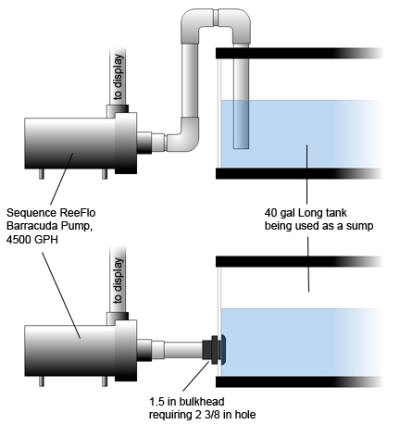
5/13/10 Re: New Tank Setup Questions, Pb 4/24/08 Scott V, Thank you for your advice. You don't know how much this help a novice like me. <You're welcome. Thank you, it is nice to know this has an impact!> I hope you can help with the following questions. When it comes to plumbing a drilled tank....I want to get expert advice on this as I don't trust my own knowledge. Well, I have zero knowledge about plumbing. <You will learn, quickly.> My tank drain hole is 1 inch. I assume the bulkhead will be one inch as well. <The two cannot be the same. The hole in the glass is very likely 1 ¾' which gives you a 1' throughput for the drain.> The refugium sump has 1 inch inlet. The refugium comes with a 3' flexible hose. Do I just secure the flexible host to the drain bulkhead and the sump inlet with clamps? Or do I need some special glue\sealant for this job. <You will need to clamp onto a short length of PVC pipe that is bonded into the bulkhead via a PVC solvent.> For the return, I will have a Mag 7. I want to put in a ball valve like you suggested. What is your recommendation for plumbing the return? <One ½' return for this flow. Over the top with LocLine near the surface will give you adjustability and the smallest transit volume (water that flows into the sump in a power outage) possible.> The Mag 7 has a 1/2 inch MPT outlet fitting. Do I get a 1/2 inch ball valve with a female thread? <You can, yes.> How would the return line vinyl tubing connect and secure to the ball valve and to the tank return line bulkhead (which is ¾ inch)? With clamps??? <For the ease of things you can reduce the bulkhead down to ½' with a PVC reducer bushing. As far as connecting the tubing, you can get PVC hose barbs that will screw right into the fittings.> My confusion is in the different in the size of the pump outlet and the return line bulkhead fitting, and also confusing about how to make everything leak proof. <Valid concerns. Do go down to your local hardware store and familiarize yourself with all the fittings and adapters available. This will clear the confusion up quickly for you.> Thank you so much for all your previous advice. Kind regards, Mick <Very welcome, have fun setting up, Scott V.> Plugging Drain Holes in Tank 3/22/08 Hi, <Hello> after looking around for quite a long time for an answer to my questions, I was unable to find it? so I figured I'd shoot you guys an email. <OK> I bought a 135 gallon Oceanic Reef Ready tank today?.. only problem is that I'm using it for freshwater and am not going the way of the wet/dry. So, I need to cap off all four holes (it's a dual overflow). So, if I connect a 1 or 1 ½ inch (depending on the hole) piece of PVC pipe to the bulkhead and cap the piece of pipe off, is that all I need? <Yes, this will do the trick. You can also plug the bulkhead directly with a PVC plug.> Or do I need some sort of valve on there? <No reason to.> Also, the overflow boxes will be useless once I plug the holes? They are huge and very unsightly. They are fixed to the back wall of the tank with silicon. Can I just take a razor blade and cut the boxes off, or are they needed to keep water pressure off of the bulkhead/cap? <Cutting the boxes out will be fine, although a pain. Just be careful of the silicone seals where the glass panes meet. Try to disturb as little there as possible.> Thanks guys! <Welcome, have fun, Scott V.> Re: Plugging Drain Holes in Tank
3/22/08 Hi, <Hello again.> Let me start off by saying I am
completely and hopelessly lost at the moment. <We will fix that.>
In my last email I sent you, I had bought a 135g Oceanic Reef Ready
Aquarium. I needed to plug the holes because I am using it for
freshwater and will not be running a wet/dry. I decided to attach to
each threaded bulkhead a piece of PVC piping and then cap off the
piping using a threaded cap and Teflon tape. <A fine way to do
it.> However, I went to a few different hardware stores, and I
couldn't find any PVC that would fit. The threads are different on
the bulkhead than they are on the PVC. I am now completely lost as to
what I should do. Is there some sort of special PVC I should be using?
<The PVC fitting or pipe you are looking for will go into the
bulkhead. Be sure you are going inside the bulkhead, not threading on
the outside. The outside threads are made for the bulkhead nut and are
very rarely compatible with pipe (PVC) threads.> Also, the overflows
are siliconed into the tank. Am I able to take this out with a razor
blade without damaging the tank seal? <Yes, the main seal is the
silicone that actually sits between the panes of glass, you will not be
messing with this.> Thank so much! Greg
New 120 Gallon Setup For A 'Pre-Drilled' Newbie -- 10/08/07 I'm a long time listener, first time caller..... <<Welcome>> I recently acquired a 120-gallon tank with stand and am in the process of plumbing and painting, etc. <<Neat!>> This is what I have done so far and I would like some input to see if what I have done is going to fly or crash. <<Always happy to proffer an opinion...>> The tank has the typical 1-inch and .75-inch through fittings in the bottom. <<Mmm, yes...two of each?>> I have built Durso type standpipes with 1.25-inch PVC in which the bottom of the intake is approx. 4 inches below the overflow (water surface). I ran a calculation on that level and if I have a power outage, the sump will not overflow. <<Excellent>> The returns will remain .75-inches and will be piped to both sides and back of the tank resulting in approx. (6) .5-inch outlets with a directional jet opening on each. <<I see>> Opposing flow patterns is what I am going for here. <<Understood... and will require a return pump capable of providing at least 2400gph (1200gph if the two initial returns are pumped separately) AFTER head loss in order to provide enough useful force/flow/volume to each ½' outlet. This is MUCH MORE than the two 1' drains can handle (figure about 600gph combined). Best to configure a 'closed-loop' if you wish to use a return manifold with multiple outlets>> Under the tank, both 1.25 drains lines will remain independent and both drain into the sumps bio box lid. <<Mmm, if the throughputs are 1' like you stated earlier, then this is your maximum drain/flow capacity>> My filter and sump are approx. 45-gallons. My return pump is a Little Giant 4-mdx? something rated at 1000 gallons at 6 feet of head pressure. I ran a flow rate computation on all fittings, pipe, etc. and came up with a corrected flow of approx. 750-gallons per hour. <<The computations are great for planning purposes, but I'm sure you realize you can only get a real value for the flow rate by firing up the pump and timing the fill of a vessel of known volume (e.g. -- 5-gal bucket)>> On the output side of the pump I would like to make a manifold with ball-valves <<Gate-valves provide much better control/finesse>> that will divert a part of this return water to a small refugium <<You can do this (though flow adjustment becomes a constant struggle due to changing flow rates from bio-film buildup, etc.), but it is best to bleed water from a return line to feed unprocessed raw tank water to the refugium which then gravity drains to the sump's pump chamber to maximize transfer of refugium biota to the tank>> as well as a UV sterilizer. <<But for commercial applications, I feel these units are superfluous, with little value versus maintenance/upkeep. Better to invest in/apply ozone via the skimmer...in my opinion>> And return this water to the display tank through a 1-inch line, "T" it off under the tank and reduce the line to the standard .75-inch fitting that fits the through fitting in the bottom of the tank. <<Huh!? As in via another pump in the refugium!? Bad idea...>> The manifold on the pump exit side could also have an auxiliary exit to pump water back to the sump directly if I end up with too forceful a flow at the tank level. <<I would simply install a gate-valve on the output side of the pump to temper flow if necessary>> Does this set-up seem to be realistic in terms of performing? <<Nope...as already stated>> Any and all suggestions would be appreciated. This is the first pre-drilled tank I have owned so this is new to me, but I have learned everything I know from watching this forum and web site...it has been an eye opener for sure. Thanks, Chip <<Chip... Do mull over my responses and get back to me with your questions...as well as more detail re your refugium setup as I think this is a problem (at least as I understand it now). Regards, Eric Russell>> Drain Pipe Diameter 11/3/05 I just started reading your site and have learned quite a bit in a short period of time. You mentioned going to Reef Central for calculation of drain size. For 1200 GPH they recommend 1.43 inch minimum drain pipe diameter and 18 inches of linear overflow size. <I'd recommend at least two 1.5" ID diameter lines for 1200 actual gph flow> In the various responses to articles you seemed to recommend for a 120 gal tank and the above flow rate 2 overflows with 1" to 1.5" of drain diameter. I know that more is better but could I get by with a 6" x 8" center overflow box and one 1.5" drain or do I need to go to a 2" drain. <The two inch> I don't want to put more than one drain hole in the overflow because I want to use a Durso or Stockman standpipe and having 2 in one overflow makes it more difficult to debug problems w/ the standpipe. Also, both Durso and Stockman only offer the standpipe for a 1.5" bulkhead. <You can make these...> 2" may be too large for a standpipe. <... uh, no> Having one center overflow will make it easier to design and build a closed loop manifold so I don't have to go around to corner overflows. <Understood> Thanks for your time <Thank you for your participation. Bob Fenner> Closed loop system question 11/24/05 After reading pages of your FAQ's and related posts on a closed loop system, I'm convinced! Will attempt one for my 65 gal w/25 gal fuge. I'll use a Mag 9.5, head is about 5', return pipe 1" from sump section of fuge. Question: Wouldn't a 3-sided rather than closed loop work? <As in... three discharges instead of more? Okay> More water flow, all aimed toward center of tank? <Better for this to be more complexed, multidirectional> Also,--if system is just below water level, even if jets are aimed a bit lower, wouldn't the movement of water near the bottom of a 24" deep tank be rather sluggish? <Yes... better to aim some discharges toward the bottom...> How is this negated? <Nozzles, elbows...> Could I run some PVC down lower, vertically, off the main manifold at the top? <Yes... though do bear in mind the possibility of water siphoning out... should there be a break in the lines behind/below the tank> This forum has been inspirational, to say the least. Thanks..... Barry <Thank you. Bob Fenner> Plumbing Insufficient Throughputs - 03/09/06 Hello all! <<Hi Kristen!>> Thanks for the great work. I am now on to the task of plumbing my AGA 72 gal bow with the horribly insufficient overflow. <<Mmm, yes...>> It has the standard two holes. one to drain, one to return. <<And both too small...>> Not enough to do different types of corals (hubby is still determining his wish list). So I am considering some other options for getting more flow without drilling more holes in my tank. I have some thoughts...tell me which you would choose or add one of your own. <<Gladly!>> 1) Current system has the drain going down to a 3 section sump and returning w/what will be a Mag 9.5 (gate valve needed here). <<Indeed! That single 1" drain is going to limit you (practically speaking) to about 300-350 gallons per hour.>> Overflow is 1" and return is 3/4". The return y's at the top and has 2 loc lines. one going to the front of the tank and one to the back. I could keep this as is and add a closed loop system similar to Melev's 29 gallon (not sure if I would go with the pump in the tank or out of the tank yet though) <<Don't think I care for this.>> 2) Make both holes in the overflow area drain holes. <<This is what many folks do.>> In this configuration I could either drain both right into the sump with one return via a manifold or make one flow into the sump and one into a closed loop system. I haven't really seen this mentioned on your website but I have not read every single page. <<Quite do-able>> I also haven't sat down and figured out what my flow would be...I suppose if it's still not enough flow it's sort of pointless to do this. <<Hmm...the closed-loop on the 3/4" drain would use/require a pump with the same size intake...this will indeed limit choices/flow.>> 3) Just keep as is and use powerheads (said with a sigh and head hanging because we are having so much fun with PVC). Thanks in advance for your sage advice! Kristen <<Well Kristen, given the choices you've outlined I would go with option #2 with some minor modifications. If I may... I would drain the 1" bulkhead to the sump and return this to the tank, over the back, with a smaller pump (Mag5/7 depending on head height, plumbing angles, etc.) and/or gate-valve striving for a flow rate of about 300-350 gph. I would then plumb the 3/4" bulkhead as a closed-loop (not through the sump!) using the Mag9.5 pump you already have. With any luck, this will give you an overall flow rate of around 10x-12x the tank's total volume. Regards, EricR>> Plumbing Insufficient Throughputs II - 03/09/06 One quick question...would I eliminate my need for all of this by getting the Wave 2k? <<This is another alternative, yes.>> I am seriously considering this and will be putting a call to them regarding rock placement in reference to the placement of the machine. Just another thought. Thanks again for your response!! <<Welcome, EricR>> Re: Tank re-drill Aloha <And to you> Thank you so much for the advice. I actually just finished figuring everything out without having to redrill the tank (I simply don't have the space in my overflow for the flange on a bulkhead that size). <Mmm, could just come over the side/top> I guess I was a little too excited to wait since Am nearly on the verge of having my tank set up again( its been way too long). I figured I would at least email you and tell you what I did to make it work. <I stated the easy options...> Never know I might have done something right that others could read this time. What I did was really just a few small modifications. To handle all of the 2400gph of overflow I used my return holes which are also in my overflows) to be Durso style drains as well. So I now have two 1.5" drains and two 1" drains. I rerouted my return up behind the tank to get to the return holes on the tanks top. My returns were only 1" so they didn't give me a huge amount of extra overflow but every little bit counts. <Yes> I also did lower my standpipes. Upon better inspection I found they couldn't have been more than an inch under water level. <Very common... and safe/r should the power/pump fail... in terms of transit volume... and a rate-limiting factor for sure... many folks seem to have some notion that somehow water is magically "sucked out" once reaching the level of such overflows.> They are now at three inches below. I also tore out all the plumbing underneath the tank. All those elbows and other fittings I figured were slowing flow down. I instead replaced all of them with flexible pvc pipe. As for the aspiration of the drain lines...(I don't know if this helped but I did it anyway) <Does help. Both for flow increase and noise reduction> I installed small tubes at the tops of the stand pipes going down almost to the bulkhead and at the end of the drain lines both submerged outputs now have small 3/8th holes just above water level to let out a little more air. Worked like a charm. Am betting the two extra 1" drains along with the flex pvc for better flow had the most to do with its success. It handles the pumps output now no problem. Of course, 2" overflows would have been much better but it is a little bit of trouble taking a 240 gallon tank down to the shop and there always the fact that they wont fit. So once again I really appreciate the advice you gave me and hope you at least get some good diving in while in Thailand. Tank care! -Chris Mahalo nui loa <Thank you for this follow-up and report of your success. Terima kasih. BobF> Proper size for PVC return 6/10/04 Sitting on the fence -- give me a push Hello all, I have conducted research on plumbing my new aquarium and have found conflicting advice (go figure). I desire your varied opinions. In plumbing an Iwaki 30rlxt (1' input and 1' output) with approximately three 45 degree elbows, one 90 degree elbow, 1 foot of horizontal run, and 5 feet of vertical ascent, should I use 1' or 1.25' PVC for the output? <either will be fine... the difference is negligible> The research indicates that the more elbows and horizontal run I have the larger the diameter the better; but the weight of the increased volume in the larger diameter pipe increases back pressure in the vertical run thus potentially negating any benefit. A call to Iwaki customer service left me believing it was a toss up. <I agree completely> Thanks, Mike the neurotic <that may be true too ;) Anthony> Plumbing intake questions If you don't mind I just have a few questions. I just want to make sure I get as much as I can right the first time. Also thanks for the quick response on the last questions I asked. My current equipment and setup...... - I have a 1" bulkhead on my sump. - I have a 3/4" return on my tank. - I purchased the Panworld/BlueLine 100PX-MD40R 790gph with 3/4" MPT in/out My questions are if I reduce the 1" bulkhead from the sump with a 1" x 3/4" reducer so that I can run 3/4" PVC from the sump all the way to the pump intake will that cause any issues? Or will this be OK as the pump only has a 3/4" intake opening. There will also be a Ball Valve and Union in the run. The reason I am wondering is because the 3/4" pipe will fit a lot easier with the room I am working with. Also I will be keeping the discharge/return of the pump at the 3/4". Thanks for letting me ask these questions as an experts advice is always welcome and a great resource. Hi, Your setup should work just fine. Depending on the output of your pump, you do in theory get less GPH with a 3/4" vs. a 1" return, but not enough to cause any issues. I did the same thing you're about to do on my latest tank. Jim Plumbing Basics- HI :) <Hello! Ryan with you today> Thanks for all the great info on your site-it's awesome!! But, I think I'm a bit overwhelmed. <It happens!> I will be ordering a 65 gal( 48x18x17) with one back center overflow box and need to know where to have them drill the drain and how big to size it. I have a 29 gal(30x12.5x18) DSB sump with about 4 ft of head between. So'¦. If I need a flow rate of 1100gph(??), what size pump do I need if I have a 1 ½' drain?? <3/4 or 1 inch> Do I have them drill it in the bottom panel for a stand pipe?( straight down means less noise right??)<Yes, in some cases. You'll have to tinker with it to eliminate "slurping."> or the top back panel? safer if I don't trust the overflow box not to leak?) <Yes, also a possibility.> Also, is it safer to drill two 1' drains in the same overflow box? in case one gets clogged or perhaps a drain to a future mangrove refugium) <Yes, but I'd recommend you to feed a refugium with a bleeder from the return, to prevent flooding.> This is too much like the SATS--I think my head is spinning!!!! <Ha! Geometry DOES come in handy...> Aquariums seemed like such a relaxing hobby <So they say...Diagram your plumbing out, and send it in. I'll have a look and make some suggestions.> ;) Dazed and confused, Jennifer <Half-Baked, Ryan. Just kidding.> - Overflow and Water Level - Been searching at the FAQs but to no avail.. a quick question here.. how do I set my desired water level at my display tank? I have two choices re-over flow; 1.) a hole drilled at the lower back side that can hold 2" PVC ending a stand pipe; how tall should be the standing pipe in order to achieve at least 3" water line below the top edge? <How tall is the tank? With a setup of this type, the water level will be just a quarter inch or so above the top of the standpipe. So... you can trim the standpipe to adjust the water level.> 2.) a 2" bulkhead drilled at the back; how far from the top edge it should be drilled to get water line same as no.1? <Again, where you put the bulkhead will determine the water level... in this case you can bet that the water entering the bulkhead will be at least half its diameter, perhaps a little more.> waiting for your help, again.. thanks! -Arnold <Cheers, J -- > Plumbing Question I am planning a new 125 gallon tank and have a plumbing question that I cannot find the answer to in you comprehensive archive. I want to achieve 20 times flow, so have special ordered a tank with two overflows with 1.5 inch drains and 1 inch returns. I would like to use the Dolphin Ampmaster 3000 that has 1.5 inch fittings in and out. Instead of running all of the flow through the sump, I was planning to have one drain go into the sump and the other connected by a tee fitting right at the pump intake, essentially making that overflow a closed loop. After leaving the pump, I would tee off the 1.5 inch line and reduce the pipe size to 1 inch before returning to the tank. Will this work or will I need a valve on the "closed" portion to ensure all of the lower head pressure sump water is returned at the same rate it drains? <Mmm, let's see... you're planning on using the one pump to draw water from both the sump (that is gravity fed I take it) and one of the 1 1/2" overflow fittings? If I understand you here I would not do this... for a few "reasons"... principally the likelihood of a power outage, pump failure... that would drain the water down through the pump and overflow lines... and depending on the size of the transit volume sump, position of the through-puts, over on to your floor... I encourage you to draw all this out, including plumbing, fittings, valves (I would have these before and after the pump/s) to facilitate their manipulation/removal... and a large sump, possibly another as a refugium (low flow)... Whatever pump you end up with I would NOT reduce the discharge of the line size from the volute. In all likelihood you are looking at using two pumps... perhaps one can be used for the sump/s and protein skimmer... Bob Fenner> Pump(s) for a Oceanic 200-gallon RR FOWLR Aquarium, actually overflows, pump/plumbing considerations Hello, <Hi there> Hope things are going well for you guys and gals. Please give me your recommendations for a pump to return water from my sump to a FOWLR aquarium. The Oceanic Rep. States the aquarium has a flow rate of 1400/2000 gph. The 2-return lines to the aquarium will be 3/4" PVC pipe and the drain lines will be 1" PVC with Durso Standpipes. <Uhh... two 3/4" inside diameter lines? I think the estimate of how much flow you can realistically expect from these fittings is dangerously over-expectant... Hear me out please... I would NOT design, install or maintain a system that did not have at least fifty percent redundancy in provided capacity here... that is, for example, if one drain line would do, I'd have two of the same size... You do NOT here... depending on how you rig your plumbing, what sort of screening you have over these two drain lines, you can be in GIANT trouble in short order... should one become occluded. DO consider your options... if it were me, my system, I would have it (re)drilled for at least two 1 1/2" inside diameter overflows (2" holes)...> Presently my options are to use 2-Iwaki MD30RLXT pumps (960 gph @4') with the outlet reduced from 1" to ¾" or to use 2-Supreme Mag-Drive 12 pumps (950 gph @ 6'). <Stop! Do NOT reduce the discharge diameters... and please show this correspondence to whoever has been encouraging you to do so... what you are suggesting is akin to buying an automobile with excess horsepower and driving with the parking brake on... don't reduce the diameter of the plumbing from your volute/s. Again, if necessary, have the available hole/s re-drilled> The overflows are located on the corners of the aquarium. I am looking for pumps that are quiet, efficient, and dependable (who isn't, right). Should I use higher flow pumps and throttle-down the flow with gate valves or will that hurt the pumps. <Might... will increase waste heat production, your electric bills> I was also told I could add two more return lines to run along the back of the aquarium and use a larger pump. If you know of a better option, please suggest. The system will also have a refugium and Euro-reef Skimmer. This is the correct flow path, water to protein skimmer, to refugium, to pump, to aquarium or water to sump to protein skimmer, to refugium, to pump, to aquarium? Using a refugium will be new to me. <Mmm, a bunch to say. First, please read through our archived FAQs on Pump Selection: http://www.wetwebmedia.com/pumpselmar.htm and the linked files (above, in blue)... then the MANY FAQs on Sumps, Refugiums... you can find them indexed here: http://www.wetwebmedia.com/marine/setup/index.htm You DON'T want to run this much, all the water through a refugium... maybe you can fit another sump for transit volume... Bob Fenner> Thanks, GDG Re: Pump(s) and through-puts for a Oceanic 200-gallon RR FOWLR Aquarium Hello Bob, Thanks for the reply and I told the LFS to call Oceanic and hold my aquarium because I need the holes drilled larger. <Ah, very good> I have been reviewing the posts on the website and I thought I had it correct for the aquarium set-up. The flow set-up I was going to use was the one included in your "Plumbing Marine Aquariums" article on the site that has a picture of the refugium. I will have Oceanic install three overflow boxes in the aquarium, on both ends and one in the middle. The drain holes will be 2" drilled and the return holes drilled 1 3/4", thus having 3-1 1/2" PVC drains and 3-1" returns. I will redo my plans for the Euro-Reef skimmer CS (12-1), sump size is not determined as of yet, and 58-gallon refugium. Your comments are greatly appreciated. Could you recommend so books that could be of help with FOWLR, I have your book already? Thanks again. GDG <Anthony Calfo's "Book of Coral Propagation" and our "Natural Marine Aquariums, Reef Invertebrates" books, though sounding like they are strictly "reef" would be of good use to you... mainly to further firm up what you already know intuitively, and will want to know soon. Sorry if this "plug" seems overly self-serving, but these indeed are your next best sources of input. They may be available at a local library. Bob Fenner> Tank plumbing Greetings Crew! I am in the process of upgrading my 40 gal tank to a 75 gal (w00t, yes...) and have a couple of (nagging?) questions. I have read, read, and re-read countless articles you have on the WWM archives re drilling the new 75gal acrylic tank. I have drilled the overflow (2" through put) (center overflow) <I'd make at least one more.> but am still undecided (hesitant?) to drill the returns. The tank itself does not lend to the non-drilling (pump -> t-bar -> over tank output) type of return, so it must be drilled. Currently I'm thinking of having my Iwaki WMD30RLXT (1" output) branch off to 3/4" t-bar to 4 returns (4 return holes in tank). I know that 2 of them will be on the outside, and high up (re power outage/siphoning), but the other 2... I *was* thinking of placing them on the same plane and just have them pointed more downwards in the tank for circulation purposes. Should I maybe consider another approach, what would you do if this were your tank? Thanks as always, Craig <Your approach is a good one... if you wanted to, you could drill just the two holes for two discharges each, tying two each together inside the tank... Bob Fenner> Overflow Question Hey crew, I was just reading over the dailies and came upon one titled "Overflow Dilemma", and that's when it happened. I had an idea. The person writing the question wanted to drill overflow holes in the backside of his tank. I was already planning on buying hang-on overflow boxes that use a siphon. My idea is to use 4 modified Durso Standpipes, as seen on Durso's website for external overflows, going directly through the back of the tank, instead of the overflows. They would be spaced along the back of the tank at the same level. I would also use the egg crate "screens" on the standpipes to keep debris out. Would this work? I'm thinking it would, if I maybe upsized the sump I'm planning on using? <Perhaps. Easy to do if you provide some "true unions", perhaps some flexible tubing in your install> This could save a bunch of money! Please let me know. <Does sound like a much better arrangement. Bob Fenner> Plumbing a 90G tank WWM Team, <Hi Mark, Don here today> First of all, I just want to say thanks for taking the time to respond to people's emails and by doing so building an incredible database of info (you may even want to publish a book of Top 500 FAQ's). <'Tis a labor of love!> Anyhow, I have a 90 gallon tank that I want to drill (I have such a fear of my tank/sump overflowing that I won't do anything until I feel comfortable with water overflow). <Could not agree more, siphon overflows are a disaster waiting to happen> I live on the 15th floor of a condo building so I don't need upset neighbors! Anyhow, I am just curious if you happen to know of any places in Manhattan (or close) that would come to my place to drill the tank? <No, but you might post the question in our forum at www.wetwebfotos.com/forum> I plan to talk to my LFS and browse the yellow pages but thought I would throw the question out there in case you know of a reliable person. Also, I was planning on having 2 or 3 overflow holes drilled even though I only have a 500 GPH pump but I'm planning now for future growth. Is 2 or 3 enough? How big should they be? I'm assuming I can "plug" the ones I don't need at first? <I would <<not?>> plumb with anything less than 1.5" pipe. You will have to get the bulkhead you need and then drill to fit than. Something like 2.75" if I remember right. You can make the decision but I would drill at least 3 maybe 4. Better to over design. If necessary, you can plug the drains you don't need.> Thanks in advance for your time. <You are welcome, Don> Mark Plumbing question (overflow and return) Hi WWM crew, <Hi Isaac, Don here today> I am in the planning stage of my new 180 gal reef system. I am moving to a new house in 2004 so I am starting my design drawings now. <OK> I plan to have two overflows where water leaves the main tank, for redundancy. How big of a opening do I need for each overflow? <Minimum 1.5". I would plan on 4 or 5 across the back> I also plan to have holes drilled in the back wall of the tank, rather than on the bottom. The overflow will just consist of a bulkhead fitting, with a strainer on top to prevent stray snails from plugging the pipes. No overflow boxes. I think this provides me with the cleanest look without taking any real estate. A crude ASCII drawing is below if you see what I mean (equal-space font recommended, such as Courier): side view +-------+ | A | v | | | | | +----+--+ | | | | | | +-------+ To sump Where the "A" is the strainer and the "v" is a hole on top of an inverted T for a vent hole. Do you see any issues with this design, in terms of noise, surface skimming or other issues? <I would put in an overflow box the length of the tank. See here: http://www.wetwebmedia.com/plumbingmarart.htm. I would also make sure there is enough room for a Durso Standpipe to eliminate noise. Search with google to find plans for these standpipes.> Now to my return lines. See following diagram: side view +-------+ | | v | -----+ | | | | | | | +--+ | | | +-------+ From sump I plan to tee off a vent hole "v" to the side of my return line to prevent back siphon in case of a power outage. Do you think this will work? Will the return water shoot through this vent hole? <Oh, yes, you will have a real nice fountain out the top. Do not do this. This is another reason to have an internal box to help control the amount of drainage during power off.> Thanks in advance. Keep up the great work and contribution to this hobby. <Thank you, Don> Isaac Reef Plumbing - 8/27/03 Anthony, I have absorbed almost all I can on the website, plus all the questions you all have answered so graciously in emails. I believe I have all the kinks worked and am looking to make sure there aren't any more flies in the soup (I've had a few). 10 months of research and I still don't have all the answers *sigh* The tank is a 90G glass with a 29G Sump that will house the AquaC EV-240 PS, 2 250W heaters, etc. I found a diagram that you had posted about reef aquarium hardware and am going to use an internal skimmer box that spans the back of the tank. It will be plumbed with 4 2" bulkheads that drain into the sump. <excellent> The water will be initially returned by an Iwaki MD70RLT (you talked me into it), but the sump will also be pre-plumbed for another Iwaki (55 or 70). The second pump will be added 6-9 months after the "above the display tank" (your very convincing) 29G refugium is complete to make sure it has time to mature producing ooooodles of zooplankton before corals are added. <heehee... it will pay off my friend :) > The second pump should increase the flow rate to ~2000-2400Gph @ 6ft. Each pump will be split for 3 return lines that will be routed through the canopy and have swiveling 45 degree elbows just below the water's surface (4 corners 1 middle front and 1 middle back). I had initially thought about just getting an Iwaki MD100RLT, but I like the redundancy. Comments? <agreed... the redundancy is good. Also... see here for a manifold description: http://www.wetwebmedia.com/pbh2oret.htm > The only other thing I have a question on is who should I graciously mail the check to? haha. Thanks once again for everything and I'm sure we'll be talking again. Jeremy <very welcome my friend... best of luck! Anthony> Reef Plumbing - 8/28/03 Ok Anthony. The inevitable has happened. I have discovered 2 more questions since your last response. <all good :) > How far should the internal skimmer box be below the top of the tank? <just low enough for comfort/safe running... likely around or not much more than 1-2" from the top of the tank. The running water level will only be 1/4" or so over that> I also read your article on the manifold setup u gave me the link to (excellent informative reading). <thanks kindly> When I plumb the tank will there be any problems that you foresee by hooking up both return pumps to the single manifold? <hmmm... I'm not trilled about it... does complicate matters slightly. If both pumps are plumbed at the same height on the same sump... then OK. Else, it is not recommended> I also anxiously await the arrival of my copy of "Reef Invertebrates" Once again thanks to you, Bob, and the whole crew for the amazing wealth of knowledge you so kindly share with those of us wishing to increase our understanding in this amazing hobby. Jeremy <best regards! Anthony> - Plumbing Question - I have a 180g reef ready Oceanic Tank that is going to be a FOWLR, the manufacturer claims that the supplied bulkheads should allow for 1800g/hour flow. <Have owned this tank... 1800 GPH is approximately true.> After reading several FAQs this does not seem realistic, the return bulkheads (2, one in each rear corner) are 3/4" ID and the drains (2, one in each rear corner) are 1" ID. Do you think this is realistic, I would like to attain this 1800g/hour flow. <Keep in mind that a this flow rate will be noisy. Better to get decent turnover - I used an Iwaki 40 [1,200 GPH] and then relied on powerheads in the tank to boost the circulation for the organisms in the tank. Much more quiet this way.> I am looking at using a Dolphin AMP Master 3000 or 4700 which I would reduce to the size of the bulkhead fittings right below the bulkhead. I was also thinking of the possibility of using the teed return manifold and using all 4 bulkhead holes as drains, If you think this is a better idea what size pump would you recommend and what would you recommend for plumbing (tubing size etc.). <I think this would work... could add probably another 500-600 GPH per 3/4" fitting. Keep in mind that you still have to pass water past the slots in the overflow towers which will become a limiting factor. I'm pretty sure the 1,800 GPH rating takes this into account.> I was thinking of running 1.5" pipe to the top of the tank and then reducing it and splitting it into either 1" or 3/4" pipe with 3/4" tees to direct the water. <You could do this or build a manifold that distributes the water at several places along the water line - many options open to you here.> I know this is a lot and not necessarily coherent but I would appreciate any help you can give me. Regards, D'Wayne <Cheers, J -- > -180 plumbing query- I have a 180g reef ready Oceanic Tank that is going to be a FOWLR, the manufacturer claims that the supplied bulkheads should allow for 1800g/hour flow. After reading several FAQs this does not seem realistic <Actually, it probably is. We run a 180 Oceanic at the shop at around 1500gph and the water levels in the overflows are still very shallow.>, the return bulkheads (2, one in each rear corner) are 3/4" ID and the drains (2, one in each rear corner) are 1" ID. Do you think this is realistic, I would like to attain this 1800g/hour flow. <I would say so, but install a gate valve on your pump just in case> I am looking at using a Dolphin AMP Master 3000 or 4700 which I would reduce to the size of the bulkhead fittings right below the bulkhead. <Have you checked out the pump curves on these guys? Even after a T and a few elbows, this may end up being too much for the tank to handle.> I was also thinking of the possibility of using the teed return manifold and using all 4 bulkhead holes as drains, If you think this is a better idea what size pump would you recommend and what would you recommend for plumbing (tubing size etc.). <If you really wanted to go wild with the return this would be a viable option, but I'd keep it below the max since who knows how high the water level in the tank will go.> I was thinking of running 1.5" pipe to the top of the tank and then reducing it and splitting it into either 1" or 3/4" pipe with 3/4" tees to direct the water. I know this is a lot and not necessarily coherent but I would appreciate any help you can give me. <No worries, and very coherent! I think the amp master 3000 would be a bit much for this tank. Big dolphin pumps, IMO, are best used on a closed loop that by-passes the overflows. Check around the forums for ideas on intake manifolds as well as return options (sea swirls!!!). I would pick a good sized return pump that wouldn't go over 1500-1800 gph after you have taken into account all the head pressure (elbows, t's, height, etc). I hope this helps! -Kevin> Regards, D'Wayne Plumbing Dilemma... I just acquired a 70 gallon reef ready tank . its got 3 holes on the bottom of the tank and 2 on one of the ends about 2/3 to 3/4 the way up. I have two canister filters and I'm not sure how to plumb this set up. As of right now I'm not sure if I'm going fresh or salt but I've got to get this plumbing thing figured out. <The fun part...LOL> Should the return lines be on the bottom of the tank with check valves in case power out age? <Frankly, check valves scare the hell out of me! They are vulnerable to failure...at the most unfortunate times... I'd prefer something above the water line, like Sea Swirls, which have the added benefit of oscillating water flow...Neat stuff...> And the line feeding into the pumps be the ones on the side? I just can't find any info out for this kind of tank. <Well, there are about as many approaches to tank plumbing as there are hobbyists...No real right or wrong answers...Just do what works or you, and remains reliable and functional...> I'd really appreciate your help , and maybe I'm way off , any suggestions ? <As above...check out Sea Swirls for returns...> I'm lost. Thanks. Sean McConnell <Well, Sean-there are lots of approaches here...you can look into plumbing on the WWM site...lots of good information here- check it out! Good luck! Regards, Scott F.> Plumbing question Hi, I have a small problem and I came across your site. I can't trust my local pet store I feel they are lying to me and ripping me off. I have a 90 gallon reef ready tank and an Amiracle SL wet/dry filter. I have had it in storage for a couple of years, and I've seemed to have forgotten how to connect the filter to the tank. The pet store is telling me I am missing a part and will need to purchase a $70 replacement kit. Knowing that I only need ONE part they are encouraging me to buy the whole kit. The worst part is I'm not sure what part I'm missing so I can't order the part through the Doctor's Foster & Smith catalog. They are telling me that the part I'm missing connects the white flex hose to the male end PVC pipe that comes out from the bottom of the tank. ANY help you can give me will be so appreciated. < hi, it is kind of hard to understand what you mean with out a picture, on the bottom of your tank you should have 2 bulkheads (they are black and go through the hole in the bottom of your tank. Out of this bulkhead you said you have a piece of pipe. If it is an All glass or oceanic tank it will be 1"pipe)to connect your hose to the pvc pipe you will need a coupling they sell them at home depot in the plumbing section. you do not need to buy the whole kit .take the pieces to the store with you and they can help you. Later MikeH> thank you in advance
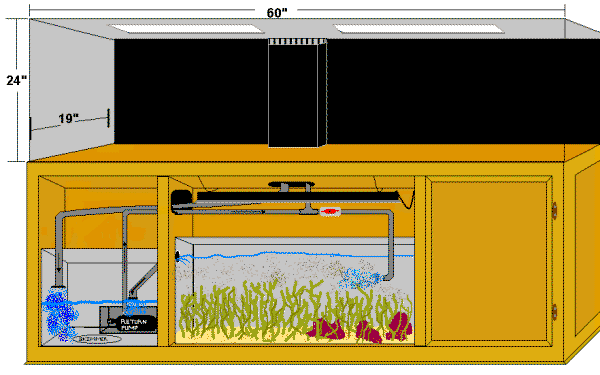
- Plumbing the Overflow in a Small Tank - To the experts, Please help I'm going nuts! I have searched the web site for hours and cannot resolve my plumbing problem. These are the basics. 30 gallon tank with a 10 gallon sump. DIY overflow (2 lees breeder boxes) 3/4 U pipe and 3/4 bulkhead fitting. 3/4 tubing down to sump. Return back to the tank is as follows: Mag 5 pump to 1/2 in. tubing to a Y fitting to 1/2 in. tubing to 1/2 in. 90's with Line lock fittings ending in the main tank. Now to the problem. I can't run the Mag 5 full open unless I remove the Durso stand pipe I've installed in the over flow. I have made 3 designs with the same results. All are design's from Mr. Durso's web site. All are based on 1 pipe size larger than the bulkhead, meaning they are constructed out of 1 in. pipe tee's, 90's etc. . I even made the straight 1 with out the Tee. All with the same results. Also can you help me out with flow rates with a 3/4 bulkhead and a 1in. bulkhead in my situation? <Hmm... think you are suffering from a couple of issues - first, I'm pretty sure the outlet of that pump is 1/2" which means that you are not restricting the pump when you use 1/2" plumbing which in turn means that the pump will perform at the rated flow. So onto the bulkhead - I think the maximum flow rate for a 3/4" bulkhead is 1,000 GPH, but not sure what the standpipe would do to change that - you might want to experiment by taking off the top of the Durso, so you just have a straight pipe, see how that runs with the pump wide open and then add the parts one by one until you find the limiting factor.> All help would be greatly appreciated, Thanks from a big fan. <Cheers, J -- > Plumbing Questions Hello Crew, <<Hello Michael!>> I have been reading your Q and A section have found it to be very informative. Thanks for all the good work. I am planning a 300 gallon reef tank and have some questions regarding design/plumbing that I am sure you can answer. The tank will be a 300 gallon acrylic with two overflow boxes - one in each corner. I am fairly certain that the standard drains are one - 1" in each overflow, which I am certainly not crazy about. <<way undersized>>I was considering having the 1" increased to 2" or adding a second 1" inch in each box. <<at least>> The return pumps will be 2-Little Giant 4mdq's with 3/4" returns. In addition to the standard returns, I was considering adding a one inch return out of the sump split with a "Y" (pump unknown at this point) and hooked to two 1/2" or 3/4" lines <<For <sic> SeaSwirls <SCWDs?> of this size, likely 3/4">>connected to appropriately sized sea swirls. I want to avoid using powerheads so I was considering adding one additional draw off of the sump to hook into a pvc manifold with two outlets (gate valved for control measures). One 1/2" line would be hooked to a spray bar along the back bottom of the tank. The other would be a 3/4" inch or 1" return line that eventually splits at a T Ball Valve electrically controlled by Aquacontroller or similar device. <<Size plumbing to the valve needed>> The T valve would split into two returns - one for each side of the tank (probably returning through the bottom of the overflow box and out the side of the overflow into a centipede splitter) to act as a wavemaker. While I think I have some good ideas, I am not sure if I can draw all of these lines out of the sump or how to size the returns, predict noise levels, which line to run through the skimmer, chiller etc. Should I bag drawing the additional lines out of the sump and use a typical closed loop system. If so, what size lines should I use out of the back of the tank, where should they be located, what pumps would you recommend, etc...??? I want to nail down the plumbing ideas so I can have the holes pre-drilled etc. Any ideas would be greatly appreciated. Thanks Michael <<Wow! Lots of goodies! Your turn over (10x tank volume minimum, can be more) is the base figure. It appears you need to size the returns to a minimum 3000 gallons per hour. To get a good idea of the size plumbing and overflows to do this you can see how overflow box manufacturers size their pipe, then go the next larger size. (check out web sites carrying overflows) My own personal experience is to go larger on the overflows and use Durso type overflows for noise reduction. Any vented overflow pipe that draws air from anywhere but the overflow itself will help in reducing flushing sounds which usually come from sucking air with water into the overflow. Flush! Even a small hole will draw enough air and be quiet in comparison to a closed overflow W/O a vent. (Vents work like the roof vents for home plumbing). Then you can size your pumps to provide the needed turnover without fear of limited overflows. As long as there is enough return flow or a dedicated return you can run as many lines off the sump as you have room for pumps, lines, flow to accommodate. My own choice would be to run the skimmer and chiller on their own line, but they could also be run off a line split off the return and valved for proper flow. To sort this out, start at the needed turnover/flow rates and work backward from there, sizing as needed. You won't regret having larger overflows. Don't forget to factor head height in your flow/pump calculations. With the exception of return lines you intend to split (which require larger pipe to accommodate flow) you can stick with pipe sizes matched to pump outlets. Your closed loop/sea swirls design needs to provide enough flow to the SeaSwirls (they have a minimum flow rate to be useful) Make sure if you do this that they get what they need to run. Lots of work and plumbing but sounds like a blast! The pumps you site are good, many choices out there. Too many variables to name brands/sizes, they need to be sized in combination with all the other flow schemes. Again, start at needed turnover and work backward from there. Quite the project! Go for it! Craig>> Return line from sump Hi Bob, I just setup a CPR Overflow (800 GPH) and a CPR Wet/Dry sump on a 50 gal tank. I have it connected to a Mag 9.5(950 GPH). I would like your advice on spray bar design on return line. I would like to drop the two 802 powerheads in the tank and just use the sump pump as water movement. The tank is a fish only, but near future a reef. Should I extend the spray bar from one end to the other with PVC and cut slots in it to dump the water? Thanks Jamie <The PVC idea should work fine, when the tank is converted into a reef you may still need more circulation, it is hard to tell with out the spraybar being set up already. You could cut slots in the PV or drill holes. Check out the links below for more information. Best Regards, Gage http://www.wetwebmedia.com/circmarfaq3.htm http://wetwebmedia.com/circmarart.htm http://wetwebmedia.com/plumbingmarart.htm> Marine plumbing Here's a drawing of the proposed tank layout. The overflow box is approx 8 x 8-1/2 deep for a single 1-1/2 drain. I am targeting about 1500 GPH through this drain (although this may be hard to fine tune since my pump will be in the basement). Any thoughts as to whether the drain should be 2" rather than 1 1/2"? <You won't regret going larger, especially if you decide you want more than 1500 gph later. Will also help with "sucking" sounds from drawing air.> The plan contemplates the use of a Stockman standpipe. (I noticed that R. Gibson asked whether the Stockman was better than the Durso. Were there any conclusions drawn from his query?) The 1" returns on each side of the box will be powered by a single pump with an actuated or motorized ball valve. To me it depends on what fits best. They are both designed to draw air to displace the vacuum which develops at the bulkheads which pulls in air and makes noise.> I like tall vents with end caps drilled with a 1/4" hole. This draws plenty of air and reduces noise through the drain vent.> On each side of the tank is a 1" return and 1 1/2" drain which all be plumbed together as a closed loop powered by a single pump with an actuated or motorized ball valve. I will target about 2000 GPH through this closed loop. <Better up the size of the plumbing/bulkhead to handle 2000 gph. If 1 1/2" is borderline for 1500 gph, this 1 1/2" bulkhead won't handle it either. I would go 2" myself.> I have taken to heart your suggestions about have a second circulation loop from the sump, but there doesn't seem to be an obviously good place for the additional returns and drains. <There never is! Remember, placement of bulkheads just needs to be well below the desired water level, ells and threaded fittings can make the water level adjustable.> Wishing you a healthy and happy new year. <Our best wishes to you as well! Craig> Re: drilled overflow tanks & flow - FOLLOW UP So, you don't like overflow boxes. What do you mean? <The standard ones are generally inadequate for my desired flow rates, they hog up space, they are small and difficult to work inside, etc.> If you drill to your own specs, don't you still need an overflow box? <No, but it is helpful. You can merely use an elbow and strained off of the bulkhead and drain from there, but this does not provide for a very thin surface skimming.> Do you then stick you own overflow, like buying a kit? <I have built a glass overflow box, similar to Anthony's CAD drawing found here http://www.wetwebmedia.com/plumbingmarart.htm There is a PDF or larger GIF file for better viewing.> Are you referring to dislike of prefab tanks? <Prefab overflows. They are like anything that is one size fits all.> And the 1200gph you mention; is that for a single 1" hole? <I assume so, but am waiting to hear from Ralph for confirmation. -Steven Pro> Re: drilled overflow tanks & flow Hey guys/gals and groovy people: After much research and many questions, (including previous discussion below) I am researching an upgrade from my 55 gallon All-Glass standard tank to a drilled overflow in a 55, 75 or 90 (thanks to an unexpected Christmas Bonus!). <Congratulation!> I searched the web and the number of hits is crazy. So a few (hopefully good) questions: 1. Can you please point me in a good direction for tank/stand? <They are all reasonably good. I will say I don't like overflow boxes. I much prefer to drill the tank to my specifications.> 2. Does a 1" overflow allow for 600 gph? <A reader, Ralph Gibson, has done some experiments and reported the results to us. I found one reference in my quick search where Ralph reported an All-Glass overflow as being able to handle 1200 gph. Perhaps, Ralph will see this email on the daily page and respond with the specifics, but really we could use him to write an article on his experiments for us to refer others to (hint, hint)!> Is there a mathematical equation for this? <There likely is, but I don't know it.> 4. If not, how many overflow holes do I need for the 55, 75, 90 sizes, assuming I want the maximum (20x?) flow for the future? <A 55 is only going to come with one overflow box. The 75 and 90 may come with two if you specify. These should be ok.> 5. What size holes for the least possible noise? <The standard is 1" bulkheads in any overflow box.> Thank you very much. Without you (and you, and you), I wouldn't be able to advance with so much confidence! Regards, Rich <Have a great weekend! -Steven Pro> Plumbing a 180g AGA Tank Crew, <Hi Jeff, Don today> I'm ready to start plumbing my 180g All-Glass tank (pre-drilled for 1" and .75" bulkheads -2 corner overflows) to my sump but have a few concerns. <Fire away> I have searched past FAQs on this site and have read that the AGA corner overflows have the capacity of about 600 gph per overflow. My return pump is a Iwaki MD70RLT, so I may not have quite enough overflow to cut it. Is the "weak link" here the 1" bulkhead or the small slots at the top of the overflow wall? <The bulkhead> I have seen that Steven Pro has suggested, in the past, to use the .75" return bulkheads as overflow drains to supplement the 1" drains. If I do this, do you think I would have to cut wider slots in the corner overflows to help supply the addition drain throughput? <I have no direct experience with this so cannot answer directly. What I would do is wait until you do a live test with fresh water to check the plumbing, leaks etc. At that time you can determine if the overflows give enough volume.> Also, the sump is up against the opposite side of the same wall that my tank is up against, in another room. If I plumb this with rigid PVC, I am going to need to put two elbows on each drain; One directly below the bulkhead fitting on the tank and one directly above the top of the sump. Do you think these elbows will induce any significant drain restriction. <Yes, use 45 degree elbows if you can.> If so, would using a thinner wall pipe, like sched. 26 help improve this, or adapting it to a large pipe, like 1.5"? <I would use 1.5" for all plumbing. You might want to look into the Durso Standpipe as these corner overflows can be noisy and the Durso Standpipe really helps. Just put Durso Standpipe into your favorite search engine.> Sorry for all the questions. It is much easier for me to ask experienced folks and get it right the first time than go it alone and screw it up. <No problem, let us/me know how it goes. Don> Jeff |
|

|
Features: |
|
| Featured Sponsors: |
.JPG) Circulation... is
as important as lighting. RMF
Circulation... is
as important as lighting. RMF