 |
|
| Home | Marine Aquariums |
Freshwater Aquariums |
Planted Aquariums |
Brackish Systems |
Ponds,
lakes & fountains |
Turtles & Amphibians |
Aquatic Business |
Aquatic Science |
Ask the WWM Crew a Question |
| Please visit our Sponsors | ||||
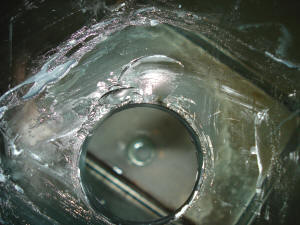
While drilling hole in tank, bit was traveling and did not
realize right away... 7/1/12
Drilling
aquarium 8/1/11 Overflow and drilling --
2/12/10 More re: Overflow and drilling
2/13/10 Re: More re: Overflow and drilling,
tempered glass bottoms 2/16/10 Where to Drill Holes for an Overflow? --
12/04/09 Re: Where to Drill Holes for an Overflow?
-- 12/05/09 Drilling Acrylic Aquarium
4/21/09 Re: a couple quick questions... Mis-mix of "reef" life... Now, Refugium design, glass tank drilling 03/04/09 Hi again! >Betillo< Thanks for the quick response to my first email (included with this one)! <Good> I had planned on replying earlier, but things have been a little hectic. So anyway, after reading some of the things you said, I got a little worried and figured I should get rid of the Arrow crab... Ironically, the morning after reading your reply I woke up and wandered over to my tank to find the crab with one of my green chromis in his claw! >=o[ <Yikes!> So, in response I got him out and took him back to my LFS without a problem. My sea hare is still doing well and readily eats lettuce since there isn't any hair algae in my tank anymore(yay!); it actually just laid a bunch of eggs too! Oh, and as far as the red slime algae removal, it was just by means of a bunch of water changes. <Okay> Ok, on to the next part... I finally decided to quit stalling and figure out this sump/refugium ordeal (or try to that is... I've been doing a lot of reading but there's so much info. that it's kind of hard to process it all). <Take your time... is elementary... well, can be... if taken one aspect and/or step at a time... Anthony Calfo and I have a book that really should be titled "Refugiums" or Marine Invertebrates and the Refugiums They Love... but is titled "Reef Invertebrates"... that is/was an attempt to introduce the several issues in going about these useful biological sumps> I was able to find a used 30gal. aquarium for $20(which I'm driving down to pick up Friday the 6th) and I'm going to install the divider baffles myself (was thinking of using 1/4" glass since I heard that acrylic doesn't seal well with silicone?). <You are correct... not well at all> Or maybe the EPDM pressure locking baffles I found on here instead. I was wondering if you had a suggestion as to the skimmer and return pump... <Mmm, yes... all my, good friends here, and friends I've yet to meet that have kindly written in and shared are posted already on WWM> My tank has been up and running for a year and the reason I've been holding out so long on putting in the sump was $$. So I'm a little torn... I want to go cheaper but obviously want it to work well...(I know it's an oxymoron) lol. I've got 4' from the bottom of the stand to the top of my tank and was thinking of going with two overflow boxes as well. Do you have any suggestions? <Mmm, yes... again... all choices and opinions I have are posted, and search-able on WWM...> I've seen a lot of different DIYs as far as skimmers and OF Boxes, but quite honestly I'm not much of a "handyman", so I don't completely trust myself to not mess up and end up wasting money... Any thoughts would be greatly appreciated. Thanks again, Betillo P.S. - Sorry this was so long. <No worries... IF you can, I would (it's not difficult to do), drill the tank... See Glass-holes.com's site please. And... we'll be chatting! Bob Fenner> Re: a couple quick questions... Mis-mix of "reef" life... ... Now, Refugium design, glass tank drilling 03/04/09 Thanks a lot, that was VERY quick! I checked out the Glass-holes.com website and I really like the look of their overflows... I'm thinking that the 1500 will be good for my 90 since I've got powerheads in the tank already... I am wondering though about the drilling process though... My tank is full of fish, inverts, corals, rock, and sand. In order to drill for the box, would I need to completely empty the contents of my tank or is it possible to drill say on the width side since I've only got 3.5 inches between the back of my tank and the wall? <I would drill this and all other systems with the water, livestock out of them... Will send along this query to ScottV, who owns part of the co. for his further input> <<It is best to empty the tank to drill it. I do not like to recommend to people to drill with water in the tank. That being said, to be perfectly honest with you, I personally drill tanks with the water level dropped only a few inches all the time. A 90 gallon is reasonably thick and one of the easier tanks to get away with this. But here is the real problem: not only do you jeopardize your tank and the livestock within, you do put yourself at risk doing this. There is always a small chance of cracking the glass while drilling....from my experience it is no more likely with water in the tank than an empty tank. The difference is if it does crack. 99% of the time water will just hemorrhage out of the crack until the tank is empty. The real risk is you are that small group that has a catastrophic failure from drilling the tank while full. It is possible it could be fatal to you! It is really your choice. But the "correct" answer is to never drill a full tank, tear the thing down to drill. Believe me, having an overflow with adequate throughputs is worth the trouble....you will hate yourself for starting the project while doing it, but in the end you will be nothing but happy you did.>> I'd hate to stress the inhabitants let alone stress myself... haha Thanks again, Betillo <Certainly welcome. BobF> <<Welcome, Scott V.>> Possible Megaflow solution?? Plumbing questions?? 12/22/08 Hey guys, Thanks for the great site! <Thanks for visiting, hello!> Here's my current dilemma. I just attempted to install a "Glass-Holes overflow kit" on my 72 bow. They offer a 2x1.5" overflow box that runs 1500gph. The issue here, is that the overflows are predrilled in the rear of the box at aprox 3" apart. I bet you can guess the next part.?? <Hmmm, no.> Well, I assumed that this sounds logical and worked well in the video on their site. <And for 1000's of installs around the world.> So I started drilling as per the attached template and instruction, hole one-ok,...hole two-looked ok. After I wiped away the milky film, I saw a nice thick hair line crack between the 2 holes. After discussing this with a glass company, they said to stay 8" apart min. on holes. <Based on what? This is quite an arbitrary, ridiculous number. Many factors are involved: glass thickness, hole size, height of the tank, and placement within. The tried and true industry standard is one hole width apart. Take a look at the Oceanic Tech series, many holes drilled mere inches apart.> Ahh... Hindsight!! <Really just the risk one takes anytime drilling glass. I do own a stake in the Glass-Holes.com company, do contact us re a refund of your purchase if you wish, we do stand behind what we do!> So I now have a 72 bow turtle/reptile tank. OK, now that, that's done, the reason I am writing is I am now looking at a new 90 gallon reef ready tank setup. This new 90 gal RR tank will feed a 30 gallon sump with a 300micron sock, a ASM G2, 2 sets of baffles and a return compartment for internal pump and heater. I may also hang a HOB CPR 19"x4"x12" fuge on the sump as well. I will be keeping softies, LPS, and possibly SPS once I get MH lighting. I can't afford big $$ on a custom tank, and it seems the only option that I have found in the Chicagoland area is the terrific "Megaflow"...... <As you imply, not so "Mega".> So, I started thinking on how to make the Megaflow, flow better. What is your thought's on this. Using both the 1" drain and the 3/4" return for drains to the sump. <Honestly common practice with these. Do note that these holes here too are drilled within 8" of each other.> Then as a return line, I want to use a 3/4" SCWD, and just feed back into the tank with 2- over the rim returns/modular fittings--one on each corner. <A fine way to route returns.> So could I assume that total drain to the 30 gal sump is 1- 3/4"(aprox. 300gph) and 1- 1" drain(aprox. 600gph)=total drain to sump approx 900 gallons(this of course does not include any 90's or restrictions)? Is this at all close? If it is not correct, what would you say the flow would be? <Not really. A 1" will only flow 300 gph safely, with a ¾" about 160 gph.> What mag pump would you recommend to return via a 1" flex into a 3/4" SCWD, then out to the corners and over into the tank? <A Mag 5, maybe 7 with a ball valve to control the amount of flow. Neither leaves you with any overflow redundancy.> Does this idea of using the additional 3/4" drain sound like it's worth the time and effort? <It is worth it with these things.> Is there a better way? <Drill it, even if just one 1.5" drain through the back, within the Megaflow box.> What is the best way to plumb the 2 feeds? 2 Dursos? <In this scenario yes.> Is there any way to get better flow from the "MegaFlows"? <A new product we/GH are currently working on, not quite there yet.> Should I stay away from the MegaFlows? <I in all honestly would.> Any better, economical options? <The one you bought IMO, just a bad turn here. Like I say, it can and does happen sometimes whilst drilling glass, or drilling wood/anything for that matter.> So my other thought to gain some flow in the new 90 gallon megareef tank, besides a single Koralia 3, is to drop a pump into the rather large Megaflow overflow chamber and use the factory Megaflow modular return as an internal closed loop(since I am using the 3/4" return as a drain) . Any thought on this? <This can work so long as the intake and output of this pump are drilled through the overflow box. Otherwise it will affect the amount of water in the box, creating many other issues.> What MAG pump would you recommend to use in this Megaflow cavity for return? <Would not, a traditional closed loop or powerheads are a far better way to go.> Is there a better pump for less heat then the MAG? <Eheims, Oceanrunners, among many others.> Also, what do you think of this setup as a whole(drains--1-3/4", 1-1"------return possible mag 7.5 or 9.5 thru SQWD into 2 returns-----small pump in the Megaflow cavity thru factory return-----Koralia 3 across top of rocks? <See above.> Does this sound like enough flow for SPS's? Should I use another Koralia 3, one on each end? <I would for SPS here.> What is ideal flow, although-not direct flow, 15x-ph, 20x-ph? <On the higher end here.> Why can't AGA see the need for bigger drain? <A question I have asked for years.> Thanks for all your time and thoughts on this. Randy-Chicagoland <Welcome, best of luck, Scott V.>
Preparing to drill back wall overflows 12/20/07 Hi Crew, <Hello David, Scott V. with you again.> Just cut the overflow towers out of my 120 gallon AGA tank. What a hassle. <Gutsy too!!> Next time I will definitely get one of their tanks without drilled bottom glass. Being in Alaska makes a person often take what they can get. I believe I would probably have to pay almost as much to ship an acrylic tank to Fairbanks, Alaska as one would pay for the same tank in the lower 48 states. I have bits due in on Friday. I am putting in two 2" bulkheads, along with a 18.25" x 3.5" x 6" toothed outlet box. <Excellent.> I also am getting a Dart pump (Sequence). Advertisements say 3600 gph @ 160 W without given data on ft/sec velocity <Fairly easy to figure.> , through a 2" inlet and 1.5" outlet., 12' max head. Definitely cheap energy cost for a lot of circulation. Sequence site says the pump can be dialed down for less gph and longer pump life. I did not check with them the cost for a controller for this task. I know industrial controllers are in the $95-$125 range, as a lot of them are used here in Alaska as Electricity in Fairbanks is $0.14-$0.16 per hour. <A ball valve on the pump output is all that is needed to accomplish this.> Three times that cost in the villages and up north. <Still relatively cheap, try $0.30-0.40 per Kwh!!> Sure a lot of flow by specs., specially through a 40 gallon sump. I was going to go with two Iwaki 40RLXT's for specs. output of 1200 gph each at 130-140 watts each. Inlet with wall at about 9" feeding skimmer compartment, putting a TurboFlotor 1000 skimmer (on 3.5-4" high platform) in second , which is the controlled height compartment, over 9"/under/over 6"/under/over 6" - partitions to dissipate skimmer bubbles before 3rd compartment which will have heaters and bulkhead for feeding chiller in 4th compartment will have auto top off, and finally fifth compartment will only have return bulkheads. What do you think about running the Dart or even two Iwaki RXLT40's through a sump this small. <I have done so in flow tests. I would not do it on an actual system. It is turbulent, noisy, and your baffles will likely not dissipate your micro bubbles before they reach your return.> The sump should be able to hold the drain down following a power outage, but with not a lot of sump capacity to spare. What do you think of that much flow through a sump. <I wouldn't.> I am think of two Iwakis as dedicated circulation pumps, mainly backup for Dart, with Dart being primary pump fed from overflow (with two 2" bulkheads). I have no room for a larger sump, and I replaced a MegaFlow sump filter to put in a 40 gallon breeder tank. I could go the opposite way but I am thinking the two Iwaki's (as dedicated circ pumps) opposing each other from each side of the tank would be a better plumbed setup then splitting the return flow out of the Dart to each side of the tank. What do you think it is going to be like with the Dart pushing through a 40 gallon breeder size tank with baffles? Doable, recommendable, too much. <Just too much from my experience.> Do you think an Aqua Medic (SP 3000 Niveaumat) auto top off float switch will function with so much flow through its chamber. I could put a portion about 4-6" inches wide next to the float that should stop most disturbances I would think. <Should work fine.> Am I way out of line moving so much water through a sump. What is the maximum recommended circulation rate for a reef which will principally hold SPS. I want a lot of flow with very little velocity I would think. Right? <Flow without a constant direct laminar flow. It seems like the upper limits of SPS tank flow is being increased all the time.> Please let me know what you think before I start drilling holes!! I am thinking over sized return lines for lessened velocity but high flow. How about bumping up return line of Dart to 2" then Ting down to two 1 1/2" lines put in over the top back of tank to make sure velocity is not to much. <The water velocity of a DART as a return out of an 1 ½' line is not too bad, two will not be much at all. I would split it into a few ¾' or 1' returns. Also consider using one of the Iwakis as your sump return and the DART as a closed loop. Make the returns adjustable and this will provide you with plenty of the correct kind of flow.> Sounds kinda off , but? Thanks Again for your time and help, David E. Harris <Welcome, good luck, Scott V.> Re: Starting Equipment, reef 12/16/07 Ok ... what if I do not feel comfortable drilling my own holes into my glass tank ... it looks like its a pretty tedious process and if I crack the glass I'm out of an aquarium <It is not really too difficult, basically grinding through, not truly drilling. If you are not comfortable doing it you may want to consider having a glass shop drilling it for you.> ... (what's the chances of cracking the glass using that method?) <Always a possibility, but not likely.> If not ... will a hang on overflow box be ok to use? <These will work, but they do rely on a siphon. Many use these successfully, just be vigilant with their use.> Thanks ... <Welcome, Scott V.> PS ... I also sent you an email yesterday concerning some lights that I want to purchase. <This was replied to also.> Drilling overflows in AGA 12/16/07 Crew, <Hello David.> I just ordered an Aquarium Glass Diamond Hole Saw Kit from Diamond Tool King who advertises as one of your sponsors. I already paid for the purchase through PayPal. Do you know if Steve @ Diamond Tool King is legitimate? His prices are excellent, which sort of scares me. I hope his being one of your sponsors, or his advertising on your pages shows he is legitimate. <No worries, the bits will work fine.> Here is why I am ordering from him. I am setting up a reef tank starting with a 120 gallon AGA tank. I keep collecting pieces and parts, and reading and continually Reading and rereading. Sorry to say I did not find out about your site until a few weeks ago. I have now repeatedly read that the bulkheads holes are to small too begin to consider the tank a "reef ready Tank". <Unfortunately the case.> Yes I will, after tank aging, use the tank principally as a SPS tank, with a small scattering of LPS and even less soft corals. To date I have obtained two Iwaki 40RLXT's, Turboflotor 1000 with Ocean Runner 2700 pump for skimming, Aqualight Pro with two 250-Watt 10,000 K and two 96-Watt PC's. I also have a Megaflow Model 4 Sump, which had to be trimmed to even allow for the TurboFlotor. If I had known that drilling bulkhead holes was not such a great task I would have never gotten the MegaFlow sump. I might still replace it with a glass aquarium and place the baffles where they will work best. <Whatever it takes to suit your setup, drilling the glass is fairly straightforward.> I do not plan on using the Bio-balls that came with the sump so it might workout OK. I plan on about 100-150 lbs Live Rock some thing from at least three different areas. Probably large Fiji rock, Tonga shelf and branch rock and some other exotic rock. Now for questions and suggestions. I plan on cutting out the AGA overflow boxes and plugging the small bulkhead holes with plugged bulkheads. Yes I even footed the stupidly high price for two Megaflow overflow kits. Learning can be expensive! <Learning generally costs something, whether it be time or money!!> Anyway I plan on two 3 inch holes for 2 inch overflow bulkheads on the tank's back wall, giving a space of at least 3-3.5 inches between hole edge and tank inner wall. Top of 3 inch holes about 2 inches below tanks glass cover ledge. <Sounds good, perhaps a little bit lower. General rule of thumb is one hole diameter away from any edge. Two inches down should be fine, but three will give you that much more strength in the end. Good choice on overflow size, plenty of capacity here.> The return locations I am not sure of. With the tanks present setting viewing will be almost entirely through front wall of tank allowing me free rein to drill return holes in side wall which I believe would create better turbulent flow possibilities due to the opposing flow from returns at both ends of tank. What do you think? <I am not a fan of drilling for sump returns, at least not too far down due to siphoning issues.> What with live rock, crushed coral, and live sand/gravel (from GARF) displacement eating up probably 20 gallons of space I figured targeting 2000-2100 gph for flow would probably be acceptable. Shouldn't be able to get around there with my two pumps returning through 1 inch PVC pipe and 1 inch bulkheads. <Yes.> I really don't know what would be optimum location for return bulkheads, ie. where on side walls. Middle of front to back? How far from top edge. How did I prevent back siphoning if pump power is loss. <Yes, this is the problem. Some rely on check valves, but these are not to be trusted to work 100% of the time.> I also have two Pan World pumps with 1 inch inputs and outputs that I could use for running circulation loop(s) or possibly throttling down one for use with a AquaC EV series skimmer if the TurboFlotor does not work out. <A closed loop is the way to go here. You will be able to put the intake/return(s) where you would like to optimize flow (perhaps even use the predrilled holes for the intake). This will also allow you to run whatever flow through your sump you desire rather than running the tanks full circulation through.> I also have a 1/4 HP chiller, lots of Maxi-Jets (900'sand 1200's) and two Wave Masters. Think I need to sale some circulation heads and wavemasters. <It always seems like you can never have too many extra utility pumps!> Is there any reason I should even consider putting return bulkhead holes in the tank backwall? <Over the top will be fine. If you want to drill consider putting it fairly close to the top (again, at least one hole diameter from any edge) and use some Loc-Line for adjustability to minimize siphoning.> Opinions and suggestions please, before I start drilling, that is if the diamond hole saws show up. Sorry this is so long, but I only have three weeks before school starts up again and I am really antsy to get started on this tank when I am not working. <Nice project to work on with time off.> Its been over six years since I last had a reef tank and things seem to keep getting better as time goes on. My last tank was a 125 gallon with a "high" turnover rate of 4 times per hour, 2 Maxi Jet 900's, a 20 gallon sump, 3 250-Watt 650 K halide shop lights, and a Kalkwasser drip. No skimmer, auto top off, CO2 calc reactor, hood with double ended halide bulbs, Actinic Power Compacts, LED moonlights. Things do change!!! <Wow! They sure do.> Thanks, David E. Harris <Welcome, have fun with your project, Scott V.> Drilling For A Closed-Loop...Use The Correct Bit Size -- 12/12/07 Hello, <<Hiya Steve>> I recently purchased a used 100 gallon long tank (60' x 20' x 20') and am in the planning stage. I would like to bring the tank to my local glass shop to have it drilled for the closed loop. (I really like the neat appearance of a tank with a drilled closed loop & no power heads or PVC to look at.) I will be using a Pan World 50PX-X external pump. I calculate around 775 gph after head loss. <<Hmm, with this flow rate you should only expect to use a couple ½' nozzles or a single ¾' nozzle for the return, and still have any useful force/strength to the flow. A good rule-of-thumb is to figure 350gph per ½' nozzle and 650gph per ¾' nozzle. Much less than this, and the water won't exit with enough 'force' to have much effect>> (My return from the sump will be running through a Mag 9.5 and should turn around 570 gph after head loss.) I am planning to drill three holes in the back glass for 1' bulkheads. <<This size throughput should be fine for the closed-loop, but do consider 1 ½' bulkheads or larger for any 'gravity' drain lines>> One will be an intake with an overflow strainer located dead center, about 1/3 of the way up from the bottom of the tank. (Should I use two intakes instead of one?) <<One throughput for the pump intake is fine, but to minimize effects from obstructions/blockages, consider using a wye-fitting and 'two' bulkhead strainers to supply the intake>> The other two will be returns drilled 2/3 of the way up 15' from either side. Problem: My local glass shop only has a 2' drill bit and the manufacturer of my bulkheads suggests a 1 ¾' hole. <<Yes...this is the correct size for the fitting>> It seems to me that the 2' inch hole may work, but I would like a second opinion on this. I have successfully used a one inch bulkhead in a 2' hole on a 29 gallon tank, but this tank would be much more expensive to replace if a problem occurs. <<I don't recommend this, the 2' hole provides too much play/removes too much material behind the rim/lip of the bulkhead for a strong and secure seal. Best to use the correct size bit for the bulkhead. A correct bit can be purchased for around $50...perhaps you can offer to buy the bit and let the glass shop keep it for drilling the holes...>> I have also considered just drilling one hole for the intake and running the returns over the back, although this is not my first choice. <<This will work...though I like your first option better>> Thanks for taking the time to guide me. <<Hope it helps>> Your advice is greatly appreciated. Steve <<Happy to share. EricR>> Re: Drilling For A Closed-Loop...Use The Correct Bit Size - 12/12/07 Thanks for the great help!!! <<Hope it proves worthy>> I took your advice and ordered the 1 3/4 inch bit. <<Ah, very good mate>> I do plan on using 1/2 inch nozzles on the two returns from the closed-loop. <<Is best>> Do you think that 775 gph (after head loss) will be sufficient? <<This will depend much on species kept, placement in the tank, aquascaping'¦ But coupled with the flow from your sump return it will likely be fine>> I don't want to add powerheads to the tank later. <<Understood>> (My inhabitants will be mostly softies that I will transfer from my 55 gallon. Here is a pic of my 55 http://i225.photobucket.com/albums/dd214/SFontana1/55-1.jpg.) <<Very nice, though if I may'¦ That Rose Anemone should be in a tank of its own'¦ And the Sun Coral colony will require direct feeding for long-term health'¦>> The 100 gallon tank I purchased is reef ready. <<Yes, well'¦a common misnomer>> It came with one corner overflow, containing a 1" drain and a 1/2" return. <<My case in point'¦ These throughputs are hardly adequate on their own for reef type flow, like the term 'reef ready' would have you think. Consequently, these throughputs will limit the size return pump to something that will provide no more than 300gph after headloss>> If both bulkheads were one inch, I would make them both drains. Would it be worth it to convert the 1/2" bulkhead to a drain?? <<Only if you want to maximize the capacity re'¦though any increase will be very marginal with the addition of a ½' bulkhead drain>> I guess I could always drill another hole on the opposite side of the tank close to the water line for a second drain and use a strainer fitting. <<Ahh'¦now you're talking!>> What would you suggest? <<Another 1 ½' bulkhead to supplement the drain, as you describe>> Thanks for taking the time to help. Steve <<Always a pleasure. Eric Russell>> Wanted to Share Positive Experience with Recommended Vendor... 12/06/2007 WWM, <Hi Paul, Mich here.> I just wanted to share a very positive experience with a vendor that you pointed me towards - glass-holes.com. I have no affiliation with them, other than being a satisfied customer. <Very good.> I was looking for internal overflow box for 120g tank, and you suggested I take a look at their website. Mike and the crew at glass-holes.com talked to me a number of times via email and telephone (yes, telephone - nice, personal touch) to help me figure out exactly what I needed. They even called the wholesale-only manufacturer of my tank and talked to the tank builder to find out if the rear wall glass was tempered or not (the manufacturer does a good job of hiding its contact info from the general public... been a while since a Google search was not productive....). <Resources are good.> The overflow box they shipped to me was custom ordered and the workmanship was flawless. To anyone comparing overflow boxes built into tanks by the manufacturers vs. something like I got - there is no comparison. No cheap, thin black plastic used. It is 1/4" acrylic, beautifully crafted. The bulkheads supplied are nice and thick (reminds me of the spa jets I put in - thick and sturdy to stand up to high pressure and heat of a 2hp Pentair pump and 400,000 BTU heater). The glass drill bit worked perfectly, and their website had helpful hints that really took a lot of fear out of a DIY project that might make a few queasy (i.e. drilling a glass aquarium). Heck, they also included a t-shirt (I know...free advertising/marketing... but custom t-shirts still cost a couple bucks to produce). <Yes, both potentially win... that is if you wear the t-shirt.> You can't beat the prices...about 1/3 to 2/3 the price of the other two custom manufacturers I could find on the web. Their drill bits are the cheapest I could find, and their bulkhead/plumbing prices are very reasonable. All in all, the folks at WWM should feel more than comfortable sending people over to glass-holes.com. They will treat your viewers right. <Thank you for sharing your positive experience. I'm sure it will benefit others as well.> Paul <Cheers, Mich> Diamond bits for drilling tanks... 12/5/07 Hi Bob, <Steve> I am interested in the top right hand corner ad space. How do I rent this spot? I sell diamond hole saws and plumbing parts like bulkheads. I have a lot of good customers from you site and some of your staff already. My EBay seller name is saltydepot and my web site is www.diamondtoolking.com Thank you, Steve Peterson <Neat products... But don't know if this exposure would be appropriate/cost effective. Do you have a short "pro" piece about your business that we could post, link to our sections on the applications of your bits? Will gladly do this. Otherwise, info. re our rates and all can be found here: http://www.wetwebmedia.com/WWMAdminSubWebIndex/wwmsponsors.htm Cheers, Bob Fenner> Re: Cursed but drillable Tanks 1/28/07 B Just an FYI, it is now common practice at most reef clubs to offer tank drilling services even on tanks with tempered glass. It is usually done very slowly and under wet conditions, but drilling tempered glass is not uncommon and usually done quite successfully, though I have seen failure. Obviously it will void any warranty. M <Thank you for this update. BobF... still too old to be drillable> I'd like to drill the tank for an internal overflow and two separate closed loop manifolds. I spoke with Perfecto and while it will void the warranty they said both the sides and bottom can be drilled. Drilling Bulkheads - 08/06/05 Dear WWM Crew, I have decided to get my 30 gallon pre-reef tank drilled and just skip messing with siphon overflows. (Thanks to reading about all the lovely problems) <<Excellent! You'll be much happier for it mate.>> But I had a few questions. <<ok>> First I gathered that tempered glass cannot be drilled but I don't know if my tank is tempered or not. It is an All-Glass 30 gallon long model (36x12x16) as far as I can gather from the previous owner it was bought new in the mid 90s. Would you think that this tanks back wall would be tempered? <<My experience with All-Glass has been that if any, only the bottom pane was/is tempered. But it's easy enough to contact the company and ask them about this one re the date of manufacture. I've drilled a few of their tanks (through the sides), both recent and unknown manufacture with no problems (if it is tempered you'll know in a hurry when it "blows out" and scares the bejesus outta ya <G>). Tanks of recent manufacture should/will be marked if tempered...but then that doesn't help you...>> If not, I am planning on having (2) 1 3/4" holes drilled to accommodate (2) 1" bulkheads. I want to have one to each side of the tank and have one drain tee off to a plenum and then connect to the other to feed the sump. I believe that they should be a minimum of 3" from the top of the tank and 3" from each side. Is this correct? <<I just did this very thing for one of my club members...when drilling bulkheads near the edge I recommend placing the outer edge of the holes equidistant from the edge at a distance equal to the diameter of the hole...e.g. - 1 3/4" hole - 1 3/4" spacing, 2 1/2" hole - 2 1/2" spacing, etc... This will let you get and still maintain strength/integrity of the pane, without guessing at it.>> I am planning on having between 600-700gph return at first but decided on the larger bulkheads in case I want/need more. Does this sound okay so far? <<Problems here I think. Be cautious of the flow calculators...better to talk to folks/query as you've done here. The reality is a 1" bulkhead will perform safer, quieter, and with less aggravation/constant fiddling of the plumbing if you only try to push about 300-350 gph per bulkhead. So...your already maxed out in my opinion. You'll need to go to a larger bulkhead if you want to turn more water.>> The tank is for 2 True Percula clowns, Euphyllia glabrescens, Plerogyra sp., Lobophyllia sp., and maybe a Fungia repanda. <<Ahh...so nice to see you're not going for the usual "reef garden" mix of organisms; you'll be all the more successful for it>> Is the flow above reasonable for these species? <<Yes...be sure to diffuse/spread throughout the tank via multiple outlets.>> If you have any other thoughts or suggestions please do not hesitate to tell me. <<Already have <G> >> I would rather know now if this setup would work than after I set it up. :) Best regards, Andrew <<And to you in kind, EricR>> Re: Drilling Bulkheads - 08/06/05 Dear Eric, <<Andrew>> Thanks a lot for your advice, I'll heed it as WWM usually saves me from my own worst ideas. But I had a few thoughts to run by you. <<Alrighty>> If I switched out the 1" bulkheads for some 1.5" bulkheads would this fix my problem of over pumping? Or, could I make one of the bulkheads a 2" and leave the other as a 1" (the one that tees off to the plenum) and instead of connecting them just run both lines to the sump? <<A pair of 1 1/2" bulkheads should be fine. The 1" bulkheads would work, you would just need to size/regulate your return pump (maybe plumb in a gate-valve on the return side) appropriately. Please have a look through our plumbing FAQs for more on this: http://www.wetwebmedia.com/plumbingmarart.htm>> Also, I'm not drilling the tank myself but from what you said it is possible to do it yourself? <<Yes, with the right tools/application.>> Or would you have a glass company do it? I have never done it before so I don't know if I want to chance it. <<First time for everything <G>. But if you're truly uncomfortable/not handy, it might be best to fine/pay someone else to do it for you.>> I think that's everything. Thanks again, Andrew <<Most welcome, EricR>> Drilling acrylic 1/8/06 Hi, I bought a custom made acrylic tank that I plan to use as my refugium. I'm going to plumb it inline with one of the outputs from my overflows (~500gph). The tank is made to hold about 27 gallons (20Lx16Wx20T) and is made out of 3/8" acrylic. I plan to use a 1" bulkhead for the inlet and 1.25" bulkhead for the outlet. This will all gravity feed back into my sump and main pump. My question is can I use a typical drill with a hole saw bit for my bulkhead holes? <Yes> And do you have any advice for how to drill the holes? <Yes... Make sure the tool is clean, sharp... go slow... in/out a bit at a time to prevent binding... Some folks advise taping over the area.> Also, I'm going to put in a 5-6 deep sand bed of sugar sized aragonite and either Gracilaria sp. or Chaetomorpha. Does this seem ideal for my setup? <... yes. To the extent your plans have been detailed here.> My main tank is a 220g with live rock, a few corals, and a lot of planktivore feeding fish? <Don't know... do you? Bob Fenner> Thanks, Brandon Using Old Rock/Drilling Bulkheads - 08/27/06 Hey guys, <<Hello (but don't forget the very capable ladies here as well)>> Thanks again for your time and dedication to our hobby! <<Is an honor/pleasure to help>> I have 2 issues I need help with: <<Alrighty>> First, I have read thru the LR section in depth and could not find an exact match to my problem. I recently purchased a used, and neglected 120 gallon that housed a single clown grouper with several large pieces of rock (it was a FO with rock??). <<Indeed...that would be a FOWLR (Fish Only With Live Rock)>> I have kept the rock wet for a few days and can see a few small life forms on it (actual moving little white/clear bug things). <<Amphipods...probably>> The rock looks terrible as the tank was neglected and the rock is all dark brown and black. I will be setting this tank up as a FOWLR and I am thinking that I would like to start over with the rock. Letting it dry and cleaning it somehow and then letting it cure in the tank for a month or two before adding new fish (pending testing results). <<Mmm...letting the rock "dry out" will negate its benefits...why not simply keep the rock as it is? If the color is an issue, it will likely change with improved water quality/lighting>> Can I get the rock to look better? <<Depends on what you consider is "better">> Is it worth losing whatever life it has on it? <<Not in my opinion>> It was not really a traditional live rock, <<...???>> it has life but it looks very bad. They are great sized pieces. The substrate is crushed coral, I would like to reuse it. It also has black and brown staining on it. <<This is most likely forms of algae, and will "change" with changes to the environment, as stated>> Can this also be cleaned? If so how? <<Swirling/rinsing with clean saltwater will do the least damage, though you will still loose some biota>> I don't mind starting over on the rock but will my cleaning methods effect any future fish or possible changes to inverts/coral down the road if I go that direction? <<Indeed it will...you could give the rock a rinse and a "light" brushing with a soft-bristle brush, or replace it (entirely or in portions) with fresh live rock>> Second, the tank is a traditional (non RR) tank. It came with a sump/wet-dry and a HOT overflow. I am weary of the overflow as I hear that they will eventually fail. <<Is a good chance, yes...but this risk can be lessened a great deal by employing a redundant system (two siphon overflow boxes) with the first>> I have once again read on WWM about tank drilling and am thoroughly confused by all the different opinions and issues. <<Let's see if I can help un-confuse you>> I would like to drill the rear for 2 sump supplies and 2 sump returns. Where exactly (how far down and over/apart) do you recommend? <<Well, if you've established the back glass in non-tempered, I recommend you place the throughputs the width of the hole-to-be-drilled from the edges of the tank, and no closer re to any other throughputs...clear as mud? For example...a heavy duty 1.5" bulkhead requires a 2.6" hole...the edge of the hole should be no closer than 2.6" from any edge of the tank, or from any edge of another bulkhead hole. Adjustment of water height in the tank can be accomplished with elbows to raise the level of the pipe outside the tank, or used as adjustable "overflows" within the tank>> Also what size is best for this size tank if I use a strainer for the supplies down and a directional elbow for the return up? <<Two 1.5" bulkheads for the drains, and one or two .75" or 1" bulkheads for the returns...or you can simply plumb the returns over the back/ends of the tank>> Should both the supply and the return have a T installed before the sump? <<For what purpose?...in what configuration?>> Also, are there and tips for drilling? <<Indeed, yes...have a read here: http://www.wetwebmedia.com/pbholesfaqs.htm >> I have seen a tank drilled before and they used cooking oil for the lubricant while cutting? Is this OK? <<I've always just used water for lubricating the drill bit...works well and is easy to clean up>> I plan on ordering the needed bits online, any recommended sources? <<Several choices about...I bought my last bit here: http://www.diamond-drill-bit-and-tool.com/Diamond-Drill/MAIN.htm >> Any tips? <<Heat is your enemy...follow the recommended rotation speed for the size core drill bit used. The manufacturer states these bits can be used "dry", but use of a lubricant (water) will keep heat down, greatly extend the life of the bit, and speed the drilling process...I use simple 'Play-Dough' to create a "damn" around the area to be drilled and fill/refill with water as needed while drilling. Also, when possible, use of a drill-press or drill-jig to keep the bit vertical to the glass surface will lessen the chance of damage/fracture of the panel>> Thanks once again for your help and contribution to our obsession!!! Randy <<Quite welcome. Regards, EricR>> Acrylic aquarium 11/6/06 Hi, I'm entirely new to this hobby, (lifestyle). I've been reading and reading and reading. <Good> I'm interested in getting an acrylic tank, 48x18x20. I'm not going to get it reef ready, but I will be drilling the back of the tank for a Calfo overflow. I'm getting different opinions on whether I can attach an acrylic interior overflow box to the back of my tank. <Mmm, you can... but if you're at all unsure of your skills at such a fashioning, attachment, I encourage you to secure this to the inside> If so what do you recommend as a good solvent to do so. <Weldon... number... 40> Will I have to worry about any bowing that would break the integrity of the attachment. <Mmm, no... not if the structure/weir is cut to be flush/parallel with the wall... and solvented all the way around... perhaps a practice go outside the tank...> Thanks for all your help. You have the best and most informative site that I've found. Joe <Thank you Joe, and welcome to our ever-wonderful hobby. Bob Fenner> Bulkheads/Wet-dry/Drilling Questions I'm new to this whole plumbing and wet dry filter thing and I have a few questions before I start to do any alterations to my tank. I currently have an acrylic TruVu 55 gallon tank with a Magnum 350 for freshwater fish. Today, I bought a Del Rey 125 wet dry filter and was planning to use the overflow/u-tube set up that came with it. Fortunately, there was not enough room to fit the overflow box. So now I plan on drilling and adding a bulkhead. Is a 1" bulkhead large enough? <I would use at least one (likely two and tee them together) 1 1/2" bulkheads> The wet dry came with an Aquaclear 802 powerhead (up to 400 gph). How big should the hole be for a 1" bulkhead? <Measure the outside diameter. Likely an inch and a half> I was thinking about placing the bulkhead in the top center of the back. Is this a good location? <Mmm, no. IF only one intake, make it at one end and return the water at the other. Better to draw and return at both ends> Also I was thinking about keeping the Magnum running along with the wet dry or would this be too much filtration? <No> When I drill, do I have to empty the entire tank, or can I just remove half the water to give myself enough room to work with? Thanks for your time. Thomas <Better by far to do the drilling with the tank all the way empty... Not hard to do (in retrospect), though daunting for first times... do have someone help you who has done this before and run the drill slowly. Please read over on WetWebMedia.com re: the use of a smear of silicone on the threads and gaskets of your through-puts. Bob Fenner> Standpipe noise, tempered glass tanks Hi Guys! Me again. <Me too!> I have read several articles about this topic, but none that help me... <Keep reading> so here goes: I have a 65 gal FOWLR set up. I just had the back drilled, and I plumbed it on down to the sump... Flowin' like a champ. However, despite how much water I send down the shoot, I get that sink-draining sucking sound. Here is what it looks like... Bulkhead is about 5" from water surface, 90 degree PVC, that goes to a 1"(or so) threaded adapter, with one of those cone shaped skimmer thingymabobs on it to keep the little guys from getting sucked in. Out the back, there is another 90 degree, that is facing 45 degrees downward, and that is attached to some reinforced 1 1/4 ID tubing... That flows on downward to the sump. Once it gets in the sump, there is a MAG-7 pushing water back up. I cut out a few of the "bars" on the thingymabob, thinking it was too restrictive, and it did increase the flow, but did nothing for the flushing sound. Is there some sort of a baffle, or trick that would fit this set up and make my living room a quieter place? Everything I read, is for bottom plumbed systems. <A few tricks... I'd try installing an aspirator here...> ALSO.. for your readers who might be thinking about drilling an aquarium... IF you have an ALL GLASS or an ODELL 55gal, and you wanna drill it... and you bought it at a chain store (Wal-Mart, Petco and so on). DON'T ! Despite the sticker saying "tempered bottom"... The whole %#%&& thing is tempered ! Let me tell ya... it is LOUD when it blows...and takes the diamond bit with it. <Yeeikes!> IF you bought the tank from a private dealer... ONLY the bottom is Tempered, and drill away. This is fact, and was verified by All Glass... Thanks again in advance guys !! John Mulrooney <Start reading here: http://www.wetwebmedia.com/dursopipefaqs.htm and on to the linked files above. Bob Fenner> Drilling Tanks (7-23-03) Wow! thanks for the fast response! I actually just bought Bob's book last night and stayed up most of the night reading it <Awesome!> (it was rough this morning). Anyhow, just a couple of follow up questions. I plan to follow your advice and get the tank drilled. Where is the best place (bottom, top back, etc). <In my opinion, bottom.> I see conflicting opinions on the various chat room sites (I guess that is why they are called opinions). Also, how do I obtain chemical filtration with a LR/PS setup? <I would buy a small outside power filter and run carbon through it, if not going with a sump other wise there are plenty of places to put carbon and other things in the sump.> Do I just buy a sump with various components? If so, any suggestions on sump "kits" (I'm not the most handy and work a lot of hours so I really don't have the time to make my own).<Here are a few place to try: http://www.myreefcreations.com/main.html http://www.lifereef.com./frame.html Also see our facts on WWM for tons of info. Cody> Thanks so much for your advice. Mark Predrilled & Drilling Tanks (7-21-03) First of all, I wanted to say your website is fantastic. I'm glad to have found it. <Me too! You got Cody today.> My question involves pre-drilled tanks. I recently received a NON pre-drilled 90 gallon tank from a friend that bought it 2 months ago but never set it up (he was transferred to London). Anyhow, I am now ready to buy filters, pumps, etc for it but have been reading that pre-drilled is best. Do you feel it worth spending the money to have the tank drilled (not sure if I trust my abilities)? <Yep, much safer than the hang on type overflows.>Also, by reading the emails on your site, that live rock is the way to go. But, 100 lbs of LR is expensive. Is there a compromise (i.e., a w/d filter with less LR needed)? I'm more interested in FO tanks but am trying to be some what flexible in case I want to move to reef/anemones.<I would just go with LR and a skimmer. You could go with a little less LR if you're doing FO. There are also many places on the internet to buy LR for good prices, check our sponsors. Stay away from w/d dry as they are nitrate producers and need constant upkeep. I would invest in a good book such as the Contentious Marine Aquarist by our very own Bob Fenner and keep reading the many facts on WWM. Cody> Thanks Mark Drilling Acrylic Can anyone offer some experience/advice for the placement of holes in acrylic tanks in relation to the seams? I'm setting up a large reef system and I'm plumbing 1 inch bulkhead returns (two per end) in the ends of the 3/4 inch acrylic tank. I want to place the bulkheads as high as I can and was wondering if I can drill the holes right next to the top seam? My understanding is once acrylic is solvent glued it's essentially all one piece, yes? Thanks! Eric <My general "rule of thumb" is to leave gaps at least as wide as the cut out diameter from seams. You can adjust the water height in the system with plumbing distal to the tank if this is a/the concern... either ell's, tee's or valves. Bob Fenner> - Return Pumps and Bulkhead Size - Hello. <Hi.> I currently have a sump with only one bulkhead (outlet) to which a little giant pump is connected (closed loop). The pump has 3/4" inlet and outlet. I need to increase my flow and would like to put a bigger pump. My question is, can I hook a pump that has a 1" inlet to the 3/4" bulk head (with adapters obviously) and not create any damage to the pump? <It won't damage the pump.> Will the flow be affected? <Yes, the smaller bulkhead will limit the pump's output just a bit.> It will be difficult to drill another hole. <As long as this sump isn't glass, consider using a Dremel tool to cut the hole out larger - in the ideal world, you should use the 1" bulkhead here if you can.> Thanks --AGT <Cheers, J -- > - Drilling Advice - Hi crew members I am going to buy a 20 gallon long tank and have it drilled. <Hmm... this is not an ideal tank for drilling. The glass used in smaller tanks is rather thin, and even 'cheap' [float glass rather than rolled or tempered] which tends to make the panels brittle. Your best bet for getting the holes cut is to disassemble the tank, then re-silicone it together once the holes are cut.> I would like one hole for an overflow down to my sump. Then have another hole drilled for a closed loop. I do not want powerheads in my tank as you can see. <It wasn't obvious until you mentioned it ;-) > The sump will be 10 gallons. Would the hole for the overflow to the sump be ok at 1". <I think so.> And when you drill for a 1" bulkhead what size should the hole be? <1.5"> Is the same size hole for the closed loop ok? <Sure, but you could size it down to 3/4"> Or would bigger be better. <Larger would likely give you trouble - weaken the panel.> I want 15-20 times turnover. So I was going to get a mag 4 to use as the closed loop pump. Is that too much or too little? <It's going to be quite a bit - you may be challenged to keep the water in the tank rather than have it slosh over the sides. The fluid dynamics of such a small box are going to be a challenge. Any chance I can convince you to try all this with a larger tank? Your overall plan is good, but I'd really like to see you attempt this with something larger.> The tank is going to have zoanthids mostly. No fish. Also would it be ok to drill the overflow in the side pane of the glass just about 1/2" below the top of the glass? <Sure.> The hole for the closed loop can go anywhere right? <For safety's sake, I'd put that just below the water line. If you put the bulkhead in the bottom of the tank and something in your plumbing fails, you will be quite sad.> Thanks, Karl <Cheers, J -- > - Drilling Advice, Follow-up - Hello JasonC <Hi.> Thank you for the fast reply. <My pleasure.> My hotmail account is not working good and I was afraid you guys didn't get my last email. I know the 20 gallon tank is not a great size to work with. It is all I have the room for and am allowed in my rental. <Fair enough.> It is an acrylic tank so drilling should be better right? <Oh sure, much better.> And if I went for a 3/4 hole for the closed loop and used a Mag 3 (350gph) would that be better or more safe so that water does no splash around. <I would plumb it in externally at first so you can experiment before you commit to drilling the hole. The Mag 4 isn't really a beefy pump and if I recall the outlet is 3/4" so you're not really going to be holding it back much.> Thank you again Karl <Cheers, J -- > - Glass Drilling - Hello. My husband just bought me a 150 x-tall (All-glass) I think tank... I would like to set it up for a reef... however, I have a question and couldn't figure it out by reading other posts, although it is possible I missed it. The dimensions of the tank are 4 ft long, 2 ft wide, and 21/2 ft deep... I would like to drill some holes in it and set up the overflow as described in Anthony's book where there is a glass shelf built in to the aquarium that the water flows over then into the bulkheads... Problem is, we don't have a LFS, and the largest hole that the local glass shop will drill into it is 1", which won't even accommodate a 1/2" bulkhead fitting, right? <Actually, think it will... typically bulkheads are about 0.5" larger than the plumbing they are intended for... but a 0.5" bulkhead is much to small for a drain - you need 1" or better.> (Also, they say if they break the tank it's my tough luck, I guess I understand...) <Yes, much better to drill before the tank is assembled.> So anyways, If I can't get them to do a 11/8" hole to accommodate a 1/2 overflow, how many would I need to accommodate the overflow I would like? <Hmm... to match the same flow rate as two 1" bulkheads, I think you would need seven or eight 0.5" bulkheads.> I would like to just have one large pump in my sump to handle all of my circulation needs if I can do that, would prefer not to use powerheads... and will all these little 1/2" bulkheads drilled, will it reduce the strength of the tank? <Yes... will need to brace up the area where they are drilled, but the nature of Anthony's overflow design is such that you will brace the tank sufficiently.> Any suggestions? <Start considering other options... perhaps external overflow boxes or find another glass shop that can drill larger holes - you really need two, 1" bulkheads.> I think the glass is either 3/8ths or 1/2"....it's still in the back of the truck! Thank You! Ginger <Cheers, J -- > I think I got hosed: plumbing question 1/8/04 This question is for Anthony. <at your service> I've been reading your articles on plumbing a reef system and I'm curious about the rate of flow you suggest and how that can best be achieved. Am I reading correctly that for a reef system consisting of live rock, live sand, corals (mostly LPS), and inverts you recommend water circulation approaching 20X the volume of the tank per hour? <quite correct... with many successful reef tanks (see Paletta 2003 for example) cited with flow rates approaching 40X per hour. Much more akin to the dynamic flow on a real/proper reef> So for my 175 gallon tank I would need to provide approximately 3,500 gph water turnover? <correct... and to be delivered in a random turbulent way of not surging (never laminar unless keeping those few species that need it)> I purchased an Oceanic 175 gal bowfront tank that is drilled for 1" drain lines and ¾" return lines in each corner overflow. <heehee... nice looking tank, but much is writ (here in WWM archives and on the 'Net abroad at great length) about the size of these so-called "reef-ready" tanks> Using the calculations I can find it does not seem possible for me to get anywhere near the suggested 3,500 gph to drain from my tank, not even if I use all four holes for drainage and run a separate return line (which will look like crap on a tank that was going to sit in the middle of a room). <you are exactly correct> I have read a few of your FAQ's concerning improving the rate of return by enlarging the size of pipe as close to the bulkhead as possible, even if I go from 1" to 1-1/2" or 2" for my drain lines on the other side of the bulkhead how much improvement might I actually see? <I cannot say... depends on the run downward: number of bends, tees, elbows... released underwater or not, etc> What is the best configuration above the bulkhead to maximize the flow of water to the sump? <this one is relative to the rockscape and needs of the corals placed upon it. Rather an experimental endeavor. Simply have enough outlets/nozzles tapped into the manifold in advance and cap off what you don't need later> The bottom of the tank is tempered so drilling additional holes does not seem to be possible, unless there is some way that I do not know of to drill tempered glass, or enlarge existing holes in tempered glass? <none alas> What are some other tricks to improve the amount of flow from drain lines? <none safely without creating noise/suction. You can just drill extra holes in the back wall like a normal drilled overflow if that glass is not tempered> On the return line side, am I correct in the assumption that I can use any size line for the return, but will experience greater losses due to friction with a smaller line? <not exactly... rather a volume vs. velocity gig here. You might consult Escobar's "Aquatic Systems Engineering" for many such technical questions/explanations> I had originally planned to use 2 or three of the holes in the overflow for drain lines and the remaining line for return, but if I need to use all four holes for drain lines I'm not left with an option other than to provide an outside return line. The pump will sit on the floor below the tank so there will be about 6' of head loss. What size pump/line would you recommend using for this situation. <I wish to help... but it simply cannot be estimated from here not knowing the system and livestock. You really need to figure out how to deliver the safe flow (say 20X) by the means available to you. In this case, a 4000 GPH return pump that is teed/bled as needed is on par> Have you ever heard of anyone running underwater electrical line through a drain line to get power to their lighting? <its possible, but not appealing to me regarding complication/safety> Thanks in advance for any assistance you can provide, it is much appreciated. Jeremy <I do wish I could be of more help, but our (mine and yours) hands are tied by the undersized overflows drilled IMO. You may simply have to deal with a powerhead or water pump to support the undersized flow of the drains. In that case, estimate what can safely be pushed through those drains (200-300 gph through a 1") and then make up the diff with a sexy Tunze streamer in the display for example <G>. Best of luck, Anthony> Re: Tank Drilling for undersized overflow 1/8/04 Anthony...thanks for your reply. I have never drilled a tank before. The oceanic (boo, hiss, never buy another one) back panel is 1/2" thick non-tempered glass. Could you describe step by step how you would go about drilling it. <hmmm... it's not something that I can describe properly in the brevity of an e-mail. It's also not something that you want improvise on. It's truly worth it for you to contact a local aquarium shop or aquarium service person that has a proper drill press and diamond hole saw with experience drilling a few hundred tanks. Truly worth the investment here> I think this is something I could do myself judging by the amount of people who have done so and could practice on an old tank or sheet of glass before I screw up the good one. <yes... ultimately its not hard at all> Am I correct in assuming that it should be drilled low on the back side inside the overflow? <not sure I follow. Most are drilled as high as possible and depend on the presence (or not) of an internal sealed horizontal overflow> The largest bulkheads I saw on the marine depot site were 2" requiring a 3" hole, but they did not list a flow rate for these. Do you know what kind of flow I can expect from a 2" bulkhead? <there is some such data in our archives if you care to do a keyword search... as well as calculators for these things on the big message boards like RC. I, however, simply consult the bulkhead mfg's website or specs to be sure> Is it any harder to drill a 3" hole than a 1.5" hole? <not at all... its all about having a sharp hole saw and proper coolant> If I need more than (2) 2" bulkheads I don't think they would fit in the overflow unless they were at different heights, would that work? <not sure here... I have no idea how deep you want/can afford the overflow to be> If I drill the back then I can use the 1" bulkheads for the return lines and use one of the 3/4" bulkheads to run power through. <I suppose... although I do not see the imperative need for submerging the power cords> I am very appreciative of your help with this. I want to make sure that I get this all done correctly. I hope you won't mind if I continue to follow up with additional questions as they arise. thank you for all of your help...Jeremy <always welcome Jeremy... best of luck. Anthony> Drilling question 2/3/04 Hey guys, I have a FOWLR 300 gal. tank that has 1 inch corner overflows with a Little Giant MD5 pump. Even with brand new pre filters, the water backs up in the overflow because the drains cannot keep up with the pump. So my question is how do I make the existing hole bigger from a 1" to a 1.5" bulkhead overflow? Since there is no longer a way for a pilot drill on the hole saw I am a little confused. Thanks Sean <you cannot drill over another hole in glass safely without a reciprocal drill ($10K machine). In your case, you will need to drill another hole or simply make due otherwise here, bub. Anthony> Drilling question II 2/3/04 Hi, Anthony sent the following, but I forgot to mention that the tank is acrylic...........any suggestions??!!?? <ahhh, yes... an important distinction! In this case, the solution is easy. Block the back of the hole soundly with a piece of solid wood or scrap acrylic. Then advance the piloting drill bit in the hole saw's mandrill far enough to at least compensate for eh depth of the hole (thickness of the tank's acrylic) and let the bit bite into the block on the other side first as you start to drill over the old hole. Best of luck. Anthony> Drilling question 2/3/04 Hey guys, I have a FOWLR 300 gal. tank that has 1 inch corner overflows with a Little Giant MD5 pump. Even with brand new pre filters, the water backs up in the overflow because the drains cannot keep up with the pump. So my question is how do I make the existing hole bigger from a 1" to a 1.5" bulkhead overflow? Since there is no longer a way for a pilot drill on the hole saw I am a little confused. Thanks Sean <you cannot drill over another hole in glass safely without a reciprocal drill ($10K machine). In your case, you will need to drill another hole or simply make due otherwise here, bub. Anthony> Plumbing (cutting through put holes in/for a sump) I am making a sump from a Rubbermaid container for my 100 gallon tank. What do I need to drill (?) or cut (?) holes into the container? Can I buy the tool at Home Depot? <What an exciting question. Really, we (our old service companies) used to have a "museum" collection of such tools, materials... some really neat to work with (for drilling through very thick acrylic especially). I would go with a simple "hole saw" kit like those sold for fitting lock/door knob sets in wooden doors here. If you think you might want to drill more than one size/diameter opening, splurge on a multiple size set with interchangeable mandrill (the pilot bit that goes in the middle)> I know that ideally water would move through the sump from one end to the other, entering dirty and leaving clean. However, since I have two overflows it would be convenient for the overflows to empty into opposite ends of the sump with the skimmer (T1000) in the middle of the sump. <Yes, good idea> I probably will mount the return pump (external) on the end (not the middle). I guess I'm worried about unclean water entering and then leaving the sump, bypassing the skimmer. What are your thoughts? <No worries... all gets about as clean as it were going linearly/in series... Only a bit of a percent lost in apparent "efficiency"> I have no room for a refugium in my sump but I am considering getting one of the CPR hang ons (24''). Will this improve my water quality? <VERY much so. A friend who lives with us, Peter, has been "experimenting" with these for years... Many advantages in their use> Since I'll need to buy a CF for the refugium, is it worth the effort and expense? <Yes, of a certainty> Thanks for all you do Bob! <Thank you for your queries. Bob Fenner> David Dowless Drilling Tank... Good evening, I seem to want to make it hard for myself. I purchased a 300 gallon acrylic tank about eleven months ago and it has the standard overflows to my skimmer, calcium reactor, and return pump. I also removed two temporary power heads and plumbed two external pumps on each side of the tank up and over the tank so no holes were drilled. Well now that the tank has been going for ten months, I would like to drill the back of the tank for two inlets to the pumps on the side of tank. If I remove approximately 110 gallons out of the tank, (here's the punch line) should and could I drill the two holes needed? <It is possible.> Part of the reason to do this is to re-incorporate my refugium back into the line up. One of the pumps would pump water back to main tank and a fraction to the gravity return refugium. As always thank you for your time. <Be sure to use extremely sharp bits/hole saw for this and go slow. -Steven Pro><<And some sort of "bucket" device to catch the bits just the same. RMF>> Overflow Prefilter Greetings, <<Hi, Don this afternoon>> Always a pleasure to read this web-site. It is great to see that you have some more "Pros" other than Steven helping out. yuk yuk yuk! <<uh, Thanks, I think, Oh, Pro, now I get it;)>> I have a overflow box that has a coarse sponge pre-filter. I typically rinse this about once a week. It always has some decaying food and mulm attached to it. I think that it needs to be cleaned more frequently maybe even daily. For a lot of reasons like travel and procrastination, daily cleaning of this pre-filter won't happen. What are my options? The overflow feeds into the sump where I have a protein skimmer. Should I remove the coarse pre-filter to provide more "raw" water to the protein skimmer? <<Recommended course. See here for more http://www.wetwebmedia.com/marmechf1.htm>> Knowing that food gets caught on the pre-filter....will the protein skimmer collect the food or will the decaying food just get moved to the next coarse pre-filter just before the return pump? <<Ahh, maintenance never stops eh? You can try a micron bag on the end of the overflow into the sump to catch crud, but it too will require regular (every other day if not every day) maintenance. Maybe best to go without either and try to get to the other filter more often. >> Also, I would like to drill the 40 gal glass tank for a 1" overflow.<<Just an observation as I don't know what your intentions are, but maybe two holes? easier now than breaking it down, again, later>> My understanding for this procedure if you do not want to remove everything from the tank and there is adequate space to drill the hole is: 1. Drain the tank well below the overflow - add filtration and heat to the lowered water 2. Clean the inside surface where the overflow box will be mounted 3. Silicone the overflow box 8"W X 5"H X 3"D in place 4. Drill the hole using the overflow box to catch debris on the inside of the tank 5. Install the bulkhead in the hole ensure that the bulkhead id is at least 1" 6. Attach plumbing to the bulkhead to the sump 7. Ensure that the silicon is dry (6-8 hrs) <<I would wait 24 for any silicone job>> 8. Re-fill the tank and restore heat and filtration in the sump. Where is the best place to get the glass bit and lubricant? <<I used water>> Is the above too risky? I do have a 20 gal tank that would be ready in case of a serious (i.e. crack) situation.<<While the above may work and for others successfully, I would not advise to drill anything but an empty (completely) tank. I got the first hole drilled in a 20H for a refugium and about half way through the second, BOOM, well, lets say I then waited for the glass shop to get a replacement cut for me. I got a bit locally, but there are many web sites selling them. Google search? Also, see if you have a marine society in your area, they may have some you can rent/borrow>> Again, thanks for the help. << Happy glass drilling Don>> Kinzie Drilling a tank I have a 2 month old Reef Ready Oceanic 58 gal tank with a 1" bulkhead in the bottom. The tank is currently set up with sand, live rock, fish, etc. I would like to re-drill the tank for a 1.5" bulkhead to accommodate a larger pump (MagDrive 1800). My question is, can I drill the tank if I drain only the overflow box or does the whole tank need to be drained? Thanks, Randy <The whole tank... needs to be taken down, drilled while empty. Bob Fenner> |
|

|
Features: |
|
| Featured Sponsors: |